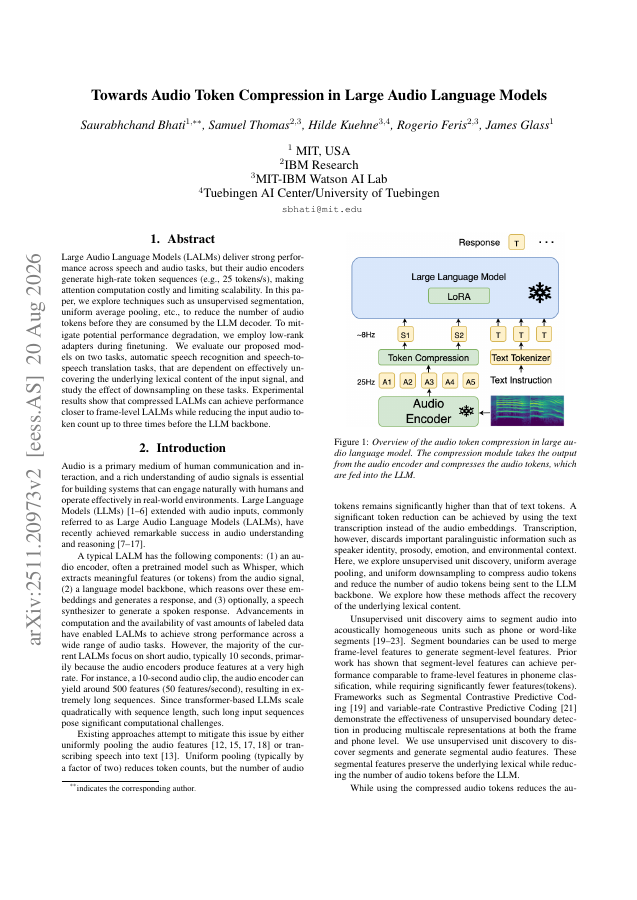
Large Audio Language Models (LALMs) deliver strong performance across speech and audio tasks, but their audio encoders generate high-rate token sequences (e.g., 25 tokens/s), making attention computation costly and limiting scalability. In this paper, we explore techniques such as unsupervised segmentation, uniform average pooling, etc., to reduce the number of audio tokens before they are consumed by the LLM decoder. To mitigate potential performance degradation, we employ low-rank adapters during finetuning. We evaluate our proposed models on two tasks, automatic speech recognition and speech-to-speech translation tasks, that are dependent on effectively uncovering the underlying lexical content of the input signal, and study the effect of downsampling on these tasks. Experimental results show that compressed LALMs can achieve performance closer to frame-level LALMs while reducing the input audio token count up to three times before the LLM backbone.
Towards Audio Token Compression in Large Audio Language Models
Large Audio Language Models (LALMs) deliver strong performance across speech and audio tasks, but their audio encoders generate high-rate token sequences (e.g., 25 tokens/s), making attention computation costly and limiting scalability.
- Preview
- Year
- 2025
- Hosting
- Abstract onlyARXIV-DEFAULT
Cite
Notes
Only stored in your browser.
Attribution
- Abstract & full text
- arxiv.org/abs/2511.20973ARXIV-DEFAULT
- TL;DR
- Semantic Scholar