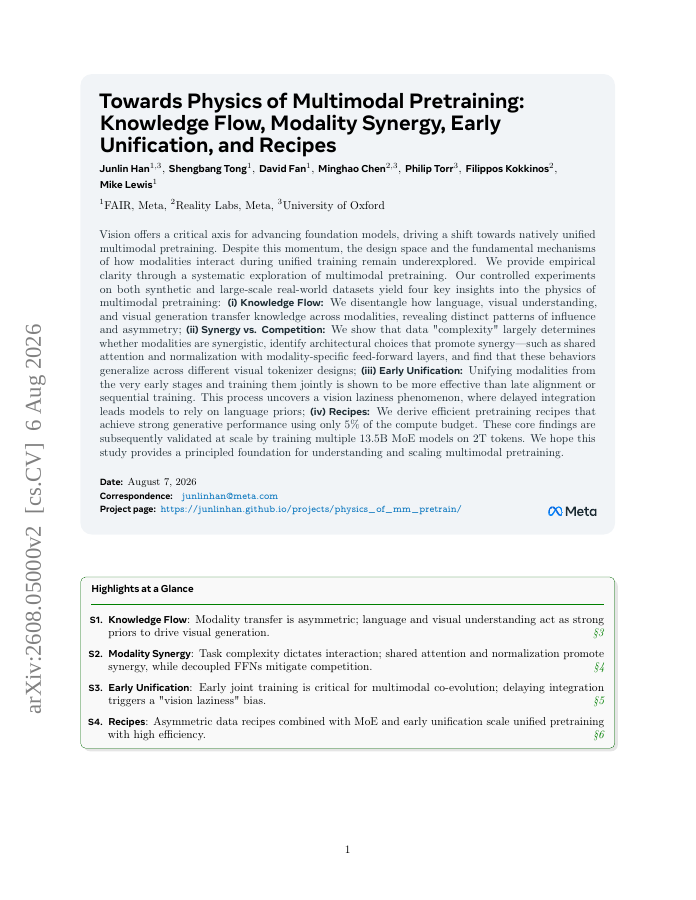
Vision offers a critical axis for advancing foundation models, driving a shift towards natively unified multimodal pretraining. Despite this momentum, the design space and the fundamental mechanisms of how modalities interact during unified training remain underexplored. We provide empirical clarity through a systematic exploration of multimodal pretraining. Our controlled experiments on both synthetic and large-scale real-world datasets yield four key insights into the physics of multimodal pretraining: (i) Knowledge Flow: We disentangle how language, visual understanding, and visual generation transfer knowledge across modalities, revealing distinct patterns of influence and asymmetry; (ii) Synergy vs. Competition: We show that data "complexity" largely determines whether modalities are synergistic, identify architectural choices that promote synergy: such as shared attention and normalization with modality-specific feed-forward layers, and find that these behaviors generalize across different visual tokenizer designs; (iii) Early Unification: Unifying modalities from the very early stages and training them jointly is shown to be more effective than late alignment or sequential training. This process uncovers a vision laziness phenomenon, where delayed integration leads models to rely on language priors; (iv) Recipes: We derive efficient pretraining recipes that achieve strong generative performance using only 5% of the compute budget. These core findings are subsequently validated at scale by training multiple 13.5B MoE models on 2T tokens. We hope this study provides a principled foundation for understanding and scaling multimodal pretraining.
Towards Physics of Multimodal Pretraining: Knowledge Flow, Modality Synergy, Early Unification, and Recipes
Vision offers a critical axis for advancing foundation models, driving a shift towards natively unified multimodal pretraining. Despite this momentum, the design space and the fundamental mechanisms of how modalities interact during unified training remain underexplored.
- Preview
- Year
- 2026
- Hosting
- Abstract onlyARXIV-DEFAULT
Cite
Notes
Only stored in your browser.
Attribution
- Abstract & full text
- arxiv.org/abs/2608.05000ARXIV-DEFAULT
- TL;DR
- Semantic Scholar