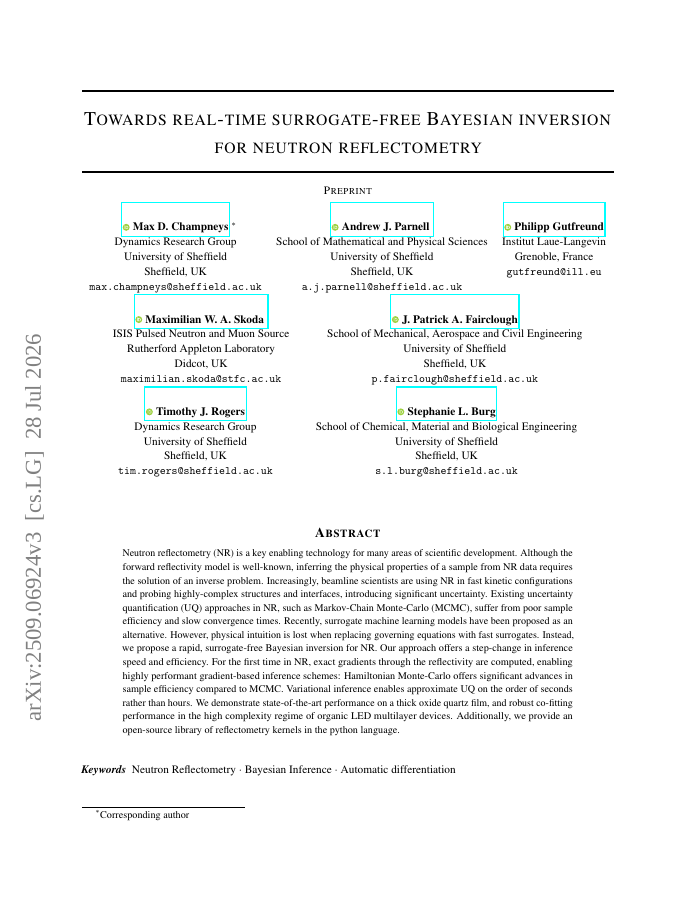
Neutron reflectometry (NR) is a key enabling technology for many areas of scientific development. Although the forward reflectivity model is well-known, inferring the physical properties of a sample from NR data requires the solution of an inverse problem. Increasingly, beamline scientists are using NR in fast kinetic configurations and probing highly-complex structures and interfaces, introducing significant uncertainty. Existing uncertainty quantification (UQ) approaches in NR, such as Markov-Chain Monte-Carlo (MCMC), suffer from poor sample efficiency and slow convergence times. Recently, surrogate machine learning models have been proposed as an alternative. However, physical intuition is lost when replacing governing equations with fast surrogates. Instead, we propose a rapid, surrogate-free Bayesian inversion for NR. Our approach offers a step-change in inference speed and efficiency. For the first time in NR, exact gradients through the reflectivity are computed, enabling highly performant gradient-based inference schemes: Hamiltonian Monte-Carlo offers significant advances in sample efficiency compared to MCMC. Variational inference enables approximate UQ on the order of seconds rather than hours. We demonstrate state-of-the-art performance on a thick oxide quartz film, and robust co-fitting performance in the high complexity regime of organic LED multilayer devices. Additionally, we provide an open-source library of reflectometry kernels in the python language.
Towards real-time surrogate-free Bayesian inversion for neutron reflectometry
Neutron reflectometry (NR) is a key enabling technology for many areas of scientific development. Although the forward reflectivity model is well-known, inferring the physical properties of a sample from NR data requires the solution of an inverse problem.
- Preview
- Year
- 2025
- Hosting
- Full text hostedCC-BY-4.0
Cite
Notes
Only stored in your browser.
Attribution
- Abstract & full text
- arxiv.org/abs/2509.06924CC-BY-4.0
- TL;DR
- Semantic Scholar