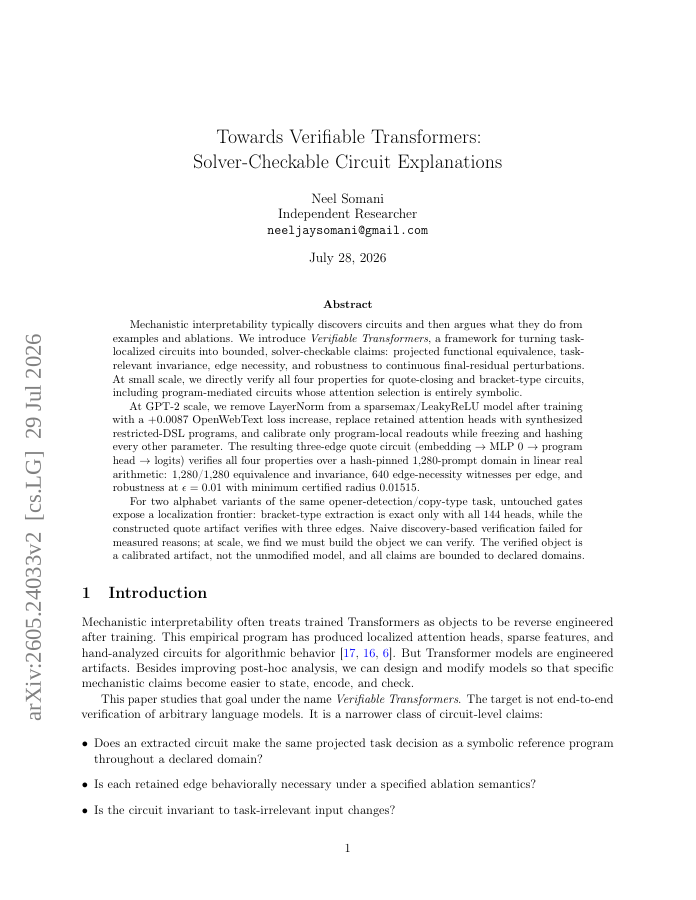
Mechanistic interpretability typically discovers circuits and then argues what they do from examples and ablations. We introduce Verifiable Transformers, a framework for turning task-localized circuits into bounded, solver-checkable claims: projected functional equivalence, task-relevant invariance, edge necessity, and robustness to continuous final-residual perturbations. At small scale, we directly verify all four properties for quote-closing and bracket-type circuits, including program-mediated circuits whose attention selection is entirely symbolic. At GPT-2 scale, we remove LayerNorm from a sparsemax/LeakyReLU model after training with a +0.0087 OpenWebText loss increase, replace retained attention heads with synthesized restricted-DSL programs, and calibrate only program-local readouts while freezing and hashing every other parameter. The resulting three-edge quote circuit (embedding \to MLP 0 \to program head \to logits) verifies all four properties over a hash-pinned 1,280-prompt domain in linear real arithmetic: 1,280/1,280 equivalence and invariance, 640 edge-necessity witnesses per edge, and robustness at ε= 0.01 with minimum certified radius 0.01515. For two alphabet variants of the same opener-detection/copy-type task, untouched gates expose a localization frontier: bracket-type extraction is exact only with all 144 heads, while the constructed quote artifact verifies with three edges. Naive discovery-based verification failed for measured reasons; at scale, we find we must build the object we can verify. The verified object is a calibrated artifact, not the unmodified model, and all claims are bounded to declared domains.
Towards Verifiable Transformers: Solver-Checkable Circuit Explanations
Mechanistic interpretability typically discovers circuits and then argues what they do from examples and ablations. We introduce Verifiable Transformers, a framework for turning task-localized circuits into bounded, solver-checkable claims: projected functional equivalence,…
- Preview
- Year
- 2026
- Hosting
- Abstract onlyARXIV-DEFAULT
Cite
Notes
Only stored in your browser.
Attribution
- Abstract & full text
- arxiv.org/abs/2605.24033ARXIV-DEFAULT
- TL;DR
- Semantic Scholar