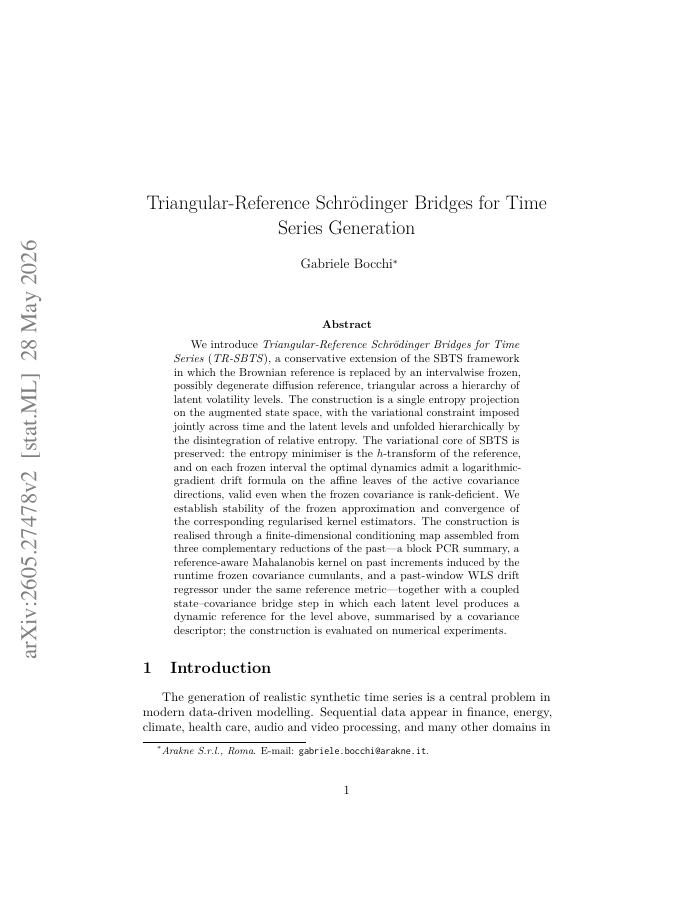
Schrödinger bridges for time series (SBTS) generate synthetic paths by projecting, in relative entropy, a Brownian reference onto the path laws that match the joint distribution of the data on the observation grid. The Brownian reference, however, fixes the quadratic variation of the generated paths, which is restrictive when stochastic volatility, correlated noise, or rank-deficient covariance structures must be reproduced. We introduce "Triangular-Reference Schrödinger Bridges for Time Series" (TR-SBTS), which keeps the entropy-projection backbone of SBTS but replaces the Brownian reference by a triangular, volatility-informed, intervalwise frozen reference on a state augmented with latent covariance descriptors. The construction remains a single entropy projection on the augmented state: the minimiser is the h-transform of the reference, and on each frozen interval the optimal drift has the logarithmic-gradient form b^\star(t,x)=A,\nabla\log H(t,x), intrinsic to the active covariance directions when the frozen covariance A is degenerate. We prove stability of the frozen approximation and consistency of the associated regularised kernel estimators, describe a reference-aware Nadaraya--Watson implementation of the conditional next-increment law, and evaluate the construction on numerical experiments.
Triangular-Reference Schrödinger Bridges for Time Series Generation
Schrödinger bridges for time series (SBTS) generate synthetic paths by projecting, in relative entropy, a Brownian reference onto the path laws that match the joint distribution of the data on the observation grid.
- Preview
- Year
- 2026
- Hosting
- Abstract onlyARXIV-DEFAULT
Cite
Notes
Only stored in your browser.
Attribution
- Abstract & full text
- arxiv.org/abs/2605.27478ARXIV-DEFAULT
- TL;DR
- Semantic Scholar