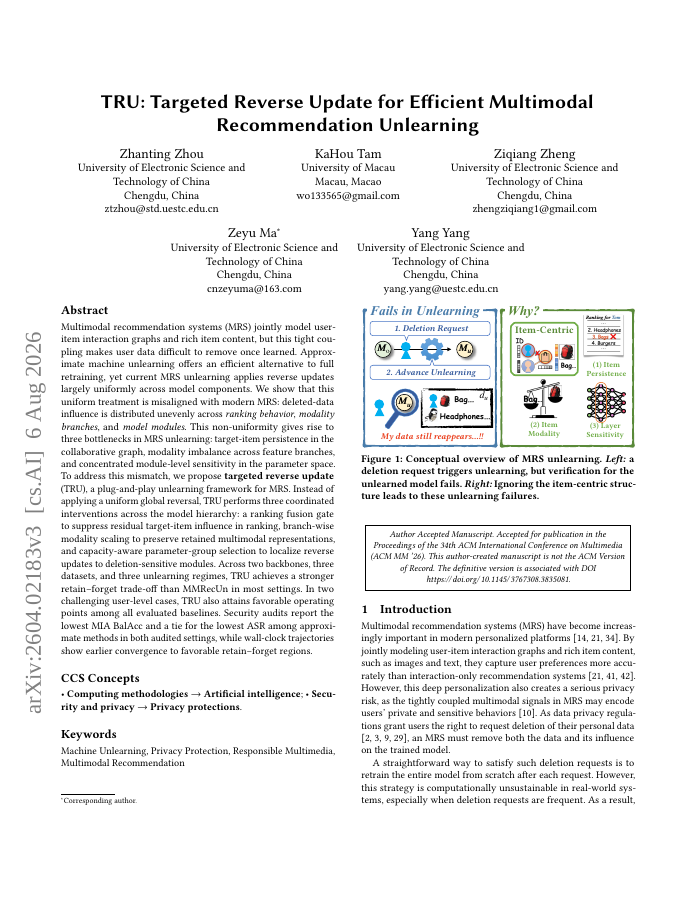
Multimodal recommendation systems (MRS) jointly model user-item interaction graphs and rich item content, but this tight coupling makes user data difficult to remove once learned. Approximate machine unlearning offers an efficient alternative to full retraining, yet current MRS unlearning applies reverse updates largely uniformly across model components. We show that this uniform treatment is misaligned with modern MRS: deleted-data influence is distributed unevenly across ranking behavior, modality branches, and model modules. This non-uniformity gives rise to three bottlenecks in MRS unlearning: target-item persistence in the collaborative graph, modality imbalance across feature branches, and concentrated module-level sensitivity in the parameter space. To address this mismatch, we propose targeted reverse update (TRU), a plug-and-play unlearning framework for MRS. Instead of applying a uniform global reversal, TRU performs three coordinated interventions across the model hierarchy: a ranking fusion gate to suppress residual target-item influence in ranking, branch-wise modality scaling to preserve retained multimodal representations, and capacity-aware parameter-group selection to localize reverse updates to deletion-sensitive modules. Across two backbones, three datasets, and three unlearning regimes, TRU achieves a stronger retain--forget trade-off than MMRecUn in most settings. In two challenging user-level cases, TRU also attains favorable operating points among all evaluated baselines. Security audits report the lowest MIA BalAcc and a tie for the lowest ASR among approximate methods in both audited settings, while wall-clock trajectories show earlier convergence to favorable retain--forget regions.
TRU: Targeted Reverse Update for Efficient Multimodal Recommendation Unlearning
Multimodal recommendation systems (MRS) jointly model user-item interaction graphs and rich item content, but this tight coupling makes user data difficult to remove once learned.
- Preview
- Year
- 2026
- Hosting
- Abstract onlyARXIV-DEFAULT
Cite
Notes
Only stored in your browser.
Attribution
- Abstract & full text
- arxiv.org/abs/2604.02183ARXIV-DEFAULT
- TL;DR
- Semantic Scholar