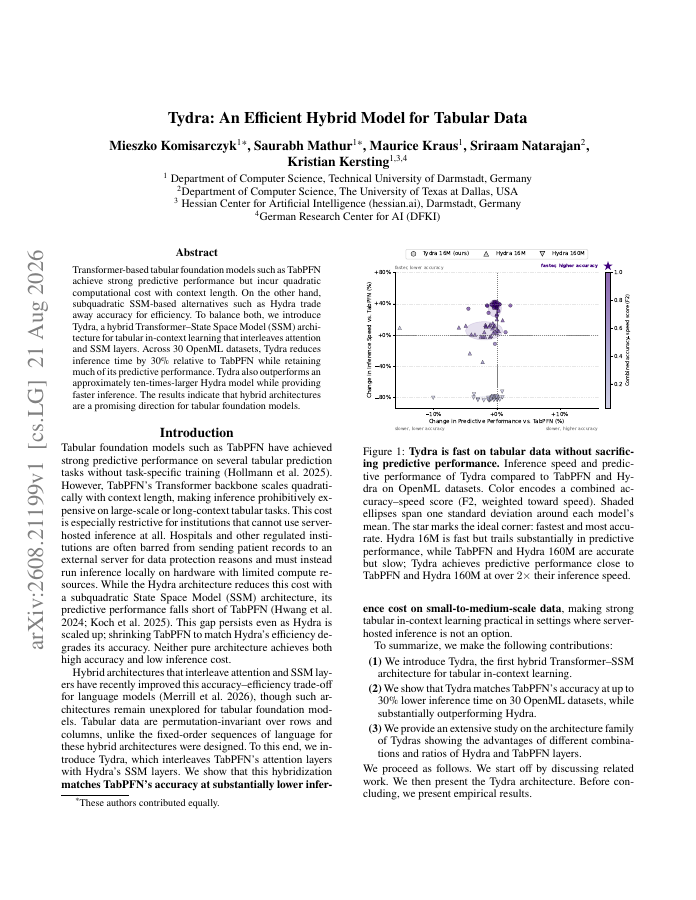
Transformer-based tabular foundation models such as TabPFN achieve strong predictive performance but incur quadratic computational cost with context length. On the other hand, subquadratic SSM-based alternatives such as Hydra trade away accuracy for efficiency. To balance both, we introduce Tydra, a hybrid Transformer-State Space Model (SSM) architecture for tabular in-context learning that interleaves attention and SSM layers. Across 30 OpenML datasets, Tydra reduces inference time by 30% relative to TabPFN while retaining much of its predictive performance. Tydra also outperforms an approximately ten-times-larger Hydra model while providing faster inference. The results indicate that hybrid architectures are a promising direction for tabular foundation models.
Tydra: An Efficient Hybrid Model for Tabular Data
Transformer-based tabular foundation models such as TabPFN achieve strong predictive performance but incur quadratic computational cost with context length. On the other hand, subquadratic SSM-based alternatives such as Hydra trade away accuracy for efficiency.
- Preview
- Year
- 2026
- Hosting
- Abstract onlyARXIV-DEFAULT
Cite
Notes
Only stored in your browser.
Attribution
- Abstract & full text
- arxiv.org/abs/2608.21199ARXIV-DEFAULT
- TL;DR
- Semantic Scholar