Sparse attention is widely deployed in long-context serving stacks, yet no framework audits how discarding blocks changes the influence of specific content on model output. We first establish that the phenomenon is real and causal: Block Sparse Flash Attention (BSFA) route replay across four architectures changes output decisions in 13 of 16 cells, with zero identity-replay label flips. We then introduce a dense-calibrated counterfactual audit using matched probe cards---Gold (carrying the correct answer label), Poison (carrying a target wrong label), and Benign (filler only)---under six-layout position symmetry, isolating the sparsification-specific effect. Two patterns compete. Signal concentration: the selector preserves Gold and Poison blocks far above filler-matched Benign blocks (G\approxP\ggB across all model--task pairs). Integration loss: discarding blocks severs cross-block attention---confirmed by an ablation where isolating the probe block collapses its influence from 4.48 logits to zero. Compression ratio governs the balance: a full sweep from mild (c=0.25) to aggressive (c=0.75) compression across four model--task pairs reveals that three of four cells move toward stronger sparse amplification at higher compression, with two exhibiting sign reversals. Three independent arms---BSFA route replay, controlled block-top-k, and KV-cache eviction---converge: sparsification changes content influence in ways aggregate accuracy cannot detect. We provide an open measurement framework deployable on any model exposing block identities.
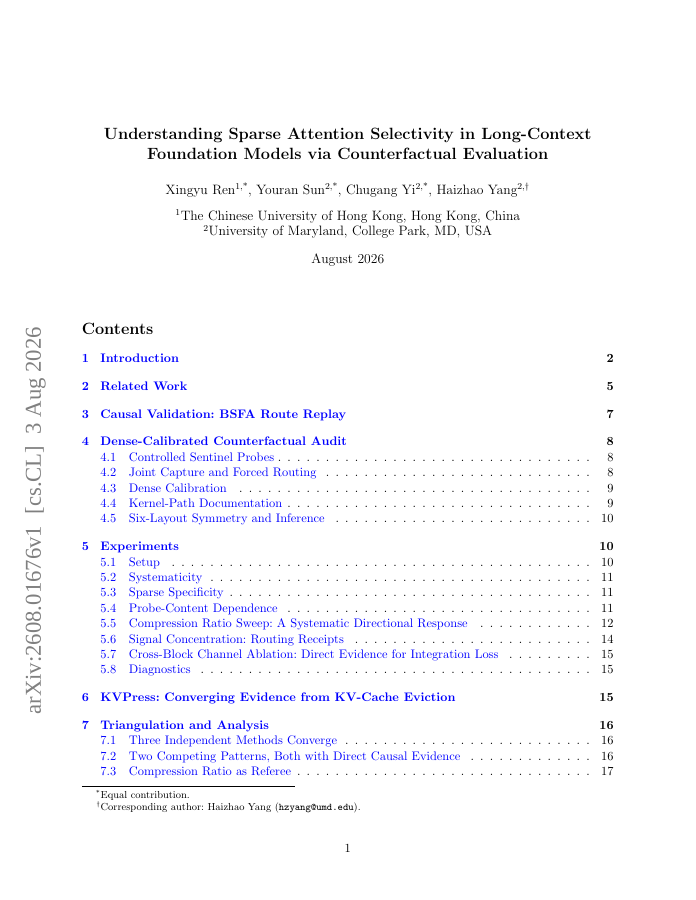
Understanding Sparse Attention Selectivity in Long-Context Foundation Models via Counterfactual Evaluation
Sparse attention is widely deployed in long-context serving stacks, yet no framework audits how discarding blocks changes the influence of specific content on model output.
- Preview
- Year
- 2026
- Hosting
- Full text hostedCC-BY-4.0
Cite
Notes
Only stored in your browser.
Attribution
- Abstract & full text
- arxiv.org/abs/2608.01676CC-BY-4.0
- TL;DR
- Semantic Scholar