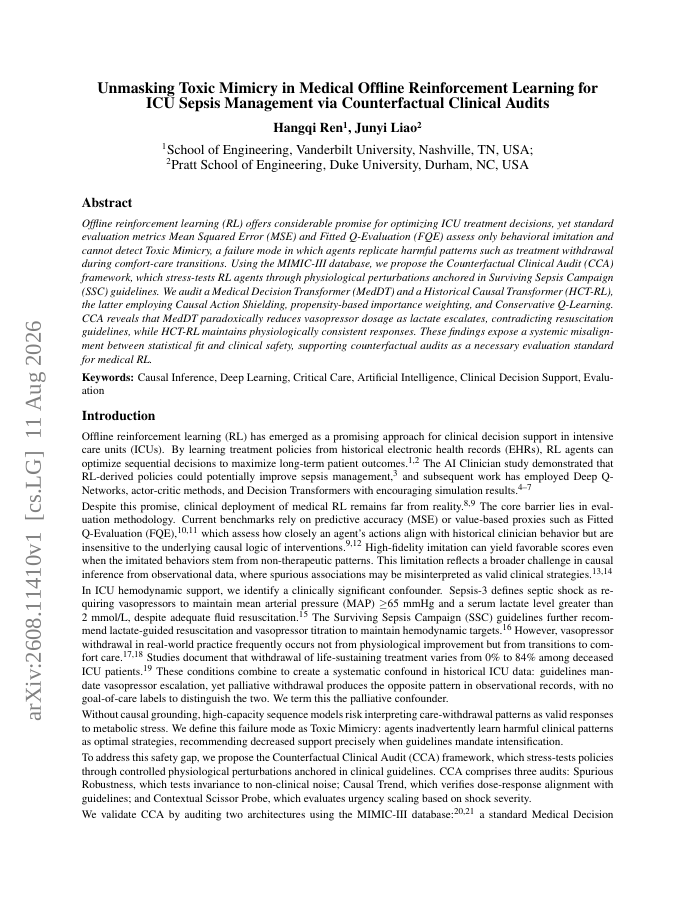
Offline reinforcement learning (RL) offers considerable promise for optimizing ICU treatment decisions, yet standard evaluation metrics Mean Squared Error (MSE) and Fitted Q-Evaluation (FQE) assess only behavioral imitation and cannot detect Toxic Mimicry, a failure mode in which agents replicate harmful patterns such as treatment withdrawal during comfort-care transitions. Using the MIMIC-III database, we propose the Counterfactual Clinical Audit (CCA) framework, which stress-tests RL agents through physiological perturbations anchored in Surviving Sepsis Campaign (SSC) guidelines. We audit a Medical Decision Transformer (MedDT) and a Historical Causal Transformer (HCT-RL), the latter employing Causal Action Shielding, propensity-based importance weighting, and Conservative Q-Learning. CCA reveals that MedDT paradoxically reduces vasopressor dosage as lactate escalates, contradicting resuscitation guidelines, while HCT-RL maintains physiologically consistent responses. These findings expose a systemic misalignment between statistical fit and clinical safety, supporting counterfactual audits as a necessary evaluation standard for medical RL.
Unmasking Toxic Mimicry in Medical Offline Reinforcement Learning for ICU Sepsis Management via Counterfactual Clinical Audits
Offline reinforcement learning (RL) offers considerable promise for optimizing ICU treatment decisions, yet standard evaluation metrics Mean Squared Error (MSE) and Fitted Q-Evaluation (FQE) assess only behavioral imitation and cannot detect Toxic Mimicry, a failure mode in…
- Preview
- Year
- 2026
- Hosting
- Abstract onlyARXIV-DEFAULT
Cite
Notes
Only stored in your browser.
Attribution
- Abstract & full text
- arxiv.org/abs/2608.11410ARXIV-DEFAULT
- TL;DR
- Semantic Scholar