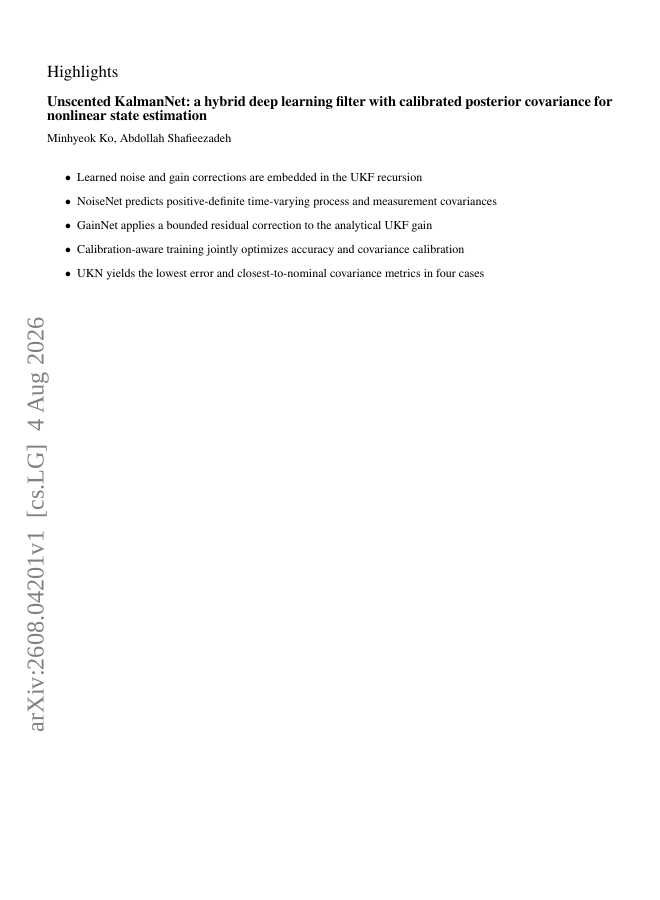
Nonlinear state estimation requires sequentially fusing model-based predictions with noisy measurements. Under imperfect dynamics and unknown, time-varying noise statistics, this fusion can degrade in both accuracy and statistical consistency. Existing learning-aided filters largely treat accuracy and uncertainty estimation separately, limiting their ability to correct model-mismatch-induced bias while retaining an explicit, calibrated posterior covariance. This paper introduces Unscented KalmanNet (UKN), a model-based deep learning architecture that extends the Unscented Kalman Filter (UKF) with learned mechanisms for these two sources of filtering error while preserving explicit posterior covariance propagation. NoiseNet learns time-varying process and measurement covariances as bounded multiplicative corrections to baseline covariances, guaranteeing positive definiteness, while GainNet learns a bounded residual correction to the analytical UKF gain to compensate for model-mismatch-induced bias. A calibration-aware training objective couples state error with posterior covariance and innovation consistency terms through adaptive weighting, jointly optimizing accuracy and calibration. UKN is benchmarked against UKF, KalmanNet, and Bayesian KalmanNet on three synthetic systems and real-flight UZH-FPV data. It achieves the lowest state-estimation error in all four examples and reduces RMSE by 26.4-49.7% compared with UKF in the synthetic cases. Leave-one-sequence-out cross-validation over 11 flights shows 22.4% and 34.3% reductions in mean position and velocity RMSE, respectively. UKN also yields the lowest fold-to-fold variability, with dimension-normalized NEES and empirical coverage closest to nominal values among covariance-reporting filters. These results show that structured learned adaptation improves estimation accuracy while retaining calibrated uncertainty.
Unscented KalmanNet: Structure-Preserving Deep Learning with Calibrated Posterior Uncertainty under Incomplete Physics and Unknown Noise
Nonlinear state estimation requires sequentially fusing model-based predictions with noisy measurements. Under imperfect dynamics and unknown, time-varying noise statistics, this fusion can degrade in both accuracy and statistical consistency.
- Preview
- Year
- 2026
- Hosting
- Abstract onlyARXIV-DEFAULT
Cite
Notes
Only stored in your browser.
Attribution
- Abstract & full text
- arxiv.org/abs/2608.04201ARXIV-DEFAULT
- TL;DR
- Semantic Scholar