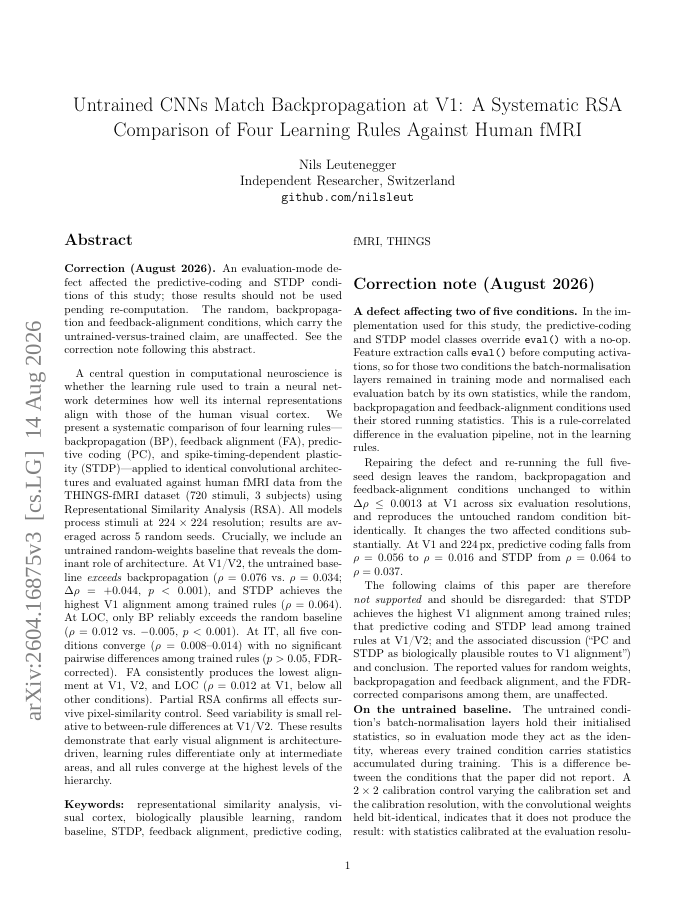
CORRECTION (August 2026): an evaluation-mode defect affected the predictive-coding and STDP conditions of this study; those results should not be used pending re-computation. At V1 and 224px, predictive coding falls from rho = 0.056 to 0.016 and STDP from 0.064 to 0.037, so the claims that STDP leads among trained rules and that PC and STDP lead at V1/V2 are not supported. The random, backpropagation and feedback-alignment conditions, which carry the untrained-versus-trained claim, are unchanged to within 0.0013. The result is however strongly dependent on the evaluation resolution, held fixed at 224px here; see arXiv:2608.12408. See the correction note on page 1; the original abstract below and the body are unchanged from v1. A central question in computational neuroscience is whether the learning rule used to train a neural network determines how well its internal representations align with those of the human visual cortex. We present a systematic comparison of four learning rules (backpropagation (BP), feedback alignment (FA), predictive coding (PC), and spike-timing-dependent plasticity (STDP)) applied to identical convolutional architectures and evaluated against human fMRI data from the THINGS-fMRI dataset (720 stimuli, 3 subjects) using Representational Similarity Analysis (RSA). All models process stimuli at 224 x 224 resolution; results are averaged across 5 random seeds. Crucially, we include an untrained random-weights baseline that reveals the dominant role of architecture. At V1/V2, the untrained baseline exceeds backpropagation (rho = 0.076 vs. rho = 0.034; Delta-rho = +0.044, p < 0.001). At LOC, only BP reliably exceeds the random baseline (rho = 0.012 vs. -0.005, p < 0.001). At IT, all five conditions converge (rho = 0.008-0.014) with no significant pairwise differences among trained rules. Partial RSA confirms all effects survive pixel-similarity control.
Untrained CNNs Match Backpropagation at V1: A Systematic RSA Comparison of Four Learning Rules Against Human fMRI
CORRECTION (August 2026): an evaluation-mode defect affected the predictive-coding and STDP conditions of this study; those results should not be used pending re-computation.
- Preview
- Year
- 2026
- Hosting
- Full text hostedCC-BY-4.0
Cite
Notes
Only stored in your browser.
Attribution
- Abstract & full text
- arxiv.org/abs/2604.16875CC-BY-4.0
- TL;DR
- Semantic Scholar