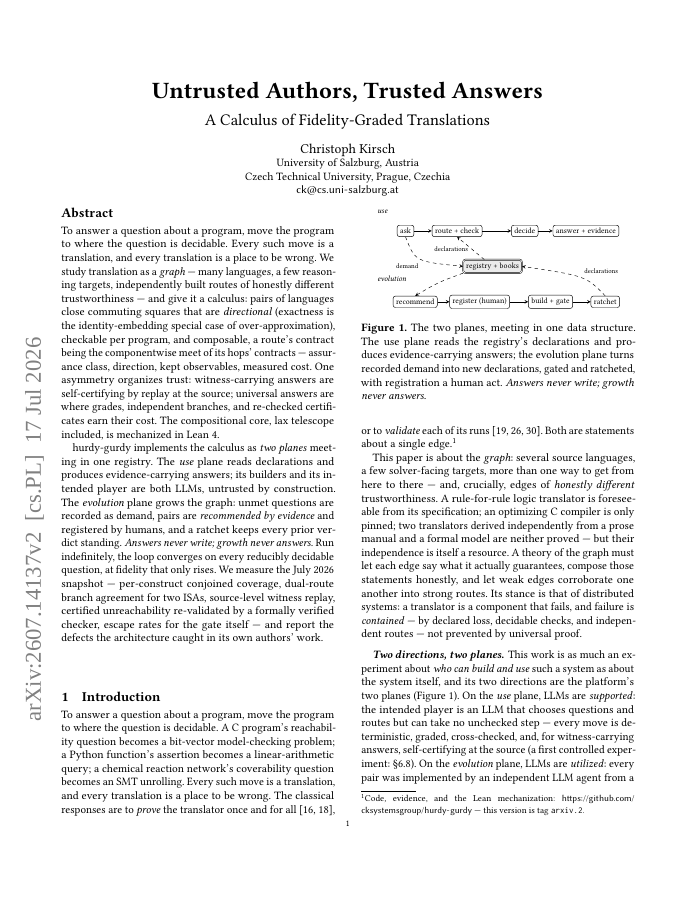
To answer a question about a program, move the program to where the question is decidable. Every such move is a translation, and every translation is a place to be wrong. We study translation as a graph -- many languages, a few reasoning targets, independently built routes of honestly different trustworthiness -- and give it a calculus: pairs of languages close commuting squares that are directional (exactness is the identity-embedding special case of over-approximation), checkable per program, and composable, a route's contract being the componentwise meet of its hops' contracts -- assurance class, direction, kept observables, measured cost. One asymmetry organizes trust: witness-carrying answers are self-certifying by replay at the source; universal answers are where grades, independent branches, and re-checked certificates earn their cost. The compositional core, lax telescope included, is mechanized in Lean 4. hurdy-gurdy implements the calculus as two planes meeting in one registry. The use plane reads declarations and produces evidence-carrying answers; its builders and its intended player are both LLMs, untrusted by construction. The evolution plane grows the graph: unmet questions are recorded as demand, pairs are recommended by evidence and registered by humans, and a ratchet keeps every prior verdict standing. Answers never write; growth never answers. Run indefinitely, the loop converges on every reducibly decidable question, at fidelity that only rises. We measure the July 2026 snapshot -- per-construct conjoined coverage, dual-route branch agreement for two ISAs, source-level witness replay, certified unreachability re-validated by a formally verified checker, escape rates for the gate itself -- and report the defects the architecture caught in its own authors' work.
Untrusted Authors, Trusted Answers: A Calculus of Fidelity-Graded Translations
To answer a question about a program, move the program to where the question is decidable. Every such move is a translation, and every translation is a place to be wrong.
- Preview
- Year
- 2026
- Hosting
- Full text hostedCC-BY-4.0
Cite
Notes
Only stored in your browser.
Attribution
- Abstract & full text
- arxiv.org/abs/2607.14137CC-BY-4.0
- TL;DR
- Semantic Scholar