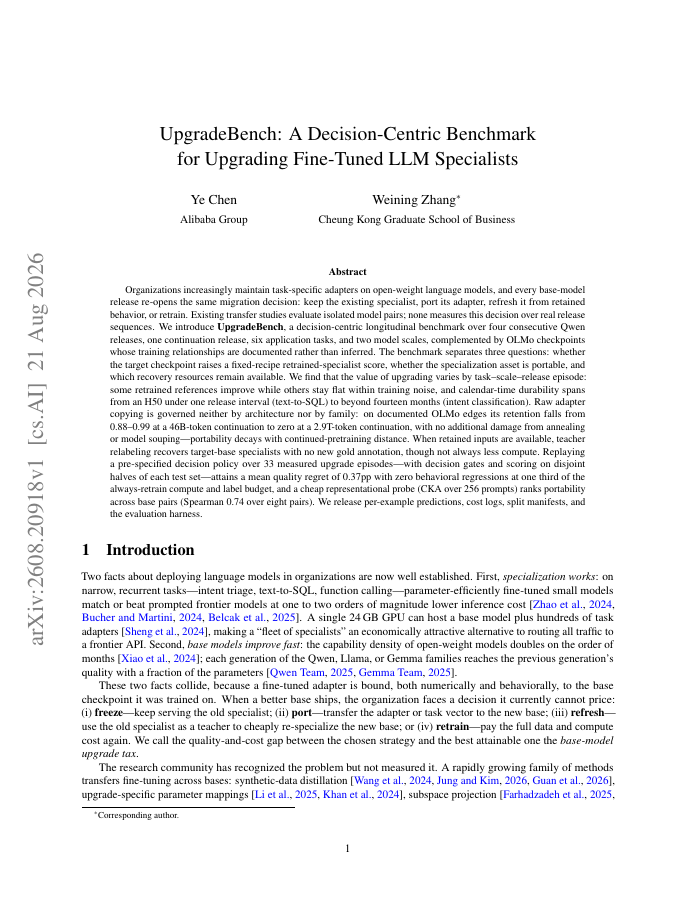
Organizations maintain task-specific adapters for open-weight language models, and each new base-model release forces a migration decision: retain existing specialists, port adapters, refresh from preserved behavior, or retrain. Prior transfer work evaluates isolated model pairs, without studying these choices across real model release sequences. We present UpgradeBench, a decision-driven longitudinal benchmark covering four consecutive Qwen releases, one continuation checkpoint, six tasks, and two model sizes, augmented by OLMo checkpoints with known training lineage. The benchmark disentangles three core questions: whether a new checkpoint improves fixed-recipe retrained specialist performance, whether specialization assets transfer across versions, and what recovery resources are usable. We observe upgrade gains differ across task-scale-release episodes: some retrained baselines improve while others stay within training noise, with durability ranging from under one release interval for text-to-SQL to over fourteen months for intent classification. Direct adapter copying depends neither on architecture nor model family: on OLMo, retention drops from 0.88-0.99 at 46B-token continued pretraining to zero at 2.9T tokens; annealing and model souping introduce no extra harm, with portability decaying with continued-pretraining distance. Given preserved input data, teacher relabeling recovers target-base specialists without fresh gold annotations, though compute savings are not guaranteed. Simulating a fixed decision policy over 33 upgrade episodes yields 0.37pp mean quality regret with zero behavioral regressions at one-third the compute and label cost of full retraining. A lightweight CKA probe over 256 prompts predicts cross-version adapter portability (Spearman 0.74 across eight model pairs). We release per-example predictions, cost logs, split manifests, and evaluation code.
UpgradeBench: A Decision-Centric Benchmark for Upgrading Fine-Tuned LLM Specialists
Organizations maintain task-specific adapters for open-weight language models, and each new base-model release forces a migration decision: retain existing specialists, port adapters, refresh from preserved behavior, or retrain.
- Preview
- Year
- 2026
- Hosting
- Excerpt onlyCC-BY-NC-SA-4.0
Cite
Notes
Only stored in your browser.
Attribution
- Abstract & full text
- arxiv.org/abs/2608.20918CC-BY-NC-SA-4.0
- TL;DR
- Semantic Scholar