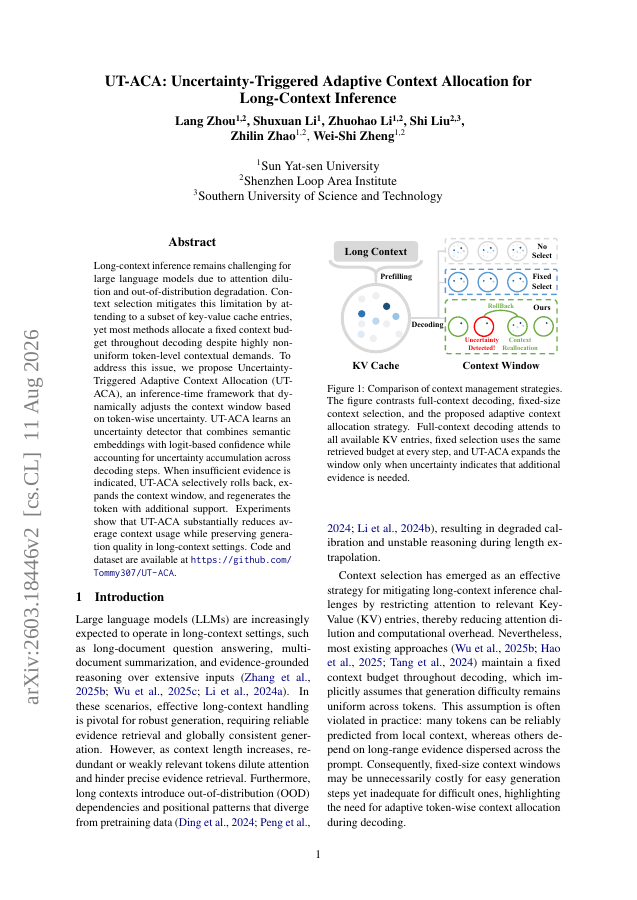
Long-context inference remains challenging for large language models due to attention dilution and out-of-distribution degradation. Context selection mitigates this limitation by attending to a subset of key-value cache entries, yet most methods allocate a fixed context budget throughout decoding despite highly non-uniform token-level contextual demands. To address this issue, we propose Uncertainty-Triggered Adaptive Context Allocation (UT-ACA), an inference-time framework that dynamically adjusts the context window based on token-wise uncertainty. UT-ACA learns an uncertainty detector that combines semantic embeddings with logit-based confidence while accounting for uncertainty accumulation across decoding steps. When insufficient evidence is indicated, UT-ACA selectively rolls back, expands the context window, and regenerates the token with additional support. Experiments show that UT-ACA substantially reduces average context usage while preserving generation quality in long-context settings. Code and dataset are available at https://github.com/Tommy307/UT-ACA.
UT-ACA: Uncertainty-Triggered Adaptive Context Allocation for Long-Context Inference
Long-context inference remains challenging for large language models due to attention dilution and out-of-distribution degradation. Context selection mitigates this limitation by attending to a subset of key-value cache entries, yet most methods allocate a fixed context budget…
- Preview
- Year
- 2026
- Hosting
- Abstract onlyARXIV-DEFAULT
Cite
Notes
Only stored in your browser.
Attribution
- Abstract & full text
- arxiv.org/abs/2603.18446ARXIV-DEFAULT
- TL;DR
- Semantic Scholar