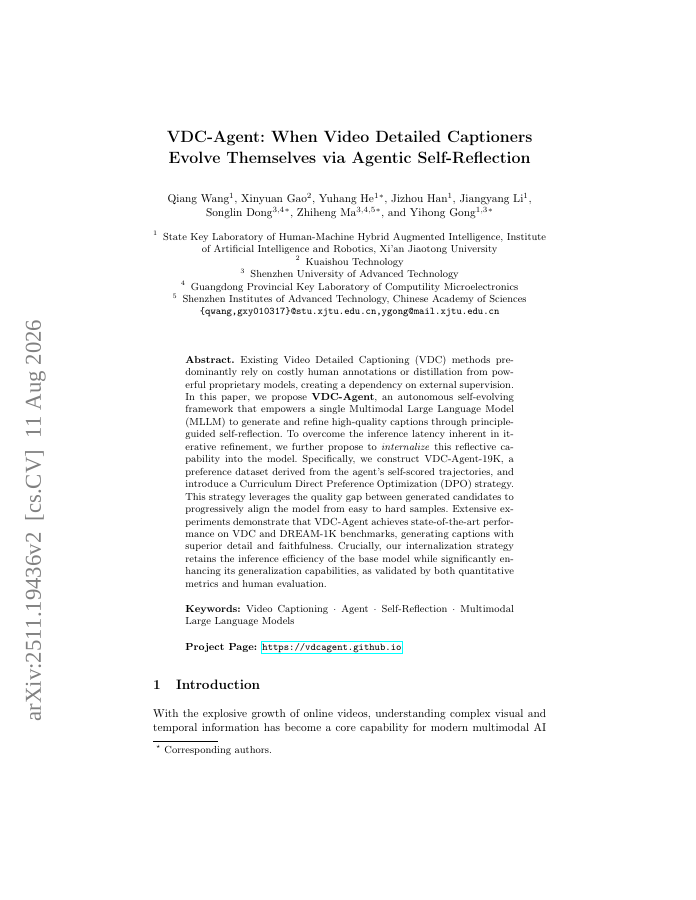
Existing Video Detailed Captioning (VDC) methods predominantly rely on costly human annotations or distillation from powerful proprietary models, creating a dependency on external supervision. In this paper, we propose VDC-Agent, an autonomous self-evolving framework that empowers a single Multimodal Large Language Model (MLLM) to generate and refine high-quality captions through principle-guided self-reflection. To overcome the inference latency inherent in iterative refinement, we further propose to internalize this reflective capability into the model. Specifically, we construct VDC-Agent-19K, a preference dataset derived from the agent's self-scored trajectories, and introduce a Curriculum Direct Preference Optimization (DPO) strategy. This strategy leverages the quality gap between generated candidates to progressively align the model from easy to hard samples. Extensive experiments demonstrate that VDC-Agent achieves state-of-the-art performance on VDC and DREAM-1K benchmarks, generating captions with superior detail and faithfulness. Crucially, our internalization strategy retains the inference efficiency of the base model while significantly enhancing its generalization capabilities, as validated by both quantitative metrics and human evaluation.
VDC-Agent: When Video Detailed Captioners Evolve Themselves via Agentic Self-Reflection
Existing Video Detailed Captioning (VDC) methods predominantly rely on costly human annotations or distillation from powerful proprietary models, creating a dependency on external supervision.
- Preview
- Year
- 2025
- Hosting
- Excerpt onlyCC-BY-NC-SA-4.0
Cite
Notes
Only stored in your browser.
Attribution
- Abstract & full text
- arxiv.org/abs/2511.19436CC-BY-NC-SA-4.0
- TL;DR
- Semantic Scholar