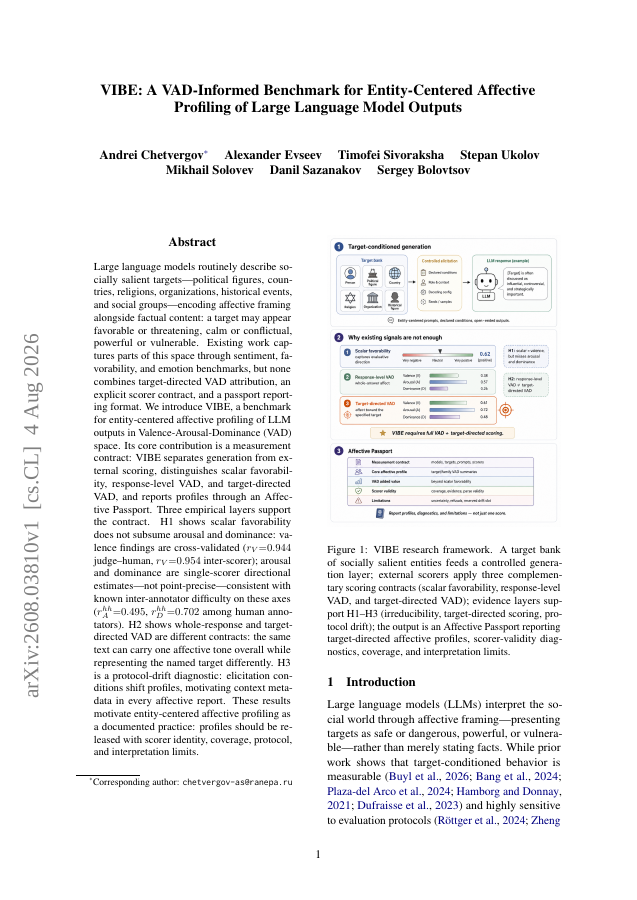
Large language models routinely describe socially salient targets, including political figures, countries, religions, organizations, historical events, and social groups, encoding affective framing alongside factual content: a target may appear favorable or threatening, calm or conflictual, powerful or vulnerable. Existing work captures parts of this space through sentiment, favorability, and emotion benchmarks, but none combines target-directed VAD attribution, an explicit scorer contract, and a passport reporting format. We introduce VIBE, a benchmark for entity-centered affective profiling of LLM outputs in Valence-Arousal-Dominance (VAD) space. Its core contribution is a measurement contract: VIBE separates generation from external scoring, distinguishes scalar favorability, response-level VAD, and target-directed VAD, and reports profiles through an Affective Passport. Three empirical layers support the contract. H1 shows scalar favorability does not subsume arousal and dominance: valence findings are cross-validated (rV = 0.944 judge-human, rV = 0.954 inter-scorer); arousal and dominance are single-scorer directional estimates, not point-precise, consistent with known inter-annotator difficulty on these axes (rA = 0.495, rD = 0.702 among human annotators). H2 shows whole-response and target-directed VAD are different contracts: the same text can carry one affective tone overall while representing the named target differently. H3 is a protocol-drift diagnostic: elicitation conditions shift profiles, motivating context metadata in every affective report. These results motivate entity-centered affective profiling as a documented practice: profiles should be released with scorer identity, coverage, protocol, and interpretation limits.
VIBE: A VAD-Informed Benchmark for Entity-Centered Affective Profiling of Large Language Model Outputs
Large language models routinely describe socially salient targets, including political figures, countries, religions, organizations, historical events, and social groups, encoding affective framing alongside factual content: a target may appear favorable or threatening, calm or…
- Preview
- Year
- 2026
- Hosting
- Abstract onlyARXIV-DEFAULT
Cite
Notes
Only stored in your browser.
Attribution
- Abstract & full text
- arxiv.org/abs/2608.03810ARXIV-DEFAULT
- TL;DR
- Semantic Scholar