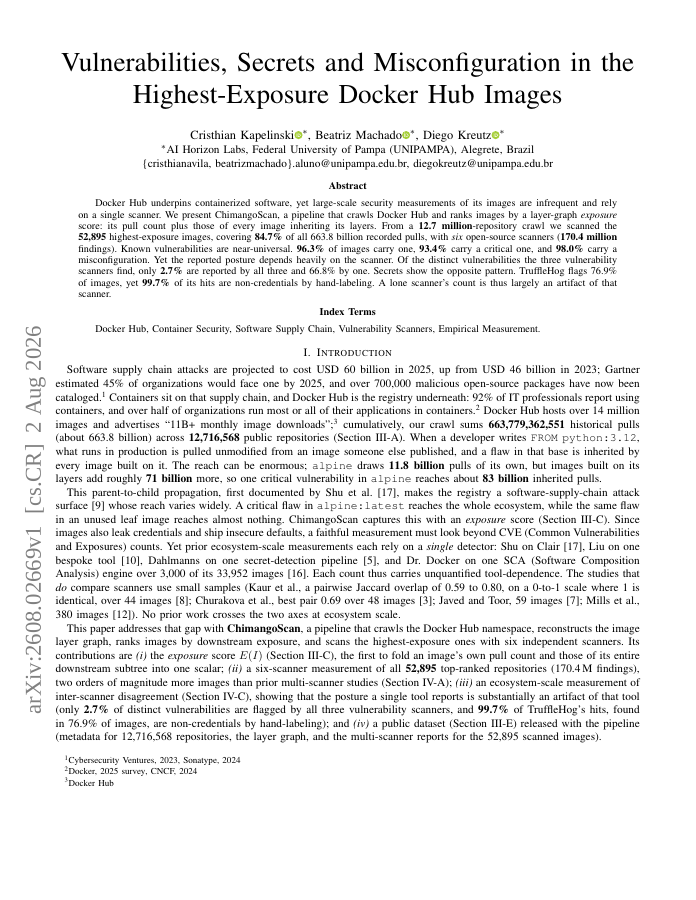
Docker Hub is the registry underneath most container deployments, and a flaw in a widely reused base image is inherited by every image built on it. Prior ecosystem-scale measurements each rely on a single detector, leaving the tool-dependence of their counts unquantified, while the studies that do compare scanners use samples of tens to hundreds of images. We present ChimangoScan, a pipeline that crawls the Docker Hub namespace (12,716,568 repositories, 663.8 billion cumulative pulls), reconstructs the image layer graph (54.4 million IS_BASE_OF edges), ranks images by an exposure score that folds an image's own pull count and those of its entire downstream subtree into one scalar, and scans the 52,895 highest-exposure repositories (84.7% of all recorded pulls) with six independent scanners, yielding 170.4 million findings. Vulnerabilities are near-universal: 96.3% of images carry a known package vulnerability, 93.4% a critical one, and 98.0% at least one CIS Docker Benchmark misconfiguration. The posture a single tool reports is largely an artifact of that tool: of 80.7 million distinct (vulnerability, package) groups, 66.8% are flagged by only one of the three vulnerability scanners and just 2.7% by all three, and the best single scanner recovers 66.9%. TruffleHog flags a secret in 76.9% of images, yet hand-labeling 1,100 random detections finds 99.7% are non-credentials. A single zlib CVE reaches images carrying 47.3% of total corpus exposure and propagates to 1.13 million distinct downstream images, but exposure does not predict how vulnerable an image is. We release the pipeline and the 283 GB dataset.
Vulnerabilities, Secrets and Misconfiguration in the Highest-Exposure Docker Hub Images
Docker Hub is the registry underneath most container deployments, and a flaw in a widely reused base image is inherited by every image built on it. Prior ecosystem-scale measurements each rely on a single detector, leaving the tool-dependence of their counts unquantified, while…
- Preview
- Year
- 2026
- Hosting
- Full text hostedCC-BY-4.0
Cite
Notes
Only stored in your browser.
Attribution
- Abstract & full text
- arxiv.org/abs/2608.02669CC-BY-4.0
- TL;DR
- Semantic Scholar