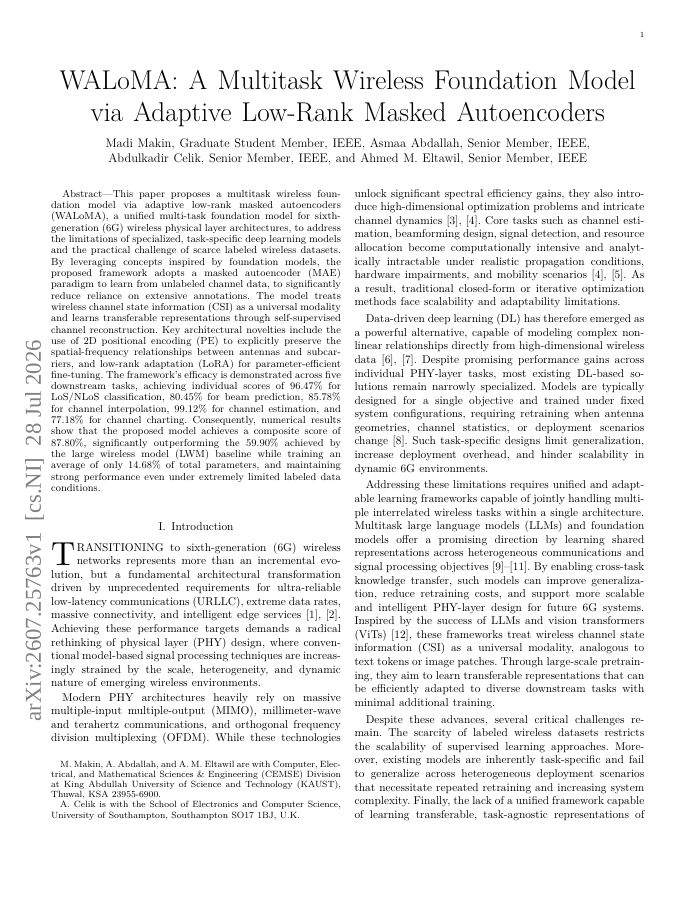
This paper proposes a multitask wireless foundation model via adaptive low-rank masked autoencoders (WALoMA), a unified multi-task foundation model for sixth-generation (6G) wireless physical layer architectures, to address the limitations of specialized, task-specific deep learning models and the practical challenge of scarce labeled wireless datasets. By leveraging concepts inspired by foundation models, the proposed framework adopts a masked autoencoder (MAE) paradigm to learn from unlabeled channel data, to significantly reduce reliance on extensive annotations. The model treats wireless channel state information (CSI) as a universal modality and learns transferable representations through self-supervised channel reconstruction. Key architectural novelties include the use of 2D positional encoding (PE) to explicitly preserve the spatial-frequency relationships between antennas and subcarriers, and low-rank adaptation (LoRA) for parameter-efficient fine-tuning. The framework's efficacy is demonstrated across five downstream tasks, achieving individual scores of 96.47% for LoS/NLoS classification, 80.45% for beam prediction, 85.78% for channel interpolation, 99.12% for channel estimation, and 77.18% for channel charting. Consequently, numerical results show that the proposed model achieves a composite score of 87.80%, significantly outperforming the 59.90% achieved by the large wireless model (LWM) baseline while training an average of only 14.68% of total parameters, and maintaining strong performance even under extremely limited labeled data conditions.
WALoMA: A Multitask Wireless Foundation Model via Adaptive Low-Rank Masked Autoencoders
This paper proposes a multitask wireless foundation model via adaptive low-rank masked autoencoders (WALoMA), a unified multi-task foundation model for sixth-generation (6G) wireless physical layer architectures, to address the limitations of specialized, task-specific deep…
- Preview
- Year
- 2026
- Hosting
- Full text hostedCC-BY-4.0
Cite
Notes
Only stored in your browser.
Attribution
- Abstract & full text
- arxiv.org/abs/2607.25763CC-BY-4.0
- TL;DR
- Semantic Scholar