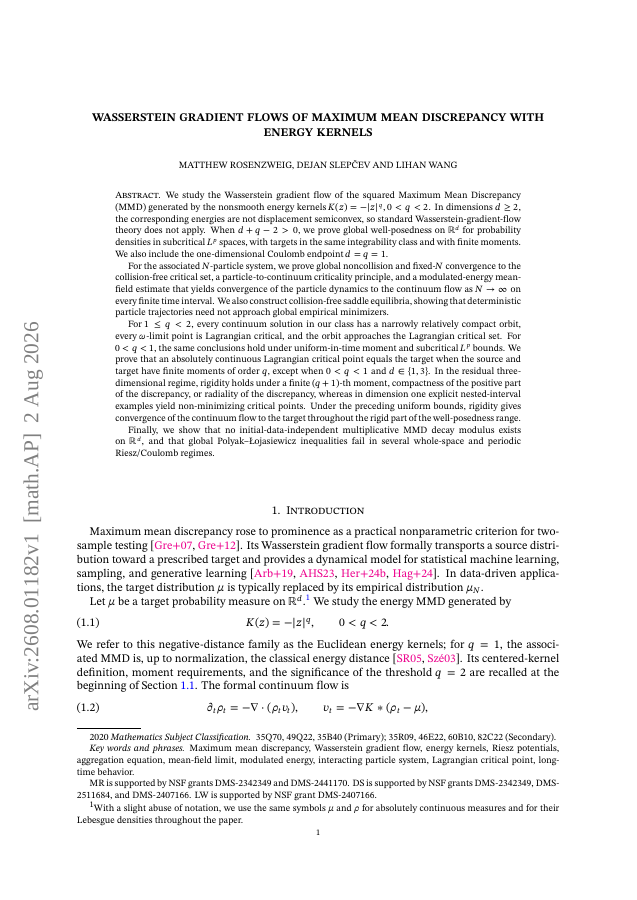
We study the Wasserstein gradient flow of the squared Maximum Mean Discrepancy (MMD) generated by the nonsmooth energy kernels K(z)=-|z|^q, 0<q<2. In dimensions d\ge2, the corresponding energies are not displacement semiconvex, so standard Wasserstein-gradient-flow theory does not apply. When d+q-2>0, we prove global well-posedness on \mathbb{R}^d for probability densities in subcritical L^p spaces, with targets in the same integrability class and with finite moments. We also include the one-dimensional Coulomb endpoint d=q=1. For the associated N-particle system, we prove global noncollision and fixed-N convergence to the collision-free critical set, a particle-to-continuum criticality principle, and a modulated-energy mean-field estimate that yields convergence of the particle dynamics to the continuum flow as N\to\infty on every finite time interval. We also construct collision-free saddle equilibria, showing that deterministic particle trajectories need not approach global empirical minimizers. For 1\le q<2, every continuum solution in our class has a narrowly relatively compact orbit, every ω-limit point is Lagrangian critical, and the orbit approaches the Lagrangian critical set. For 0<q<1, the same conclusions hold under uniform-in-time moment and subcritical L^p bounds. We prove that an absolutely continuous Lagrangian critical point equals the target when the source and target have finite moments of order q, except when 0<q<1 and d\in{1,3}. Under the preceding uniform bounds, rigidity gives convergence of the continuum flow to the target throughout the rigid part of the well-posedness range. Finally, we show that no initial-data-independent multiplicative MMD decay modulus exists on \mathbb{R}^d, and that global Polyak--Łojasiewicz inequalities fail in several whole-space and periodic Riesz/Coulomb regimes.
Wasserstein gradient flows of Maximum Mean Discrepancy with energy kernels
We study the Wasserstein gradient flow of the squared Maximum Mean Discrepancy (MMD) generated by the nonsmooth energy kernels $K(z)=-|z|^q$, $0<q<2$. In dimensions $d\ge2$, the corresponding energies are not displacement semiconvex, so standard Wasserstein-gradient-flow theory…
- Preview
- Year
- 2026
- Hosting
- Abstract onlyARXIV-DEFAULT
Cite
Notes
Only stored in your browser.
Attribution
- Abstract & full text
- arxiv.org/abs/2608.01182ARXIV-DEFAULT
- TL;DR
- Semantic Scholar