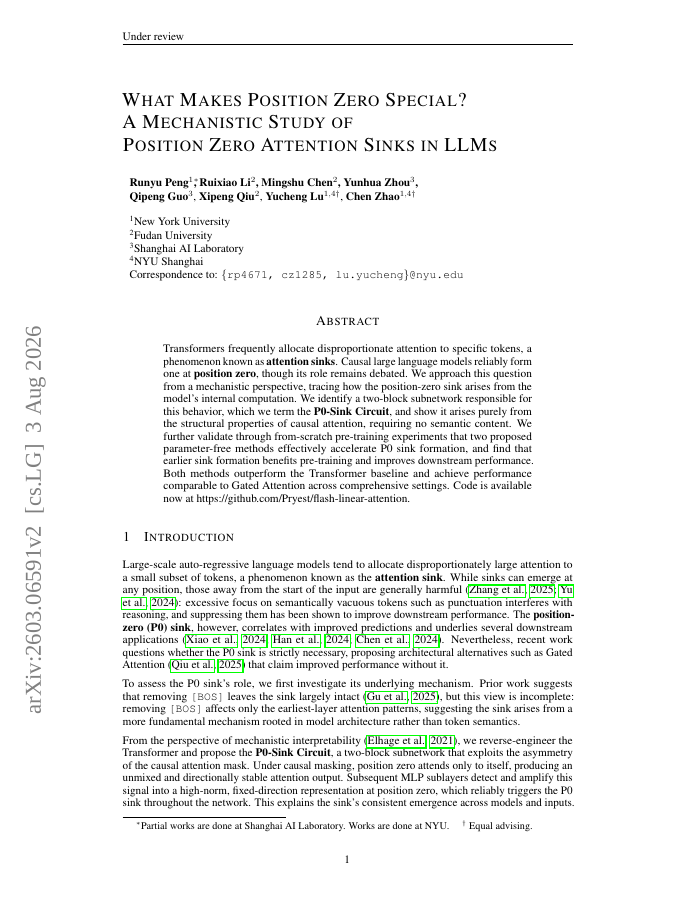
Transformers frequently allocate disproportionate attention to specific tokens, a phenomenon known as attention sinks. Causal large language models reliably form one at position zero, though its role remains debated. We approach this question from a mechanistic perspective, tracing how the position-zero sink arises from the model's internal computation. We identify a two-block subnetwork responsible for this behavior, which we term the P0-Sink Circuit, and show it arises purely from the structural properties of causal attention, requiring no semantic content. We further validate through from-scratch pre-training experiments that two proposed parameter-free methods effectively accelerate P0 sink formation, and find that earlier sink formation benefits pre-training and improves downstream performance. Both methods outperform the Transformer baseline and achieve performance comparable to Gated Attention across comprehensive settings. Code is available now at https://github.com/Pryest/flash-linear-attention.
What Makes Position Zero Special? A Mechanistic Study of Position Zero Attention Sinks in LLMs
Transformers frequently allocate disproportionate attention to specific tokens, a phenomenon known as attention sinks. Causal large language models reliably form one at position zero, though its role remains debated.
- Preview
- Year
- 2026
- Hosting
- Full text hostedCC-BY-4.0
Cite
Notes
Only stored in your browser.
Attribution
- Abstract & full text
- arxiv.org/abs/2603.06591CC-BY-4.0
- TL;DR
- Semantic Scholar