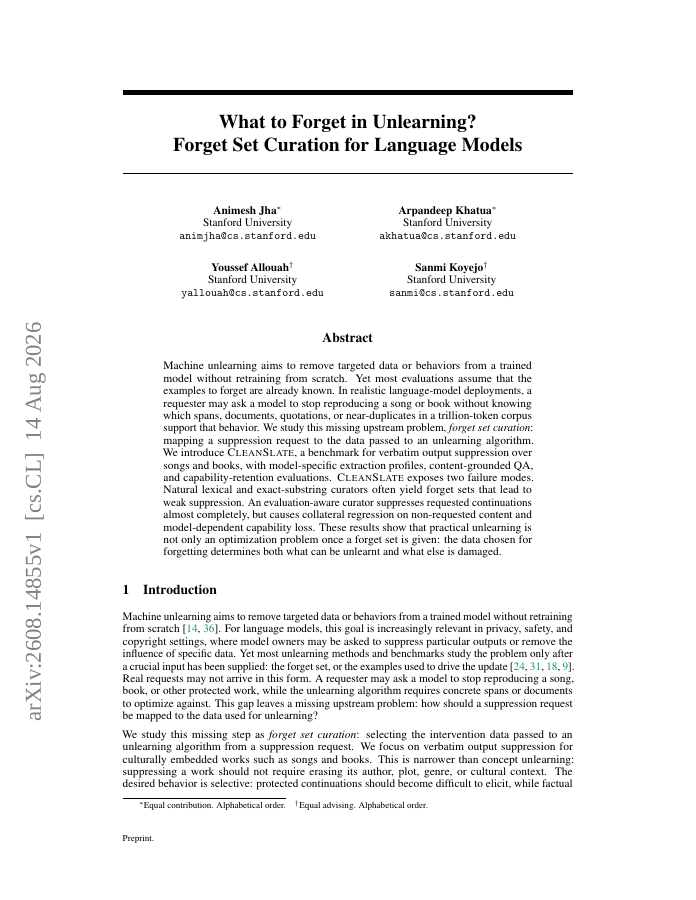
Machine unlearning aims to remove targeted data or behaviors from a trained model without retraining from scratch. Yet most evaluations assume that the examples to forget are already known. In realistic language-model deployments, a requester may ask a model to stop reproducing a song or book without knowing which spans, documents, quotations, or near-duplicates in a trillion-token corpus support that behavior. We study this missing upstream problem, forget set curation: mapping a suppression request to the data passed to an unlearning algorithm. We introduce CleanSlate, a benchmark for verbatim output suppression over songs and books, with model-specific extraction profiles, content-grounded QA, and capability-retention evaluations. CleanSlate exposes two failure modes. Natural lexical and exact-substring curators often yield forget sets that lead to weak suppression. An evaluation-aware curator suppresses requested continuations almost completely, but causes collateral regression on non-requested content and model-dependent capability loss. These results show that practical unlearning is not only an optimization problem once a forget set is given: the data chosen for forgetting determines both what can be unlearnt and what else is damaged.
What to Forget in Unlearning? Forget Set Curation for Language Models
Machine unlearning aims to remove targeted data or behaviors from a trained model without retraining from scratch. Yet most evaluations assume that the examples to forget are already known.
- Preview
- Year
- 2026
- Hosting
- Full text hostedCC-BY-4.0
Cite
Notes
Only stored in your browser.
Attribution
- Abstract & full text
- arxiv.org/abs/2608.14855CC-BY-4.0
- TL;DR
- Semantic Scholar