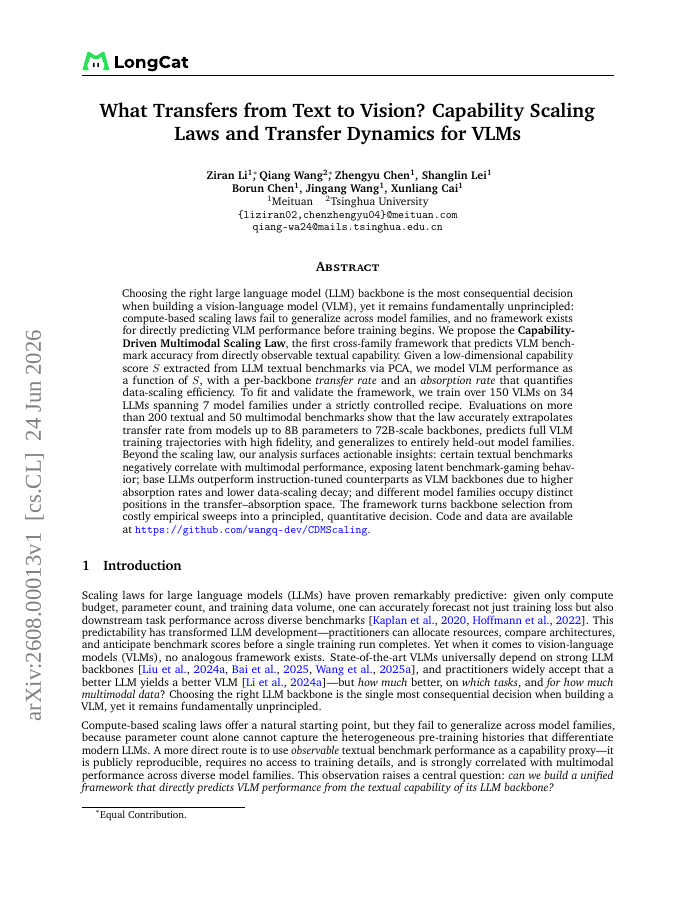
Choosing the right large language model (LLM) backbone is the most consequential decision when building a vision-language model (VLM), yet it remains fundamentally unprincipled: compute-based scaling laws fail to generalize across model families, and no framework exists for directly predicting VLM performance before training begins. We propose the Capability-Driven Multimodal Scaling Law, the first cross-family framework that predicts VLM benchmark accuracy from directly observable textual capability. Given a low-dimensional capability score S extracted from LLM textual benchmarks via PCA, we model VLM performance as a function of S, with a per-backbone transfer rate and an absorption rate that quantifies data-scaling efficiency. To fit and validate the framework, we train over 150 VLMs on 34 LLMs spanning 7 model families under a strictly controlled recipe. Evaluations on more than 200 textual and 50 multimodal benchmarks show that the law accurately extrapolates transfer rate from models up to 8B parameters to 72B-scale backbones, predicts full VLM training trajectories with high fidelity, and generalizes to entirely held-out model families. Beyond the scaling law, our analysis surfaces actionable insights: certain textual benchmarks negatively correlate with multimodal performance, exposing latent benchmark-gaming behavior; base LLMs outperform instruction-tuned counterparts as VLM backbones due to higher absorption rates and lower data-scaling decay; and different model families occupy distinct positions in the transfer--absorption space. The framework turns backbone selection from costly empirical sweeps into a principled, quantitative decision. Code and data are available at https://github.com/wangq-dev/CDMScaling.
What Transfers from Text to Vision? Capability Scaling Laws and Transfer Dynamics for VLMs
Choosing the right large language model (LLM) backbone is the most consequential decision when building a vision-language model (VLM), yet it remains fundamentally unprincipled: compute-based scaling laws fail to generalize across model families, and no framework exists for…
- Preview
- Year
- 2026
- Hosting
- Abstract onlyARXIV-DEFAULT
Cite
Notes
Only stored in your browser.
Attribution
- Abstract & full text
- arxiv.org/abs/2608.00013ARXIV-DEFAULT
- TL;DR
- Semantic Scholar