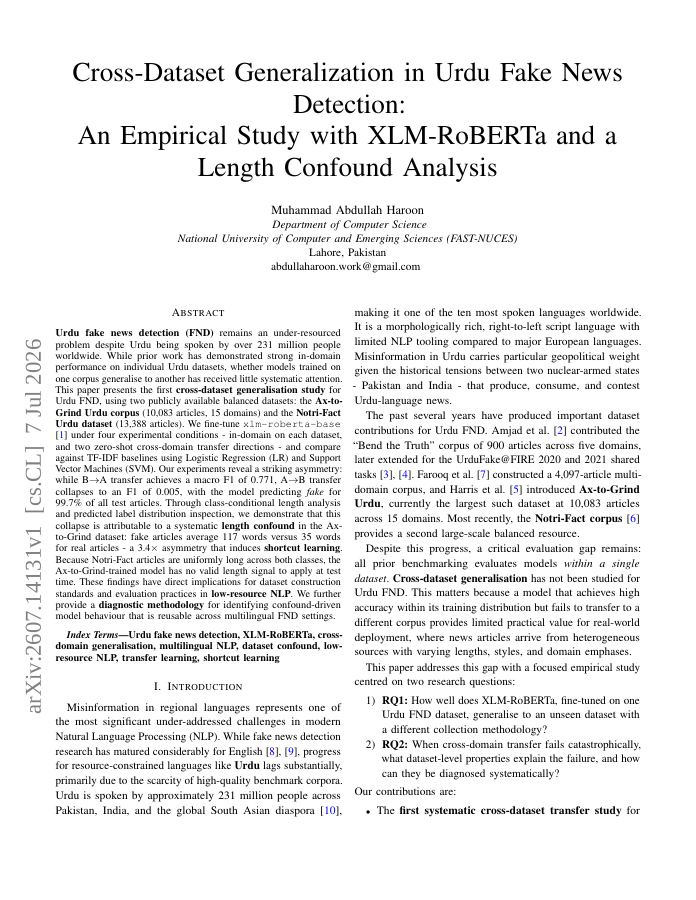
Cross-dataset generalisation is a fundamental requirement for deploying text classifiers in real-world settings, yet systematic evaluation across corpora from different sources remains uncommon in fake news detection and virtually absent in sarcasm detection research. This paper presents a unified empirical study of zero-shot cross-dataset transfer in three domains: Urdu fake news detection (FND), English FND, and sarcasm detection. For each domain, we fine-tune xlm-roberta-base on one corpus and evaluate it on a second corpus from a different source, comparing against TF-IDF baselines with Logistic Regression (LR) and Support Vector Machines (SVM). In Urdu FND (Ax-to-Grind vs. Notri-Fact), we identify a severe length confound in the Ax-to-Grind dataset, fake articles average 3.4 times more words than real articles, causing catastrophic A to B transfer collapse (macro F1 = 0.005) while B to A achieves F1 = 0.771. Extension to English FND (WELFake vs. ISOT) and sarcasm detection (TweetEval Irony vs. Sarcasm Corpus V2) reveals that such failure modes extend beyond Urdu, confirming that shortcut learning from distributional artefacts is a cross-lingual, cross-domain challenge in binary text classification. We provide a reusable diagnostic methodology, combining class-conditional length analysis, bidirectional transfer asymmetry, and predicted label collapse inspection, applicable across any binary text classification setting.
When Benchmarks Mislead: Shortcut Learning, Length Confounds, and the Limits of Cross-Dataset Generalization in Multilingual Fake News and Sarcasm Detection
Cross-dataset generalisation is a fundamental requirement for deploying text classifiers in real-world settings, yet systematic evaluation across corpora from different sources remains uncommon in fake news detection and virtually absent in sarcasm detection research.
- Preview
- Year
- 2026
- Hosting
- Full text hostedCC-BY-4.0
Cite
Notes
Only stored in your browser.
Attribution
- Abstract & full text
- arxiv.org/abs/2607.14131CC-BY-4.0
- TL;DR
- Semantic Scholar