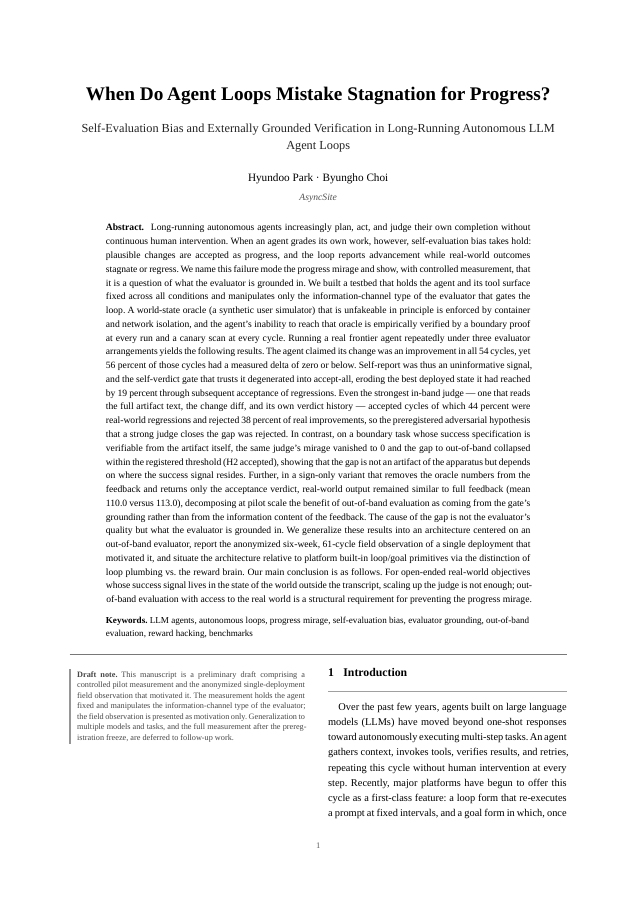
Long-running autonomous agents plan, act, and judge their own completion without human intervention. When an agent grades its own work, self-evaluation bias takes hold: plausible changes are accepted as progress while real-world outcomes stagnate or regress. We name this failure mode the progress mirage and show, with controlled measurement, that it is a question of what the evaluator is grounded in. We built a testbed that holds the agent and its tool surface fixed and manipulates only the information-channel type of the evaluator that gates the loop. A world-state oracle, unfakeable in principle, is enforced by container and network isolation and verified at every run. Across 54 cycles a frontier agent claimed improvement every time, yet 56 percent had a measured delta of zero or below. Self-report was thus uninformative, and the self-verdict gate degenerated into accept-all, eroding the best deployed state it had reached by 19 percent. Even the strongest in-band judge, reading the full artifact text, the change diff, and its own verdict history, accepted cycles of which 44 percent were real-world regressions and rejected 38 percent of real improvements; the preregistered adversarial hypothesis that a strong judge closes the gap was rejected. On a boundary task whose success specification is verifiable from the artifact itself, the same judge's mirage vanished to zero and the gap collapsed within the registered threshold, showing that the gap depends on where the success signal resides. A sign-only variant returning only the acceptance verdict kept real-world output similar to full feedback (110.0 versus 113.0), locating the benefit in the gate's grounding rather than in feedback content. For open-ended objectives whose success signal lives outside the transcript, scaling up the judge is not enough; out-of-band evaluation with real-world access is a structural requirement.
When Do Agent Loops Mistake Stagnation for Progress? Self-Evaluation Bias and Externally Grounded Verification in Long-Running Autonomous LLM Agent Loops
Long-running autonomous agents plan, act, and judge their own completion without human intervention. When an agent grades its own work, self-evaluation bias takes hold: plausible changes are accepted as progress while real-world outcomes stagnate or regress.
- Preview
- Year
- 2026
- Hosting
- Full text hostedCC-BY-4.0
Cite
Notes
Only stored in your browser.
Attribution
- Abstract & full text
- arxiv.org/abs/2607.25152CC-BY-4.0
- TL;DR
- Semantic Scholar