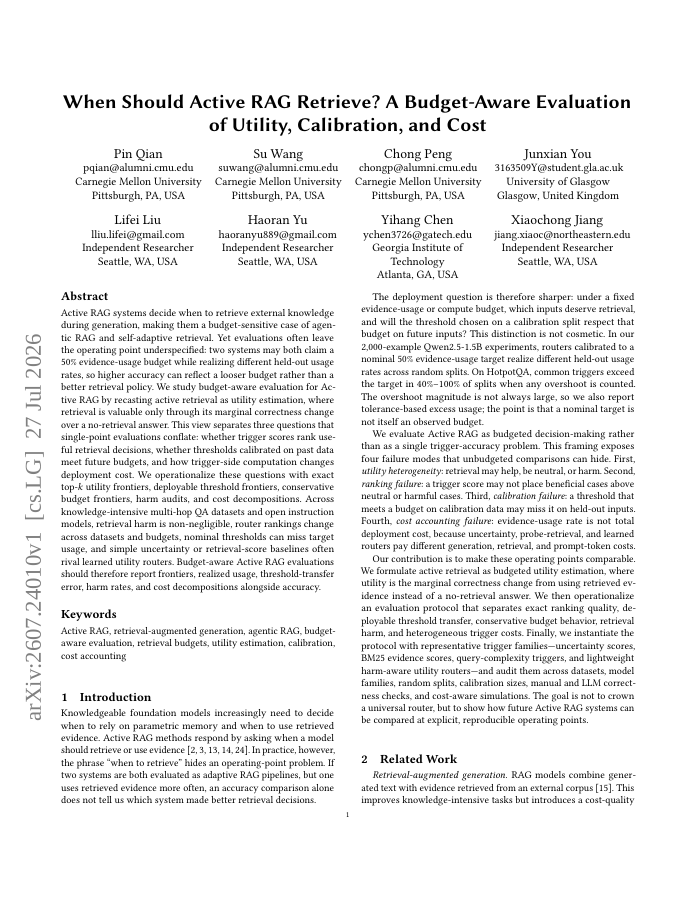
Active RAG systems decide when to retrieve external knowledge during generation, making them a budget-sensitive case of agentic RAG and self-adaptive retrieval. Yet evaluations often leave the operating point underspecified: two systems may both claim a 50% evidence-usage budget while realizing different held-out usage rates, so higher accuracy can reflect a looser budget rather than a better retrieval policy. We study budget-aware evaluation for Active RAG by recasting active retrieval as utility estimation, where retrieval is valuable only through its marginal correctness change over a no-retrieval answer. This view separates three questions that single-point evaluations conflate: whether trigger scores rank useful retrieval decisions, whether thresholds calibrated on past data meet future budgets, and how trigger-side computation changes deployment cost. We operationalize these questions with exact top-k utility frontiers, deployable threshold frontiers, conservative budget frontiers, harm audits, and cost decompositions. Across knowledge-intensive multi-hop QA datasets and open instruction models, retrieval harm is non-negligible, router rankings change across datasets and budgets, nominal thresholds can miss target usage, and simple uncertainty or retrieval-score baselines often rival learned utility routers. Budget-aware Active RAG evaluations should therefore report frontiers, realized usage, threshold-transfer error, harm rates, and cost decompositions alongside accuracy.
When Should Active RAG Retrieve? A Budget-Aware Evaluation of Utility, Calibration, and Cost
Active RAG systems decide when to retrieve external knowledge during generation, making them a budget-sensitive case of agentic RAG and self-adaptive retrieval. Yet evaluations often leave the operating point underspecified: two systems may both claim a 50% evidence-usage budget…
- Preview
- Year
- 2026
- Hosting
- Full text hostedCC-BY-4.0
Cite
Notes
Only stored in your browser.
Attribution
- Abstract & full text
- arxiv.org/abs/2607.24010CC-BY-4.0
- TL;DR
- Semantic Scholar