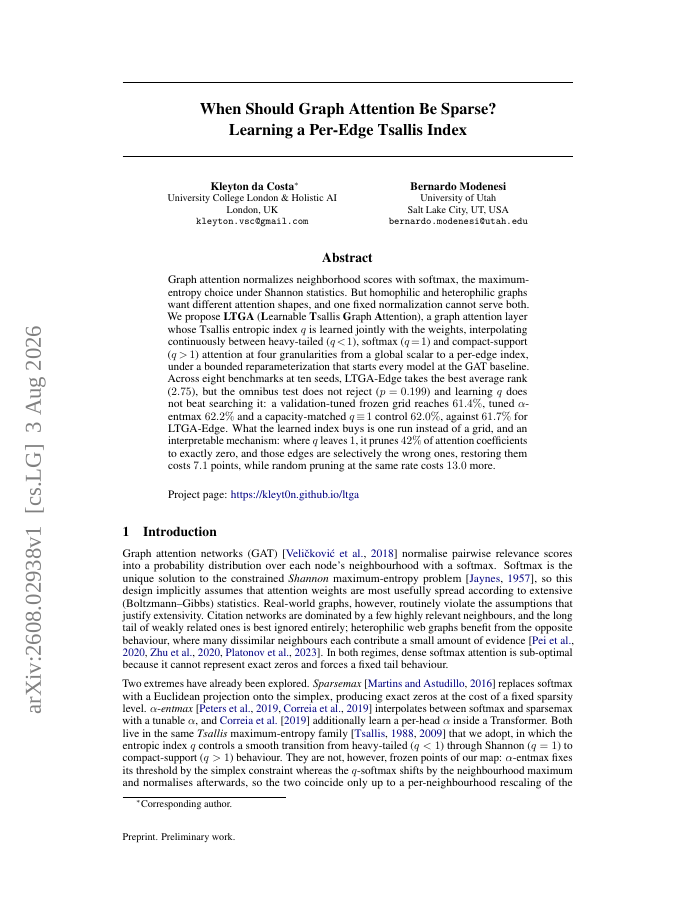
Graph attention normalizes neighborhood scores with softmax, the maximum-entropy choice under Shannon statistics. But homophilic and heterophilic graphs want different attention shapes, and one fixed normalization cannot serve both. We propose LTGA (Learnable Tsallis Graph Attention), a graph attention layer whose Tsallis entropic index q is learned jointly with the weights, interpolating continuously between heavy-tailed (q!<!1), softmax (q!=!1) and compact-support (q!>!1) attention at four granularities from a global scalar to a per-edge index, under a bounded reparameterization that starts every model at the GAT baseline. Across eight benchmarks at ten seeds, LTGA-Edge takes the best average rank (2.75), but the omnibus test does not reject (p!=!0.199) and learning q does not beat searching it: a validation-tuned frozen grid reaches 61.4%, tuned α-entmax 62.2% and a capacity-matched q!\equiv!1 control 62.0%, against 61.7% for LTGA-Edge. What the learned index buys is one run instead of a grid, and an interpretable mechanism: where q leaves 1, it prunes 42% of attention coefficients to exactly zero, and those edges are selectively the wrong ones, restoring them costs 7.1 points, while random pruning at the same rate costs 13.0 more. Project page: https://kleyt0n.github.io/ltga
When Should Graph Attention Be Sparse? Learning a Per-Edge Tsallis Index
Graph attention normalizes neighborhood scores with softmax, the maximum-entropy choice under Shannon statistics. But homophilic and heterophilic graphs want different attention shapes, and one fixed normalization cannot serve both.
- Preview
- Year
- 2026
- Hosting
- Full text hostedCC-BY-4.0
Cite
Notes
Only stored in your browser.
Attribution
- Abstract & full text
- arxiv.org/abs/2608.02938CC-BY-4.0
- TL;DR
- Semantic Scholar