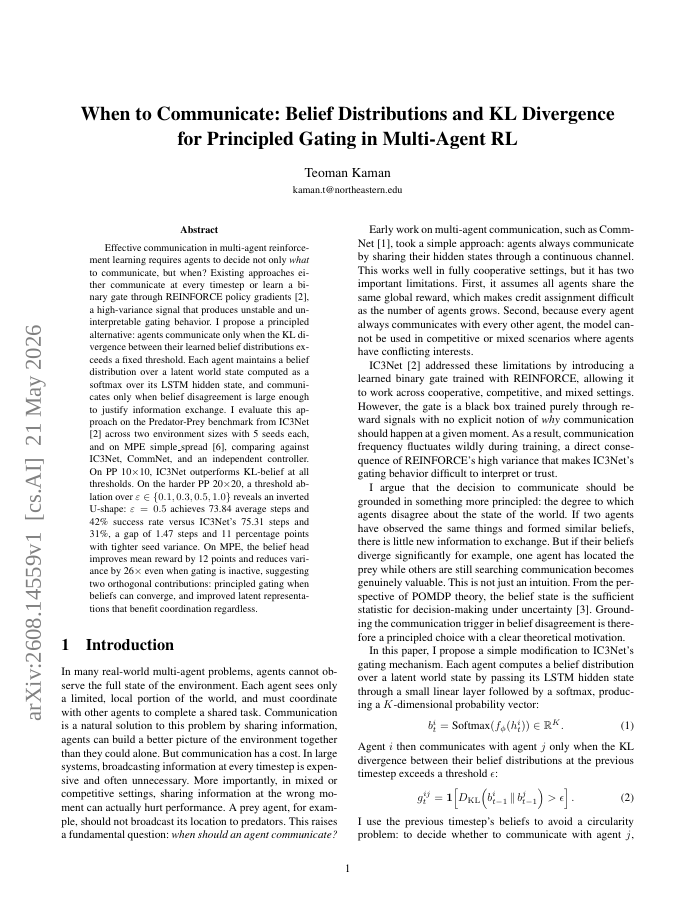
Effective communication in multi-agent reinforcement learning requires agents to decide not only what to communicate, but when? Existing approaches either communicate at every timestep or learn a binary gate through REINFORCE policy gradients \cite{singh2019}, a high-variance signal that produces unstable and uninterpretable gating behavior. I propose a principled alternative: agents communicate only when the KL divergence between their learned belief distributions exceeds a fixed threshold. Each agent maintains a belief distribution over a latent world state computed as a softmax over its LSTM hidden state, and communicates only when belief disagreement is large enough to justify information exchange. I evaluate this approach on the Predator-Prey benchmark from IC3Net \cite{singh2019} across two environment sizes with 5 seeds each, and on MPE simple_spread \cite{lowe2017}, comparing against IC3Net, CommNet, and an independent controller. On PP 10\times10, IC3Net outperforms KL-belief at all thresholds. On the harder PP 20\times20, a threshold ablation over \varepsilon \in {0.1, 0.3, 0.5, 1.0} reveals an inverted U-shape: \varepsilon=0.5 achieves 73.84 average steps and 42% success rate versus IC3Net's 75.31 steps and 31%, a gap of 1.47 steps and 11 percentage points with tighter seed variance. On MPE, the belief head improves mean reward by 12 points and reduces variance by 26\times even when gating is inactive, suggesting two orthogonal contributions: principled gating when beliefs can converge, and improved latent representations that benefit coordination regardless.
When to Communicate: Belief Distributions and KL Divergence for Principled Gating in Multi-Agent RL
Effective communication in multi-agent reinforcement learning requires agents to decide not only \textit{what} to communicate, but when? Existing approaches either communicate at every timestep or learn a binary gate through REINFORCE policy gradients \cite{singh2019}, a…
- Preview
- Year
- 2026
- Hosting
- Full text hostedCC-BY-4.0
Cite
Notes
Only stored in your browser.
Attribution
- Abstract & full text
- arxiv.org/abs/2608.14559CC-BY-4.0
- TL;DR
- Semantic Scholar