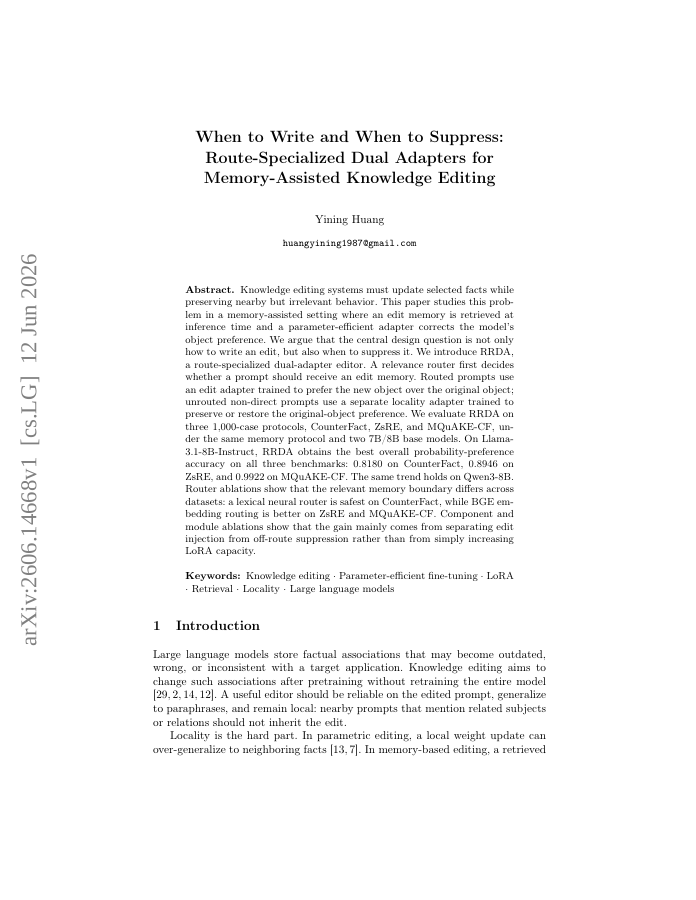
Knowledge editing systems must update selected facts while preserving nearby but irrelevant behavior. This paper studies this problem in a memory-assisted setting where an edit memory is retrieved at inference time and a parameter-efficient adapter corrects the model's object preference. We argue that the central design question is not only how to write an edit, but also when to suppress it. We introduce RRDA, a route-specialized dual-adapter editor. A relevance router first decides whether a prompt should receive an edit memory. Routed prompts use an edit adapter trained to prefer the new object over the original object; unrouted non-direct prompts use a separate locality adapter trained to preserve or restore the original-object preference. We evaluate RRDA on three 1,000-case protocols, CounterFact, ZsRE, and MQuAKE-CF, under the same memory protocol and two 7B/8B base models. On Llama-3.1-8B-Instruct, RRDA obtains the best overall probability-preference accuracy on all three benchmarks: 0.8180 on CounterFact, 0.8946 on ZsRE, and 0.9922 on MQuAKE-CF. The same trend holds on Qwen3-8B. Router ablations show that the relevant memory boundary differs across datasets: a lexical neural router is safest on CounterFact, while BGE embedding routing is better on ZsRE and MQuAKE-CF. Memory, component, and module ablations show that explicit memory supplies the largest edit gain, while route-specialized adapters improve the final reliability-locality balance rather than simply increasing LoRA capacity.
When to Write and When to Suppress: Route-Specialized Dual Adapters for Memory-Assisted Knowledge Editing
Knowledge editing systems must update selected facts while preserving nearby but irrelevant behavior. This paper studies this problem in a memory-assisted setting where an edit memory is retrieved at inference time and a parameter-efficient adapter corrects the model's object…
- Preview
- Year
- 2026
- Hosting
- Full text hostedCC-BY-4.0
Cite
Notes
Only stored in your browser.
Attribution
- Abstract & full text
- arxiv.org/abs/2606.14668CC-BY-4.0
- TL;DR
- Semantic Scholar