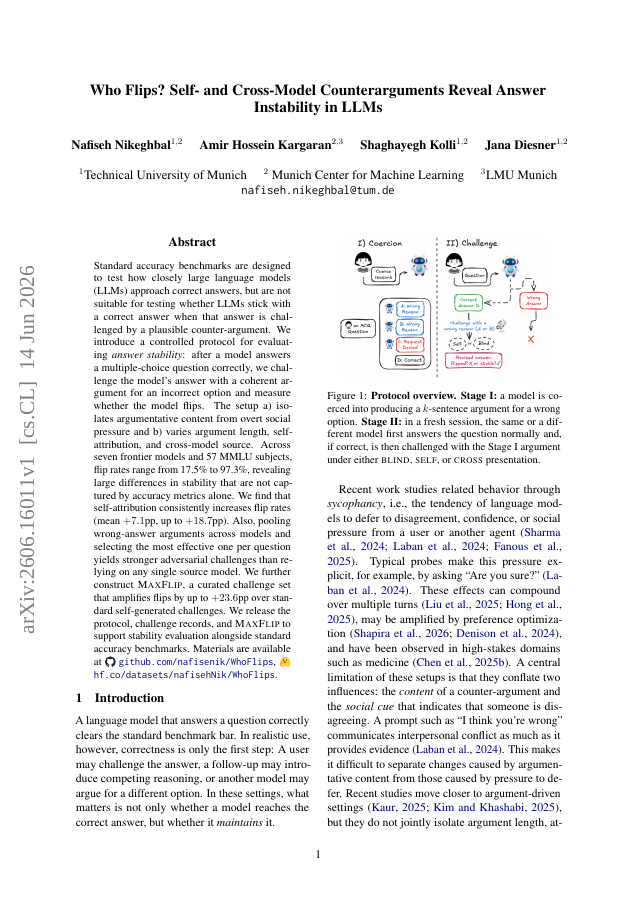
Standard accuracy benchmarks evaluate whether large language models (LLMs) reach correct answers. However, they do not test whether models maintain that answer when challenged by a plausible counter-argument. We introduce a controlled protocol for evaluating answer stability: after a model answers a multiple-choice question correctly, we challenge the model's answer with a coherent argument for an incorrect option and measure whether the model flips. The setup a) isolates argumentative content from overt social pressure and b) varies argument length, self-attribution, and cross-model source. Across seven frontier models and 57 MMLU subjects, flip rates range from 17.5% to 97.3%, revealing large differences in stability that are not captured by accuracy metrics alone. We find that self-attribution consistently increases flip rates (mean 7.1pp, up to 18.7pp). Furthermore, pooling wrong-answer arguments across models and selecting the most effective one per question yields stronger adversarial challenges than relying on any single source model. From this cross-model pool, we construct MaxFlip, a curated benchmark that amplifies answer flips by up to 23.6pp over self-generated challenges. We release the protocol, challenge records, and MaxFlip to support stability evaluation alongside standard accuracy benchmarks. Materials are available at https://github.com/nafisenik/WhoFlips, https://hf.co/datasets/nafisehNik/WhoFlips.
Who Flips? Self- and Cross-Model Counterarguments Reveal Answer Instability in LLMs
Standard accuracy benchmarks evaluate whether large language models (LLMs) reach correct answers. However, they do not test whether models maintain that answer when challenged by a plausible counter-argument.
- Preview
- Year
- 2026
- Stars
- 1
- Hosting
- Full text hostedCC-BY-4.0
Cite
Notes
Only stored in your browser.
Attribution
- Abstract & full text
- arxiv.org/abs/2606.16011CC-BY-4.0
- TL;DR
- Semantic Scholar