8 Sep 2026
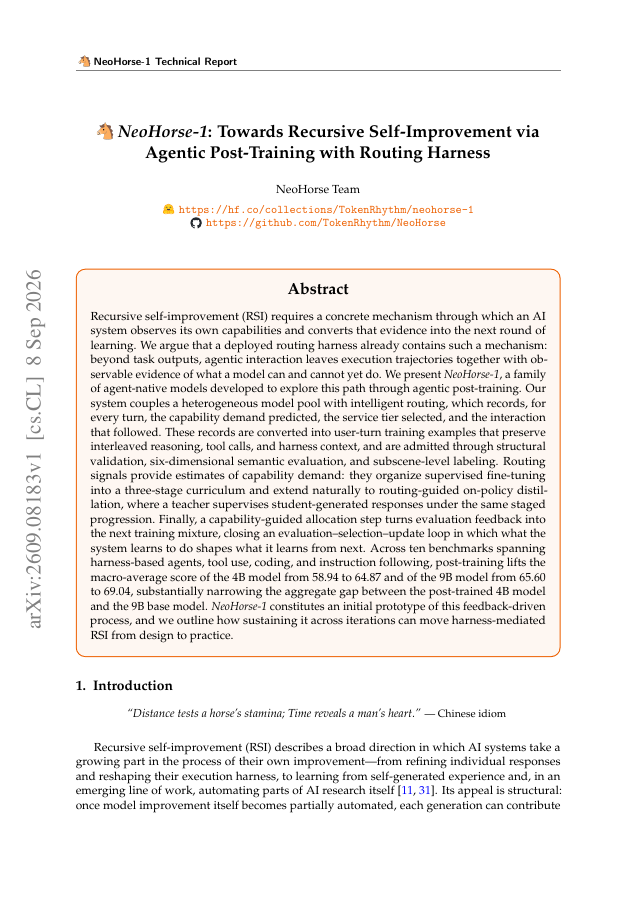
Recursive self-improvement (RSI) requires a concrete mechanism through which an AI system observes its capabilities and converts that evidence into the next round of learning.
Trending research and the full catalog - each paper linked to the benchmarks, methods, and models it introduces.
Filtering here covers the 2,000 most recent papers, as much as one page can hold in memory. See the full index of 22,300 papers.
8 Sep 2026
Recursive self-improvement (RSI) requires a concrete mechanism through which an AI system observes its capabilities and converts that evidence into the next round of learning.
29 Sep 2026
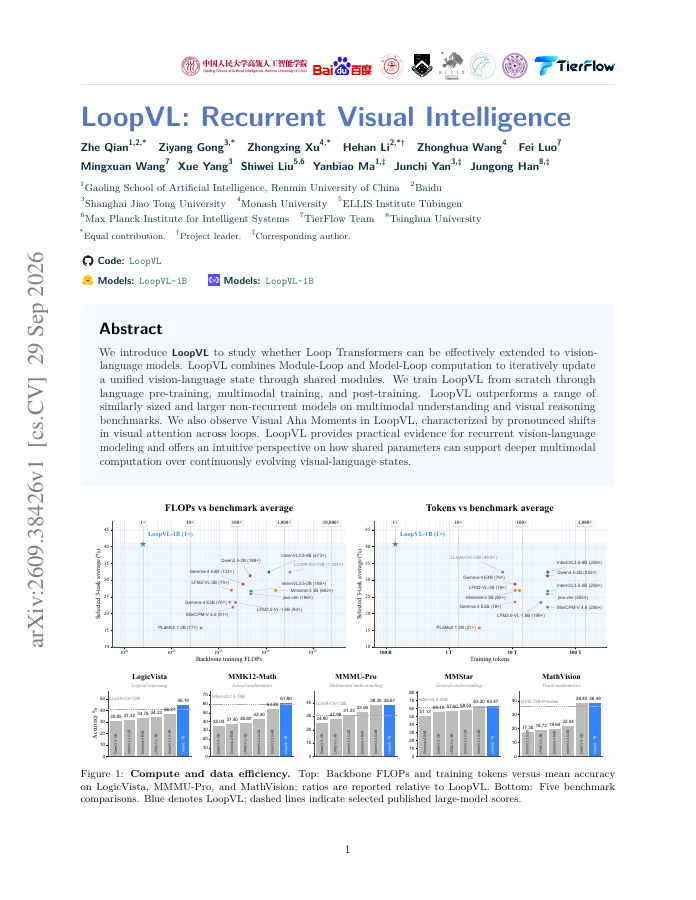
We introduce LoopVL to study whether Loop Transformers can be effectively extended to vision- language models. LoopVL combines Module-Loop and Model-Loop computation to iteratively update a unified vision-language state through shared modules.
26 Sep 2026
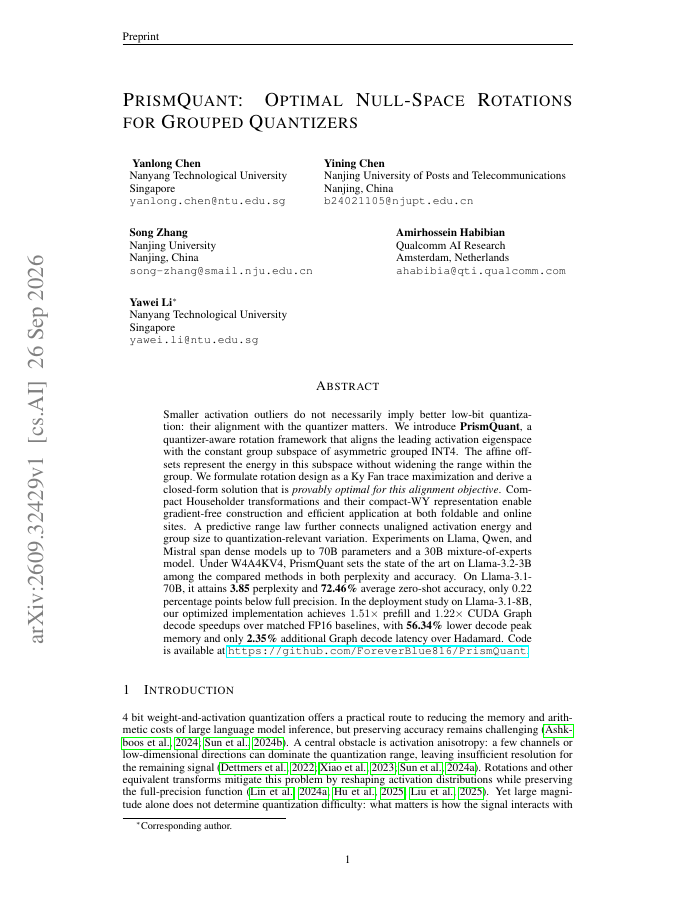
Smaller activation outliers do not necessarily imply better low-bit quantization: their alignment with the quantizer matters. We introduce PrismQuant, a quantizer-aware rotation framework that aligns the leading activation eigenspace with the constant group subspace of…
16 Sep 2026
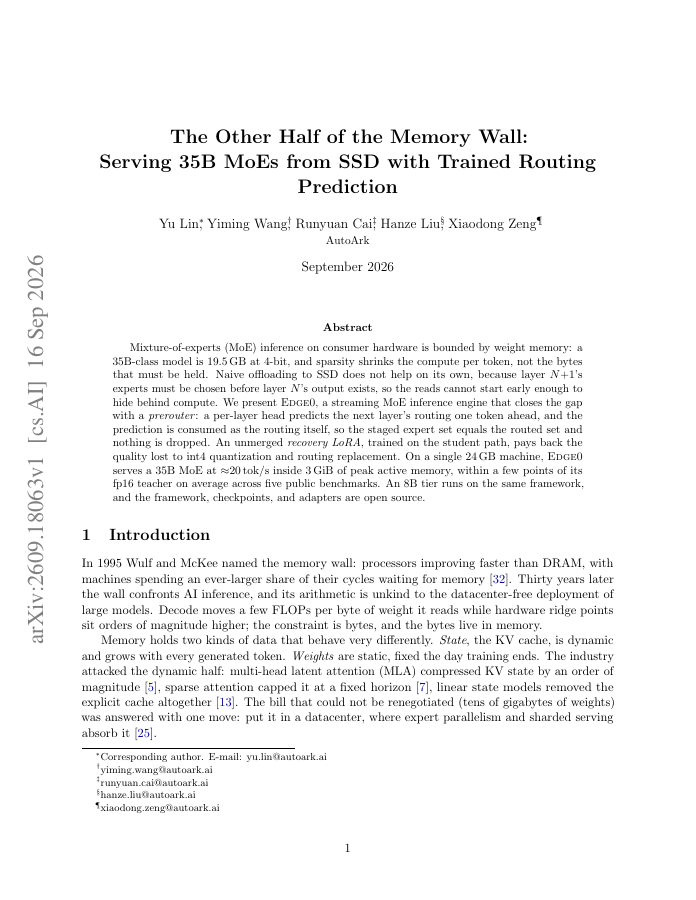
Mixture-of-experts (MoE) inference on consumer hardware is bounded by weight memory: a 35B-class model is 19.5GB at 4-bit, and sparsity shrinks the compute per token, not the bytes that must be held.
14 Sep 2026
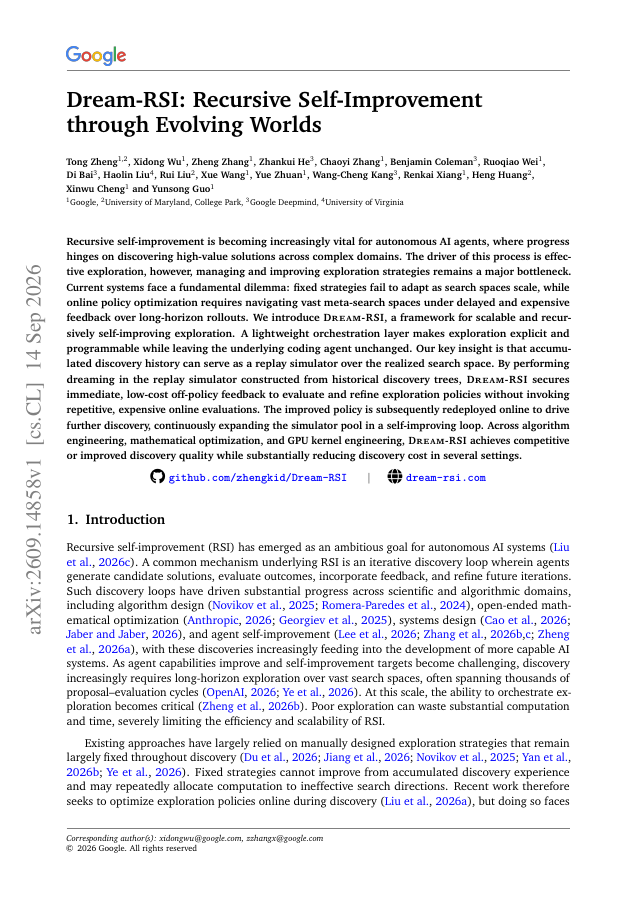
Recursive self-improvement is becoming increasingly vital for autonomous AI agents, where progress hinges on discovering high-value solutions across complex domains. The driver of this process is effective exploration, however, managing and improving exploration strategies…
11 Sep 2026
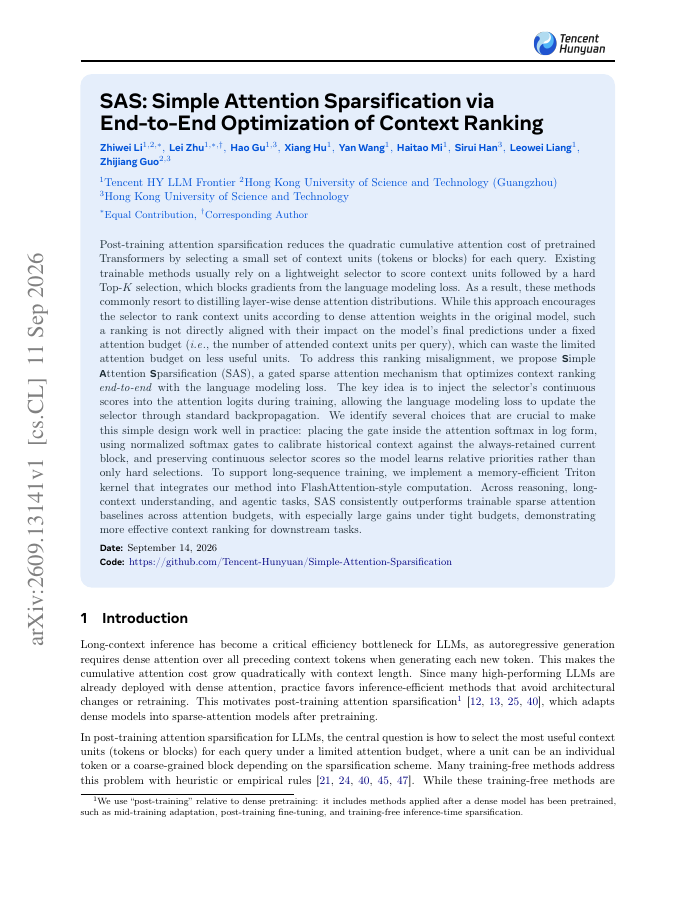
Post-training attention sparsification reduces the quadratic cumulative attention cost of pretrained Transformers by selecting a small set of context units (tokens or blocks) for each query.
11 Sep 2026
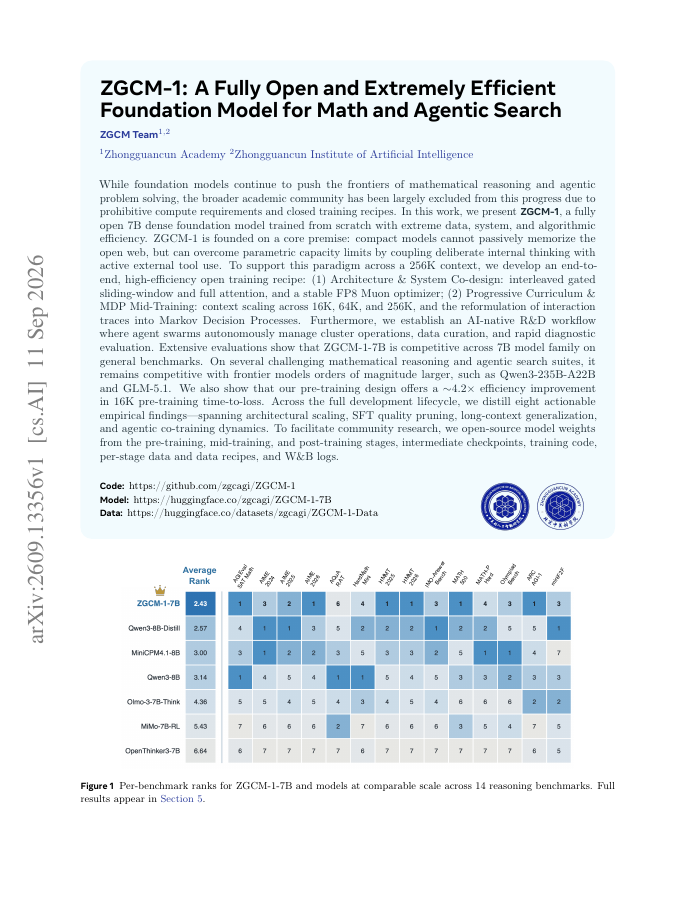
In this work, we present ZGCM-1, a fully open 7B dense foundation model trained from scratch with extreme data, system, and algorithmic efficiency. ZGCM-1 is founded on a core premise: compact models cannot passively memorize the open web, but can overcome parametric capacity…
7 Sep 2026
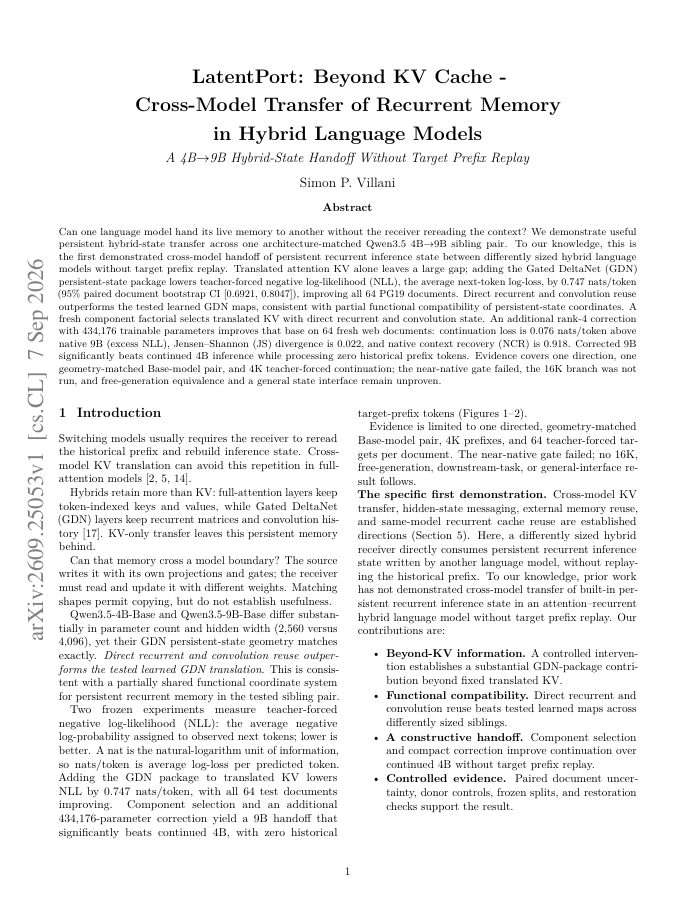
Can one language model hand its live memory to another without the receiver rereading the context? We demonstrate useful persistent hybrid-state transfer across one architecture-matched Qwen3.5 4B-to-9B sibling pair.
17 Sep 2026
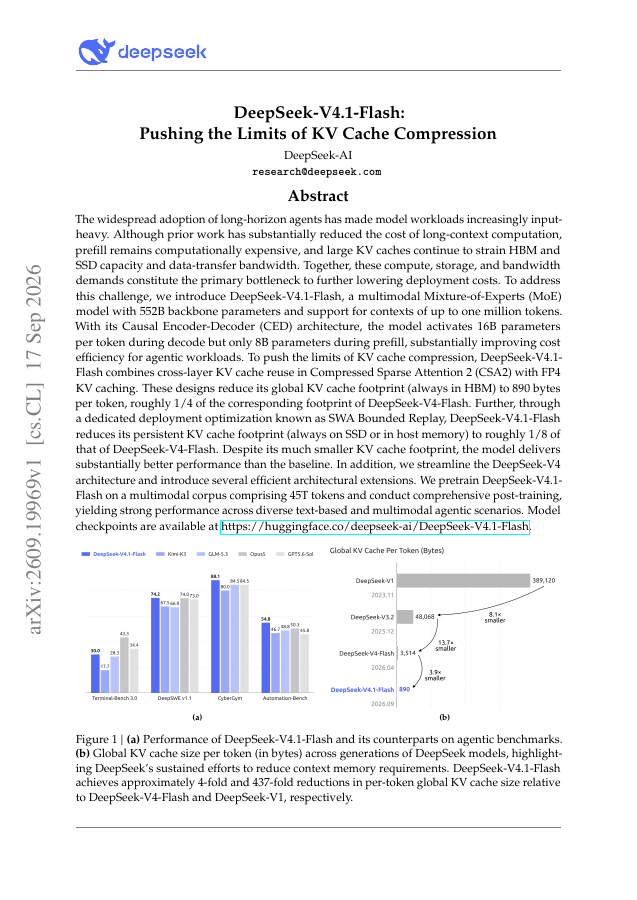
The widespread adoption of long-horizon agents has made model workloads increasingly input-heavy. Although prior work has substantially reduced the cost of long-context computation, prefill remains computationally expensive, and large KV caches continue to strain HBM and SSD…
18 Sep 2026
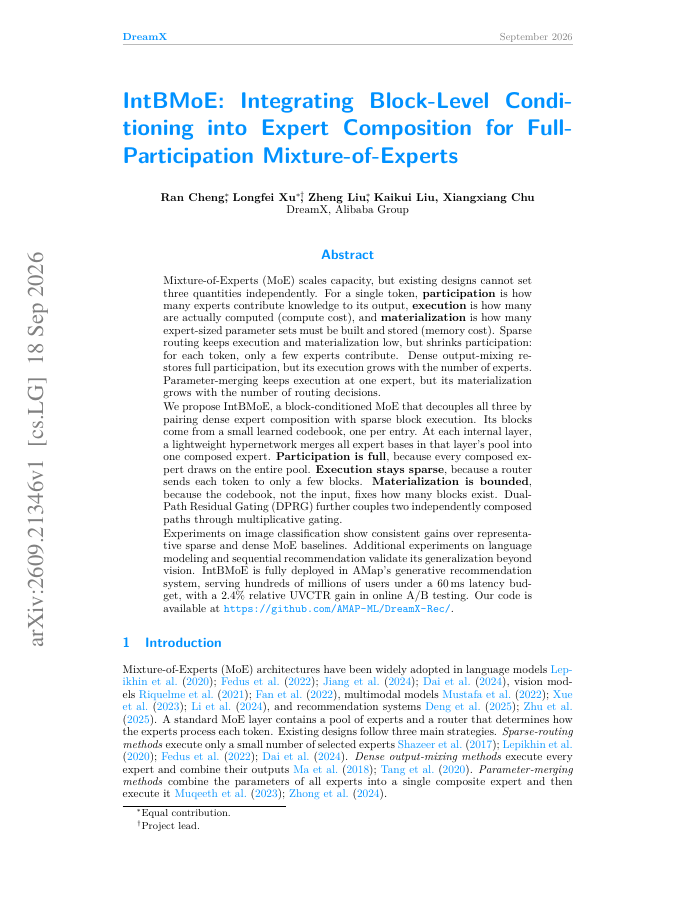
Mixture-of-Experts (MoE) scales capacity, but existing designs cannot set three quantities independently. For a single token, participation is how many experts contribute knowledge to its output, execution is how many are actually computed (compute cost), and materialization is…
29 Sep 2026
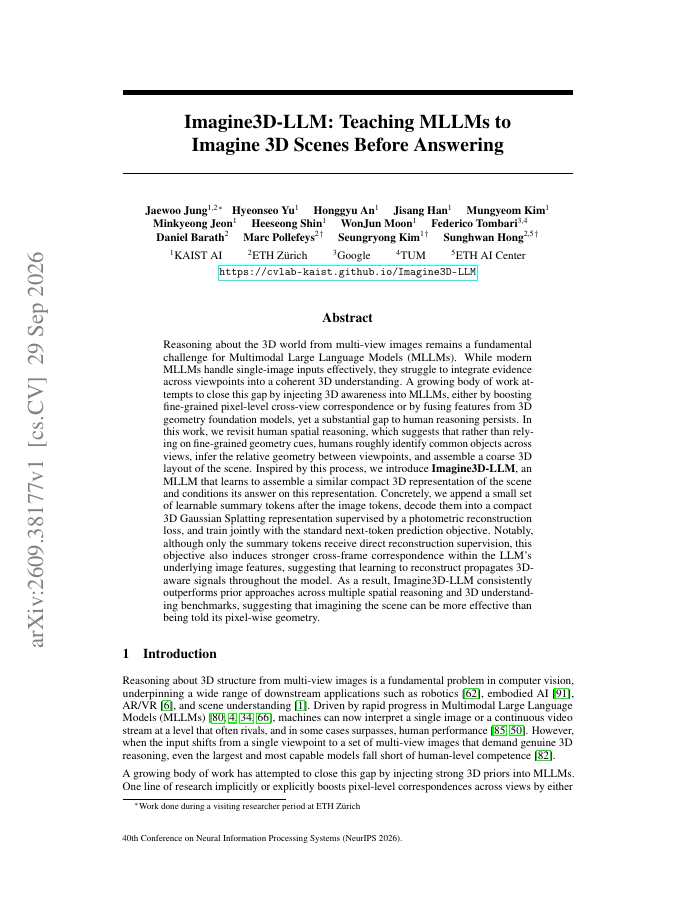
Reasoning about the 3D world from multi-view images remains a fundamental challenge for Multimodal Large Language Models (MLLMs). While modern MLLMs handle single-image inputs effectively, they struggle to integrate evidence across viewpoints into a coherent 3D understanding.