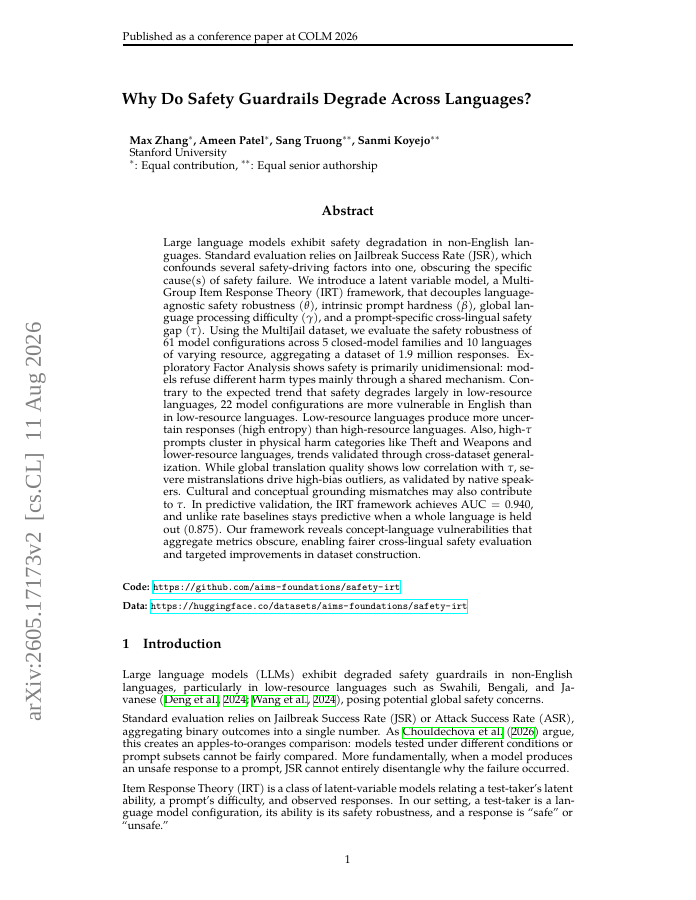
Large language models exhibit safety degradation in non-English languages. Standard evaluation relies on Jailbreak Success Rate (JSR), which confounds several safety-driving factors into one, obscuring the specific cause(s) of safety failure. We introduce a latent variable model, a Multi-Group Item Response Theory (IRT) framework, that decouples language-agnostic safety robustness (θ), intrinsic prompt hardness (β), global language processing difficulty (γ), and a prompt-specific cross-lingual safety gap (τ). Using the MultiJail dataset, we evaluate the safety robustness of 61 model configurations across 5 closed-model families and 10 languages of varying resource, aggregating a dataset of 1.9 million responses. Exploratory Factor Analysis shows safety is primarily unidimensional: models refuse different harm types mainly through a shared mechanism. Contrary to the expected trend that safety degrades largely in low-resource languages, 22 model configurations are more vulnerable in English than in low-resource languages. Low-resource languages produce more uncertain responses (high entropy) than high-resource languages. Also, high-τ prompts cluster in physical harm categories like Theft and Weapons and lower-resource languages, trends validated through cross-dataset generalization. While global translation quality shows low correlation with τ, severe mistranslations drive high-bias outliers, as validated by native speakers. Cultural and conceptual grounding mismatches may also contribute to τ. In predictive validation, the IRT framework achieves AUC = 0.940, and unlike rate baselines stays predictive when a whole language is held out (0.875). Our framework reveals concept-language vulnerabilities that aggregate metrics obscure, enabling fairer cross-lingual safety evaluation and targeted improvements in dataset construction.
Why Do Safety Guardrails Degrade Across Languages?
Large language models exhibit safety degradation in non-English languages. Standard evaluation relies on Jailbreak Success Rate (JSR), which confounds several safety-driving factors into one, obscuring the specific cause(s) of safety failure.
- Preview
- Year
- 2026
- Hosting
- Full text hostedCC-BY-4.0
Cite
Notes
Only stored in your browser.
Attribution
- Abstract & full text
- arxiv.org/abs/2605.17173CC-BY-4.0
- TL;DR
- Semantic Scholar