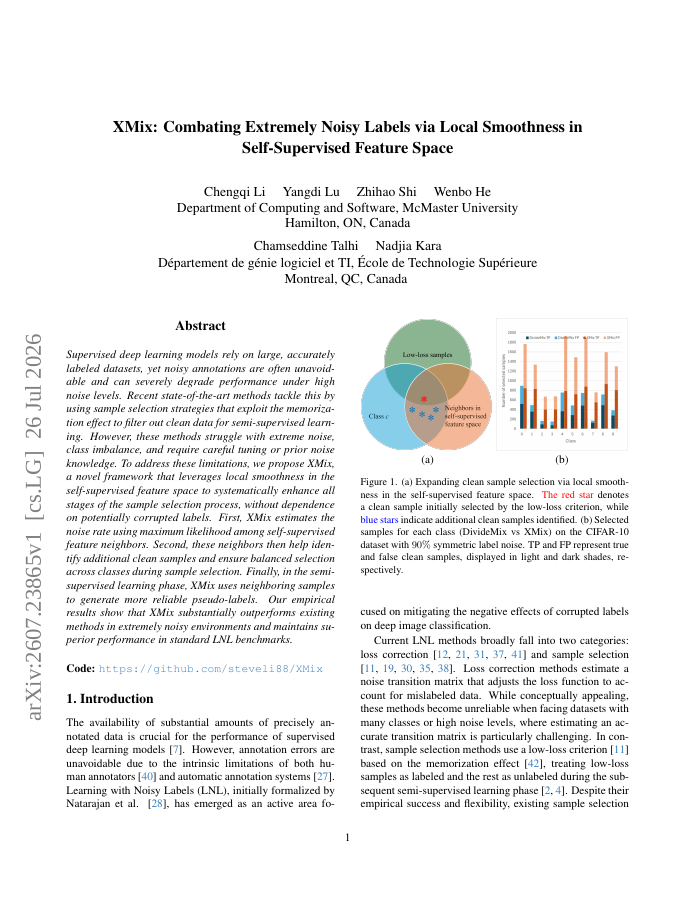
Supervised deep learning models rely on large, accurately labeled datasets, yet noisy annotations are often unavoidable and can severely degrade performance under high noise levels. Recent state-of-the-art methods tackle this by using sample selection strategies that exploit the memorization effect to filter out clean data for semi-supervised learning. However, these methods struggle with extreme noise, class imbalance, and require careful tuning or prior noise knowledge. To address these limitations, we propose XMix, a novel framework that leverages local smoothness in the self-supervised feature space to systematically enhance all stages of the sample selection process, without dependence on potentially corrupted labels. First, XMix estimates the noise rate using maximum likelihood among self-supervised feature neighbors. Second, these neighbors then help identify additional clean samples and ensure balanced selection across classes during sample selection. Finally, in the semi-supervised learning phase, XMix uses neighboring samples to generate more reliable pseudo-labels. Our empirical results show that XMix substantially outperforms existing methods in extremely noisy environments and maintains superior performance in standard LNL benchmarks.
XMix: Combating Extremely Noisy Labels via Local Smoothness in Self-Supervised Feature Space
Supervised deep learning models rely on large, accurately labeled datasets, yet noisy annotations are often unavoidable and can severely degrade performance under high noise levels.
- Preview
- Year
- 2026
- Hosting
- Full text hostedCC-BY-4.0
Cite
Notes
Only stored in your browser.
Attribution
- Abstract & full text
- arxiv.org/abs/2607.23865CC-BY-4.0
- TL;DR
- Semantic Scholar