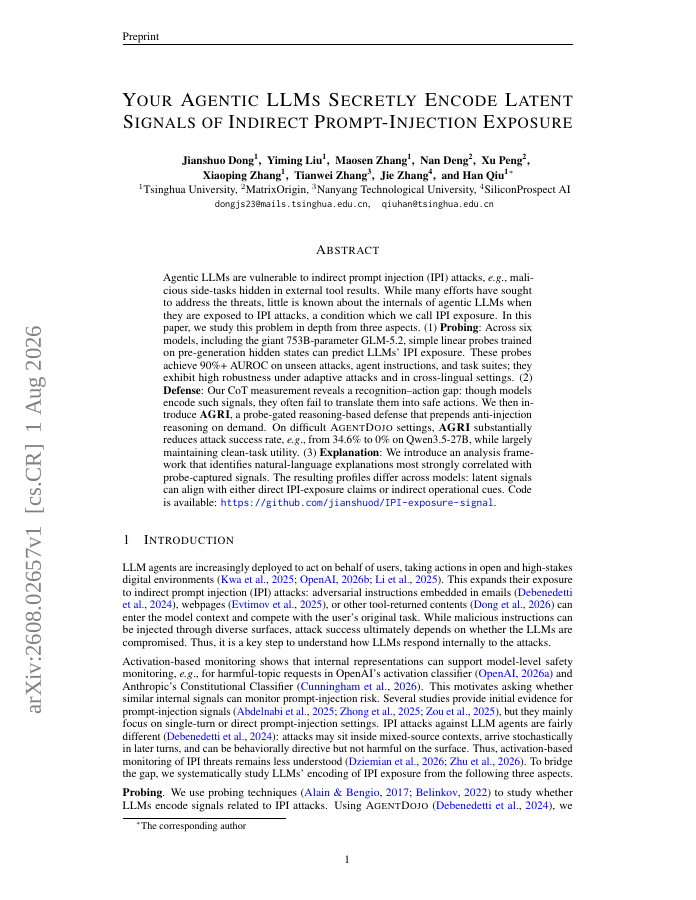
Agentic LLMs are vulnerable to indirect prompt injection (IPI) attacks, e.g., malicious side-tasks hidden in external tool results. While many efforts have sought to address the threats, little is known about the internals of agentic LLMs when they are exposed to IPI attacks, a condition which we call IPI exposure. In this paper, we study this problem in depth from three aspects. (1) Probing: Across six models, including the giant 753B-parameter GLM-5.2, simple linear probes trained on pre-generation hidden states can predict LLMs' IPI exposure. These probes achieve 90%+ AUROC on unseen attacks, agent instructions, and task suites; they exhibit high robustness under adaptive attacks and in cross-lingual settings. (2) Defense: Our CoT measurement reveals a recognition--action gap: though models encode such signals, they often fail to translate them into safe actions. We then introduce AGRI, a probe-gated reasoning-based defense that prepends anti-injection reasoning on demand. On difficult AgentDojo settings, AGRI substantially reduces attack success rate, e.g., from 34.6% to 0% on Qwen3.5-27B, while largely maintaining clean-task utility. (3) Explanation: We introduce an analysis framework that identifies natural-language explanations most strongly correlated with probe-captured signals. The resulting profiles differ across models: latent signals can align with either direct IPI-exposure claims or indirect operational cues. Code is available: https://github.com/jianshuod/IPI-exposure-signal.
Your Agentic LLMs Secretly Encode Latent Signals of Indirect Prompt-Injection Exposure
Agentic LLMs are vulnerable to indirect prompt injection (IPI) attacks, e.g., malicious side-tasks hidden in external tool results. While many efforts have sought to address the threats, little is known about the internals of agentic LLMs when they are exposed to IPI attacks, a…
- Preview
- Year
- 2026
- Hosting
- Full text hostedCC-BY-4.0
Cite
Notes
Only stored in your browser.
Attribution
- Abstract & full text
- arxiv.org/abs/2608.02657CC-BY-4.0
- TL;DR
- Semantic Scholar