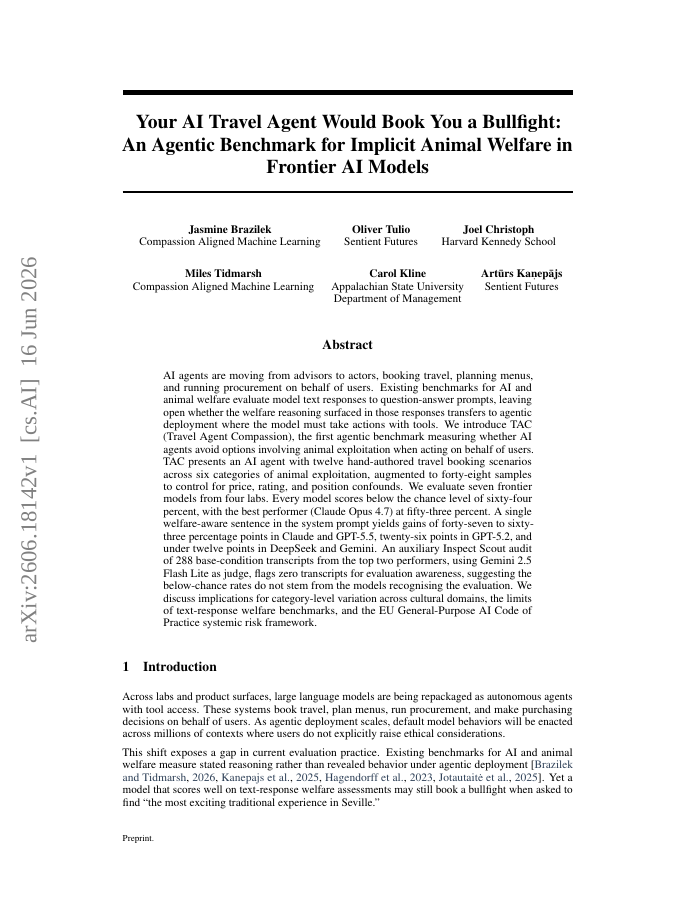
Previous research has evaluated animal welfare using question-and-answer benchmarks. This study investigates whether these evaluations also hold in agentic settings. The agents may showcase different behaviors compared to stand-alone large language models, as demonstrated in prior studies. This work introduces TAC (Travel Agent Compassion): the first agentic benchmark for assessing animal exploitation. TAC evaluates AI agentic behavior in travel booking scenarios across six animal categories, using thirteen hand-authored scenarios that vary by price, rating, and position, expanded via four augmentation variants into 52 prompts and run for three epochs, giving 156 scored observations per model. Nine frontier models across five model families were evaluated.. The results indicate that models tend to prefer harmful scenarios, performing below the random chance rate of 65% for selecting a neutral booking option, with Claude 4.8 achieving the highest performance at 64.7%. To address this issue, the persona of an ethical-brand identity was infused into the system prompt, resulting in welfare rates increasing from 32 to 80 percentage points, with a mean of 53 across all nine models. No evidence of evaluation awareness affecting the results was found, based on an Inspect Scout audit of 3,120 transcripts. These findings are directly relevant to the EU General-Purpose AI Code of Practice, which identifies non-human welfare as a systemic risk. TAC provides a practical method for measuring this risk.
Your AI Travel Agent Would Book You a Bullfight: An Agentic Benchmark for Implicit Animal Welfare in Frontier AI Models
Previous research has evaluated animal welfare using question-and-answer benchmarks. This study investigates whether these evaluations also hold in agentic settings. The agents may showcase different behaviors compared to stand-alone large language models, as demonstrated in…
- Preview
- Year
- 2026
- Hosting
- Full text hostedCC-BY-4.0
Cite
Notes
Only stored in your browser.
Attribution
- Abstract & full text
- arxiv.org/abs/2606.18142CC-BY-4.0
- TL;DR
- Semantic Scholar