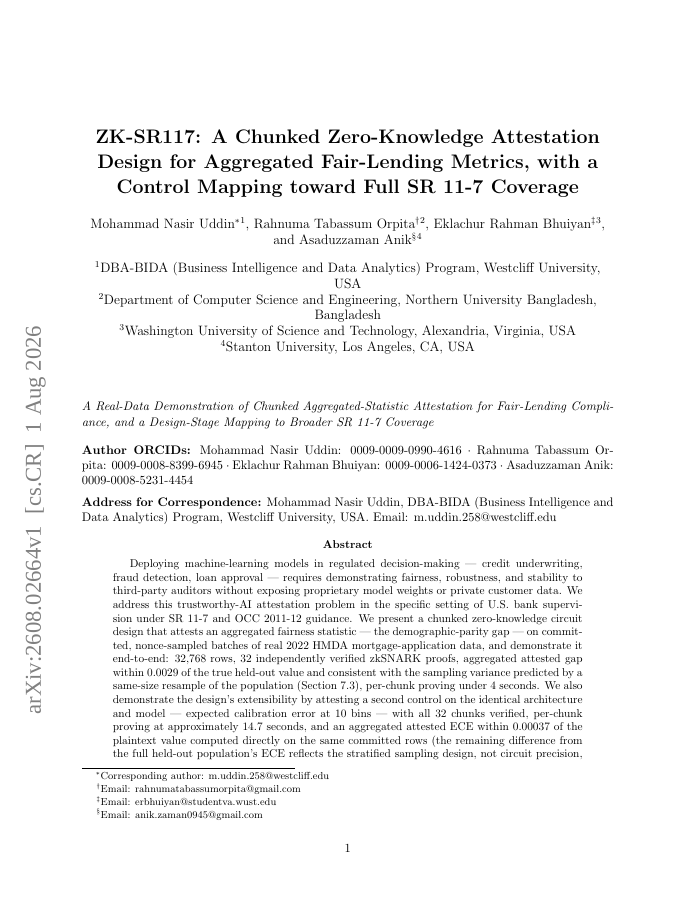
Deploying ML models in regulated decision-making (credit underwriting, fraud detection, loan approval) requires demonstrating fairness and robustness to auditors without exposing model weights or customer data. We address this attestation problem for U.S. bank supervision under SR 11-7 and OCC 2011-12 guidance. We present a chunked zero-knowledge circuit design that attests an aggregated fairness statistic - the demographic-parity gap - on committed, nonce-sampled batches of real 2022 HMDA mortgage data, and demonstrate it end-to-end: 32,768 rows, 32 independently verified zkSNARK proofs, aggregated attested gap within 0.0029 of the true held-out value, per-chunk proving under 4 seconds. We also demonstrate extensibility by attesting a second control on the identical architecture - expected calibration error at 10 bins - with all 32 chunks verified, per-chunk proving at about 14.7 seconds, and attested ECE within 0.00037 of the plaintext value on the same committed rows. We compare this design against two alternatives - a flat summation circuit, which overflows past a few thousand rows, and a tree-reduction circuit, numerically exact but intractable to compile - and find the chunked design is the only one that reached this scale. We discovered and root-caused a genuine data-quality failure (a sentinel-code outlier distorting circuit proving and the fairness statistic itself) and resolved it with a published preprocessing specification. We also propose a fuller mapping from SR 11-7 and OCC 2011-12 control language to zero-knowledge statements (nine control elements spanning soundness, calibration, robustness, and drift), a nonce-based sampling protocol resisting bank-side cherry-picking, and a threat model for deployment, proposed as design work, not implemented results. Two controls, one model class, one task are demonstrated end-to-end; the rest is scoped and left as future work.
ZK-SR117: A Chunked Zero-Knowledge Attestation Design for Aggregated Fair-Lending Metrics, with a Control Mapping toward Full SR 11-7 Coverage
Deploying ML models in regulated decision-making (credit underwriting, fraud detection, loan approval) requires demonstrating fairness and robustness to auditors without exposing model weights or customer data. We address this attestation problem for U.S.
- Preview
- Year
- 2026
- Hosting
- Abstract onlyARXIV-DEFAULT
Cite
Notes
Only stored in your browser.
Attribution
- Abstract & full text
- arxiv.org/abs/2608.02664ARXIV-DEFAULT
- TL;DR
- Semantic Scholar