10 Jun 2026
Decoding-time truthfulness methods -- layer-contrast decoding, inference-time intervention, and learned logit adapters -- have demonstrated 10-30 point gains on TruthfulQA when applied to base language models.
Trending research and the full catalog - each paper linked to the benchmarks, methods, and models it introduces.
Filtering here covers the 2,000 most recent papers, as much as one page can hold in memory. See the full index of 22,502 papers.
10 Jun 2026
Decoding-time truthfulness methods -- layer-contrast decoding, inference-time intervention, and learned logit adapters -- have demonstrated 10-30 point gains on TruthfulQA when applied to base language models.
10 Jun 2026
The performance of machine learning and deep learning models largely depends on the quality of the training data. However, the quality of the real-world datasets is often compromised by noisy labels, which can substantially degrade model accuracy and reliability.
10 Jun 2026
Enterprise security was built to govern data boundaries: the protected surface was data at rest and in transit, and the controls -- access control, data-loss prevention, perimeter inspection -- governed crossings of that boundary. Production AI agents dissolve this assumption.
10 Jun 2026
We propose that value -- the quantity goal-directed agents create, destroy, and exchange -- is a lawful structural quantity in the same category as information. Following Shannon's method, we make one ruthless abstraction: value is the rate at which an agent converts a resource…
10 Jun 2026
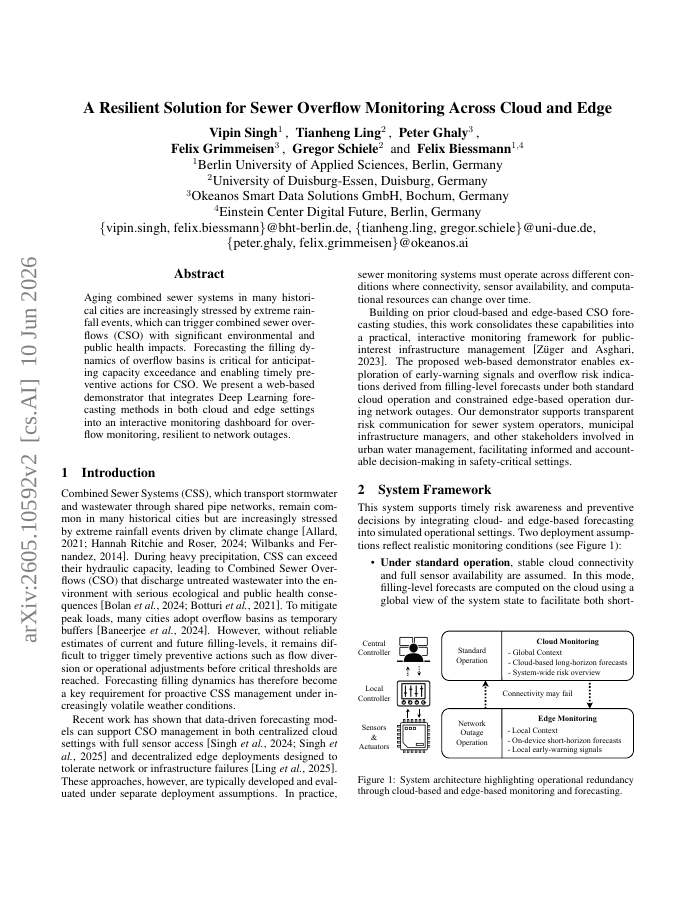
Aging combined sewer systems in many historical cities are increasingly stressed by extreme rainfall events, which can trigger combined sewer overflows (CSO) with significant environmental and public health impacts.
10 Jun 2026
Enthymemes, arguments with unstated premises or conclusions, are pervasive in persuasive discourse, yet their annotation remains notoriously subjective. We present a resource of 1,482 tweets from politically controversial discourse, annotated by five annotators for the presence…
10 Jun 2026
Low-rank optimal transport (OT) mitigates the quadratic scaling of classical solvers, yet existing approaches rely heavily on first-order mirror-descent updates that require careful hyperparameter tuning and ignore the optimization landscape's curvature.
10 Jun 2026
Diffusion models provide expressive data-driven priors for Bayesian inverse problems, but many diffusion posterior samplers rely on heuristic guidance approximations that can fail for nonlinear operators and multimodal posteriors.
10 Jun 2026
Learning compatible representations aims to learn feature representations that can be used interchangeably over time whenever a model undergoes updates. In this paper, we demonstrate that stationary representations learned by d-Simplex fixed classifiers imply compatibility as in…
10 Jun 2026
We give a simple, unified, and nearly tight bound for sampling arbitrary logconcave distributions from a warm start using the In-and-Out algorithm along with exponential lifting.
10 Jun 2026
Cross-domain graph anomaly detection (GAD) aims to identify abnormal nodes in unseen target graphs, showing strong potential in real-world applications with heterogeneous graph data.
9 Jun 2026
The Gromov--Wasserstein (GW) distance provides a framework for comparing metric measure spaces, regardless of their underlying structure or geometry. For network-based data, it enables direct comparisons of graphs with different numbers of nodes, without requiring an embedding…
9 Jun 2026
Large language models generate code from natural language prompts, enabling "vibe coding," which allows non-programmers to develop computational solutions. Vibe coding for teachers amplifies the value of teachers-as-designers, improving technology integration while…
9 Jun 2026
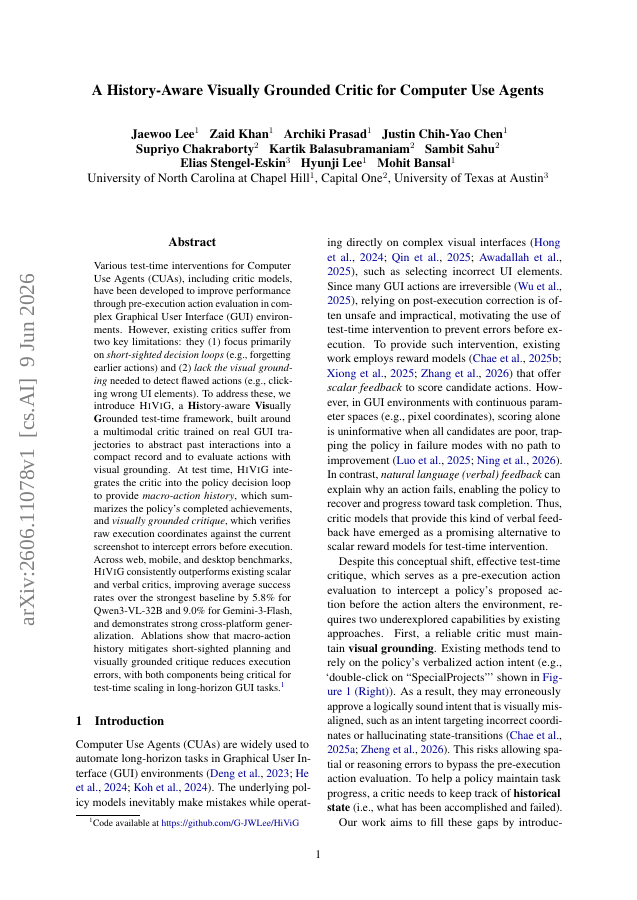
Various test-time interventions for Computer Use Agents (CUAs), including critic models, have been developed to improve performance through pre-execution action evaluation in complex Graphical User Interface (GUI) environments.
9 Jun 2026
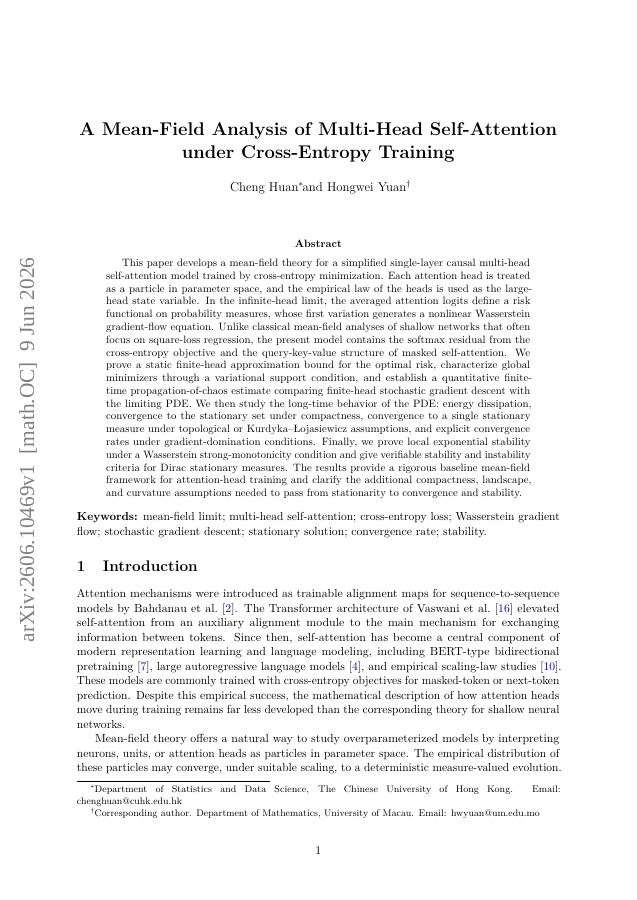
This paper develops a mean-field theory for a simplified single-layer causal multi-head self-attention model trained by cross-entropy minimization. Each attention head is treated as a particle in parameter space, and the empirical law of the heads is used as the large-head state…
9 Jun 2026
Data leakage -- contamination of a model with information unavailable at baseline -- is the dominant reproducibility failure in machine-learning-based science, yet detection tools require training code, external data, or domain expertise.
9 Jun 2026
Structured abstracts are important for biomedical literature processing, by facilitating information retrieval, text mining, and knowledge synthesis. However, a vast portion of abstracts indexed in PubMed remain unstructured, presenting a significant bottleneck for downstream…
9 Jun 2026
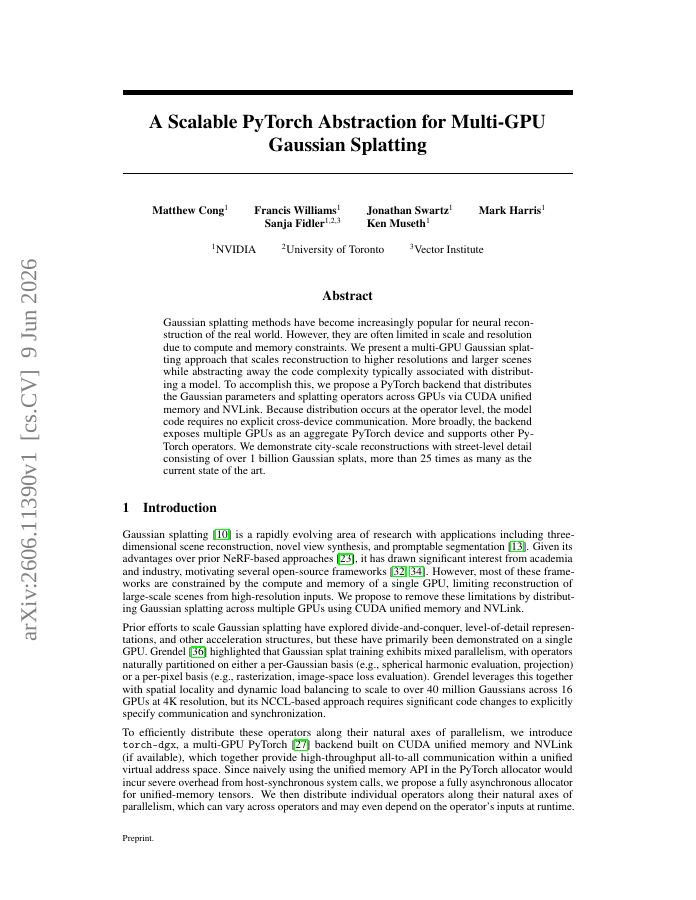
Gaussian splatting methods have become increasingly popular for neural reconstruction of the real world. However, they are often limited in scale and resolution due to compute and memory constraints.
9 Jun 2026
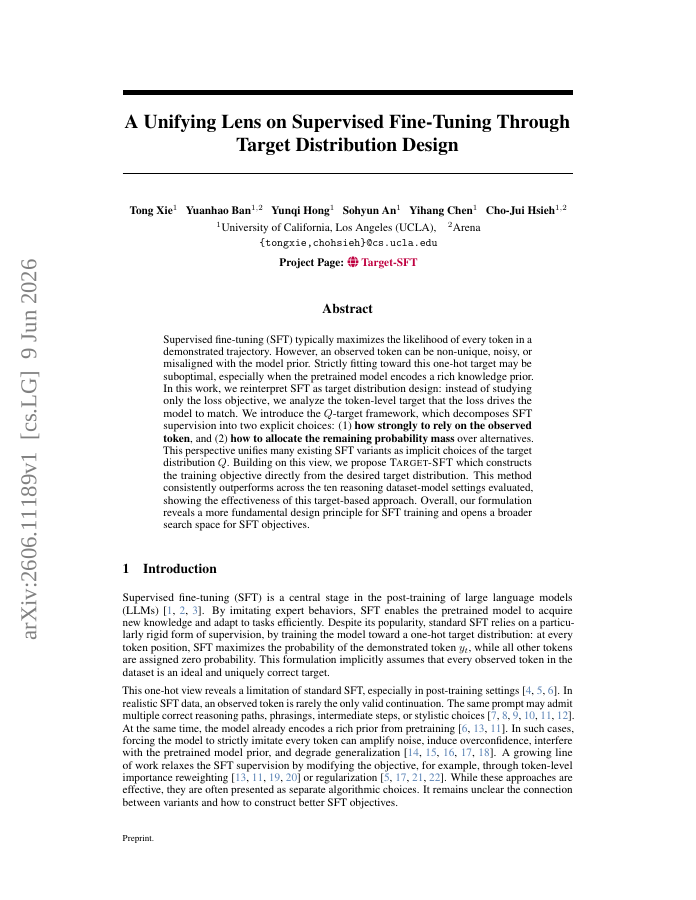
Supervised fine-tuning (SFT) typically maximizes the likelihood of every token in a demonstrated trajectory. However, an observed token can be non-unique, noisy, or misaligned with the model prior.
9 Jun 2026
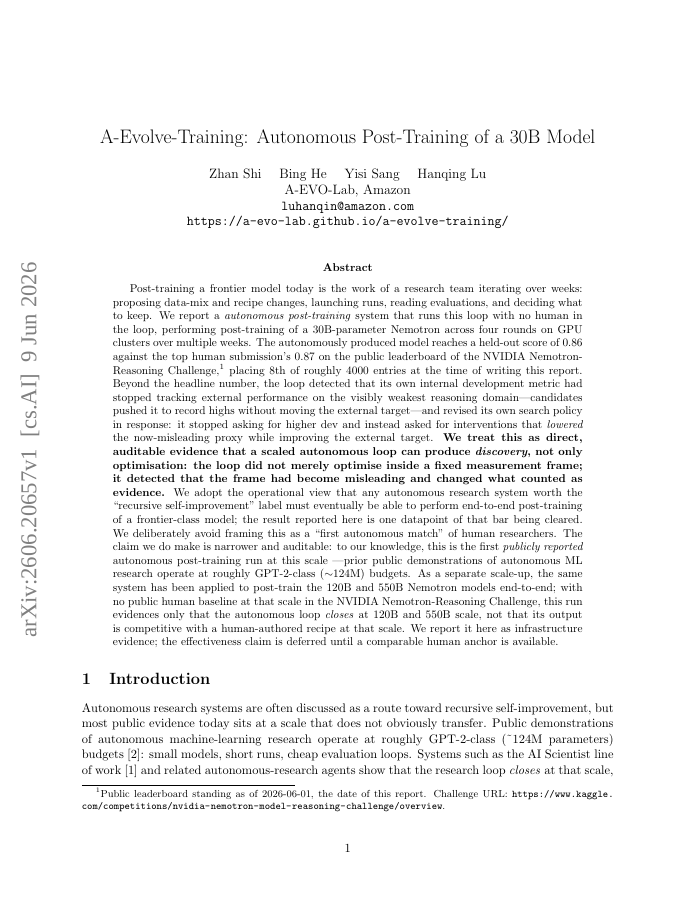
Post-training a frontier model is normally weeks of human work: proposing data and recipe changes, launching runs, reading evals, deciding what to keep. We report an autonomous system that runs this loop with no human in the loop, post-training a 30B Nemotron across four rounds…
8 Jun 2026
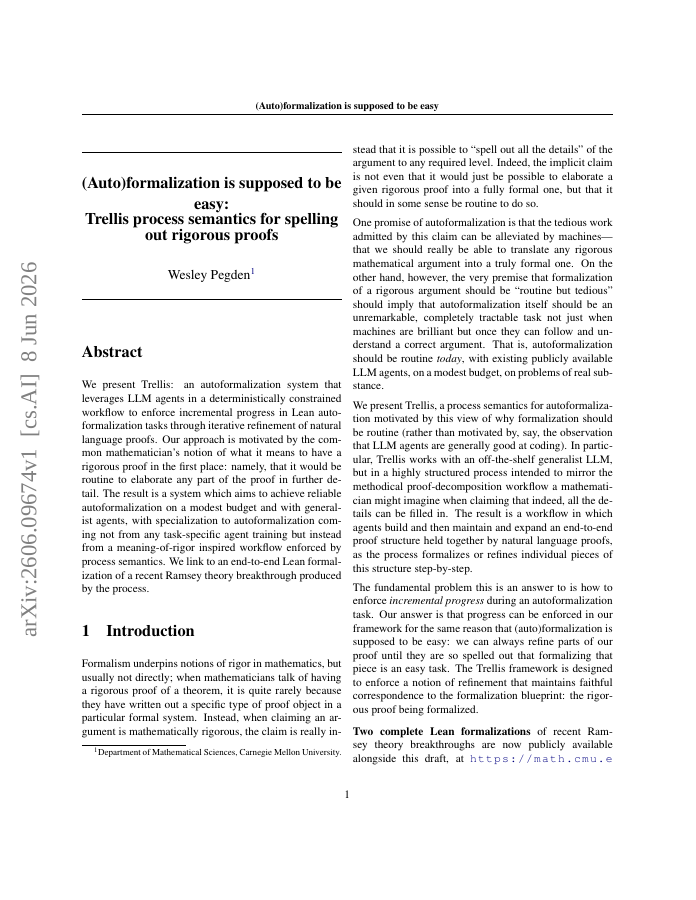
We present Trellis: an autoformalization system that leverages LLM agents in a deterministically constrained workflow to enforce incremental progress in Lean autoformalization tasks through iterative refinement of natural language proofs.
8 Jun 2026
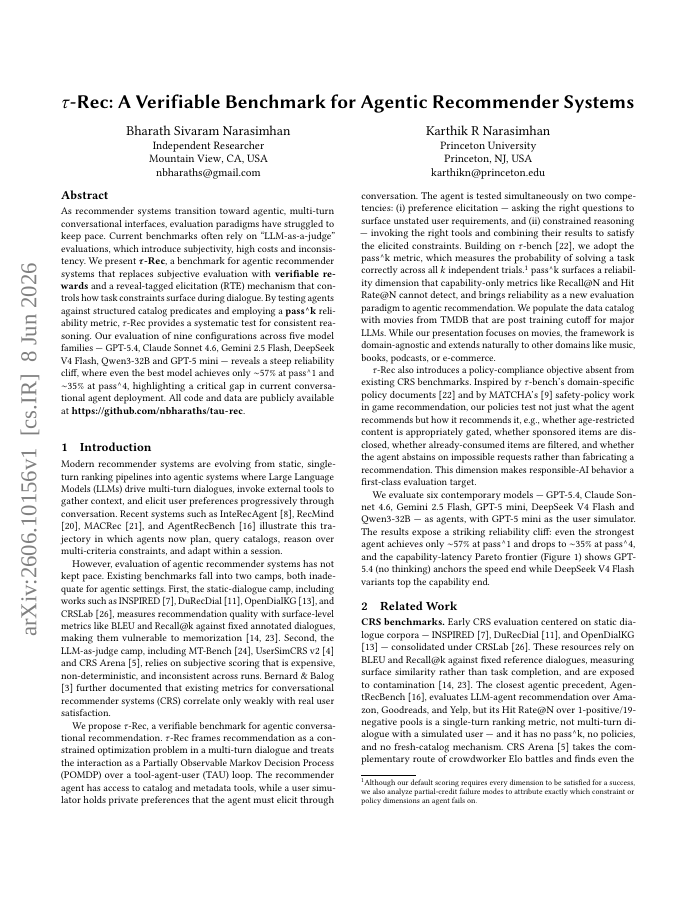
As recommender systems transition toward agentic, multi-turn conversational interfaces, evaluation paradigms have struggled to keep pace. Current benchmarks often rely on "LLM-as-a-judge" evaluations, which introduce subjectivity, high costs and inconsistency.
8 Jun 2026
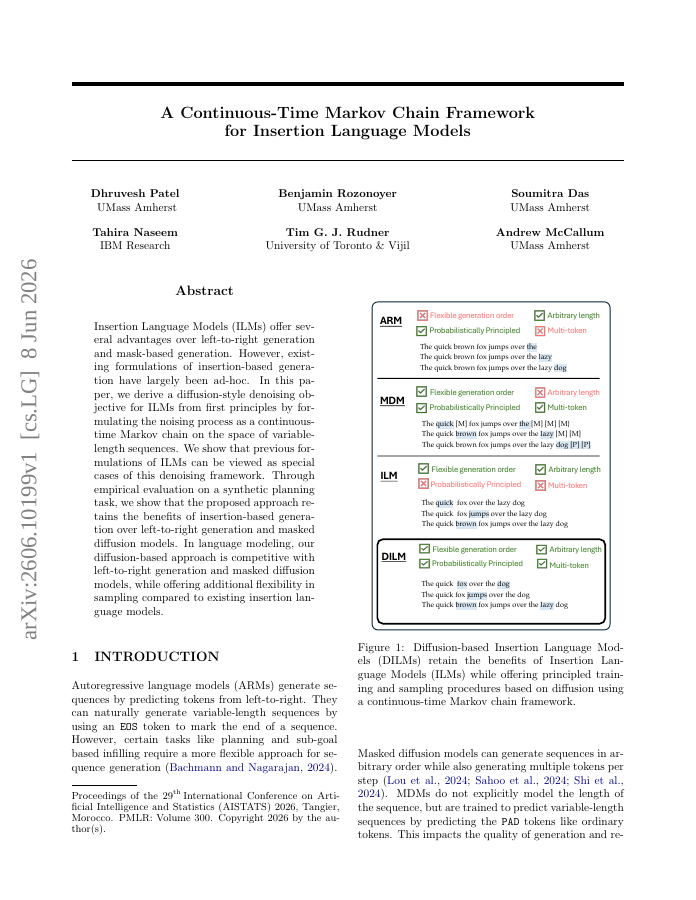
Insertion Language Models (ILMs) offer several advantages over left-to-right generation and mask-based generation. However, existing formulations of insertion-based generation have largely been ad-hoc.
8 Jun 2026
Automated L2 speech assessment can assign proficiency labels, but often lacks interpretability. We propose a rubric-guided SpeechLLM for multi-aspect, multi-granular assessment, trained with a hybrid objective combining supervised fine-tuning and Bounded Direct Preference…