25 Sep 2026
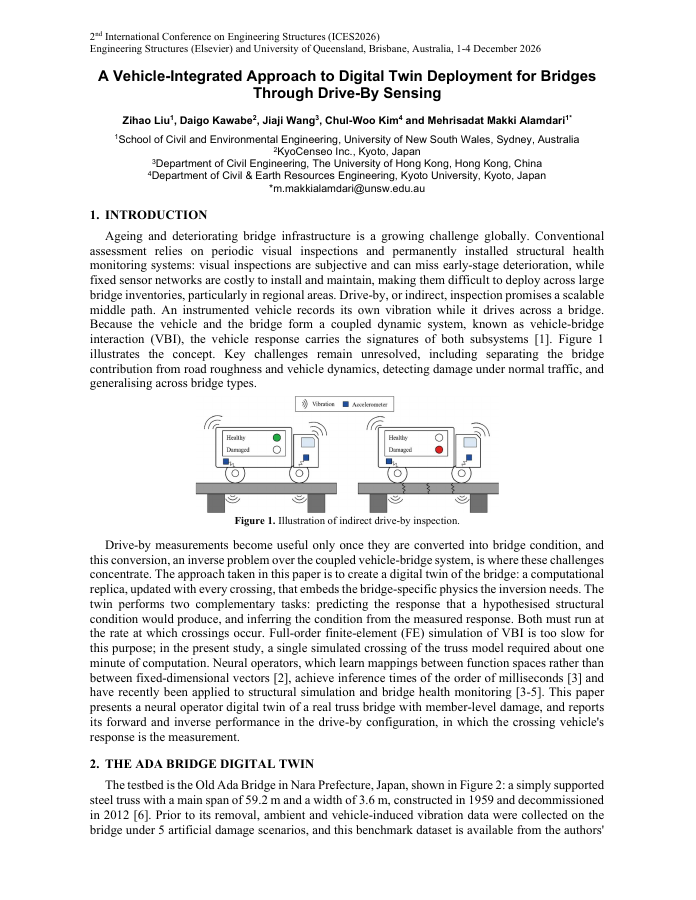
Ageing bridge infrastructure is a growing global concern, yet conventional Structural Health Monitoring (SHM) systems are costly and difficult to scale, and routine visual inspections remain subjective.
Trending research and the full catalog - each paper linked to the benchmarks, methods, and models it introduces.
Filtering here covers the 2,000 most recent papers, as much as one page can hold in memory. See the full index of 22,778 papers.
25 Sep 2026
Ageing bridge infrastructure is a growing global concern, yet conventional Structural Health Monitoring (SHM) systems are costly and difficult to scale, and routine visual inspections remain subjective.
24 Sep 2026
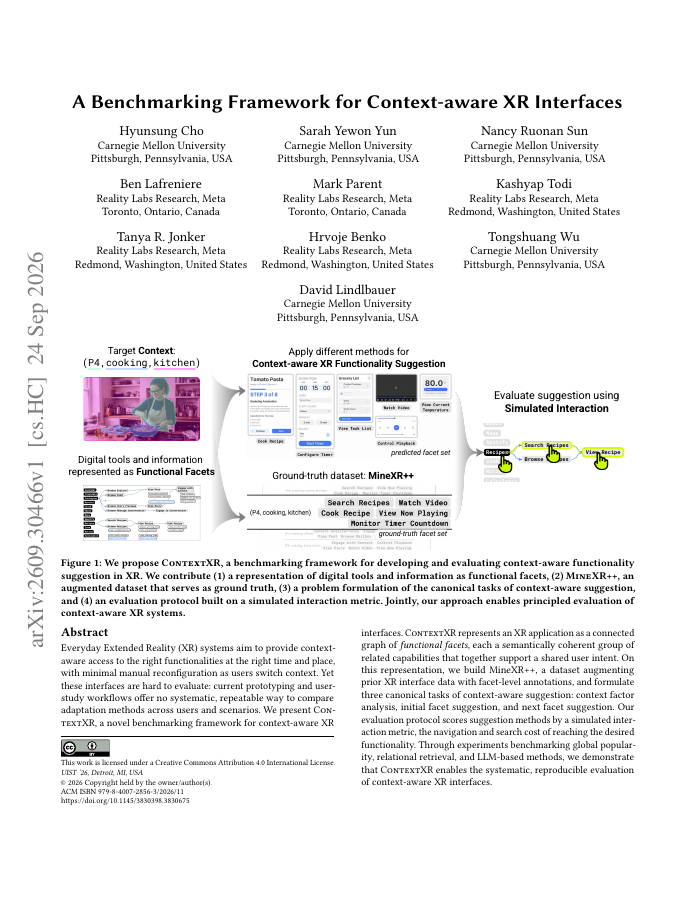
Everyday Extended Reality (XR) systems aim to provide context-aware access to the right functionalities at the right time and place, with minimal manual reconfiguration as users switch context.
24 Sep 2026
Significant research effort has been directed in recent years towards establishing both asymptotic and non-asymptotic convergence guarantees for two-timescale actor--critic algorithms, where the actor recursion is run on a slower timescale than the critic recursion.
24 Sep 2026
Many iterative algorithms rely on bootstrapping. A variable is updated using a second, frozen copy as a target, which is periodically replaced with the updated variable.
24 Sep 2026
On-demand delivery platforms pay riders through incentive activities whose tiers are set from recent completions of riders with a similar history. Operators request such plans for changing periods, rider populations, payment rules and budgets, often for holidays or bad weather,…
24 Sep 2026
Large language model (LLM)-based clinical assistants are increasingly being integrated into electronic health record (EHR) systems, transforming how clinicians retrieve and synthesize information from patient records.
24 Sep 2026
Automatic speaking assessment systems can provide holistic proficiency scores, but often lack interpretable measures that characterize pronunciation quality. We propose a native-reference phone-class geometry for measuring second language (L2) pronunciation deviation without…
24 Sep 2026
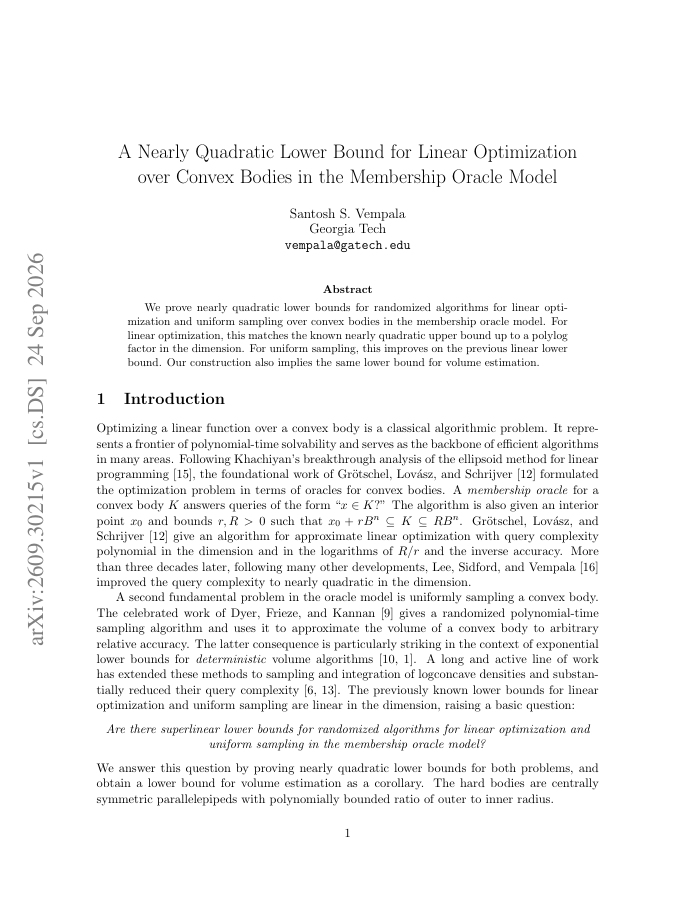
We prove nearly quadratic lower bounds for randomized algorithms for linear optimization and uniform sampling over convex bodies in the membership oracle model. For linear optimization, this matches the known nearly quadratic upper bound up to a polylog factor in the dimension.
24 Sep 2026
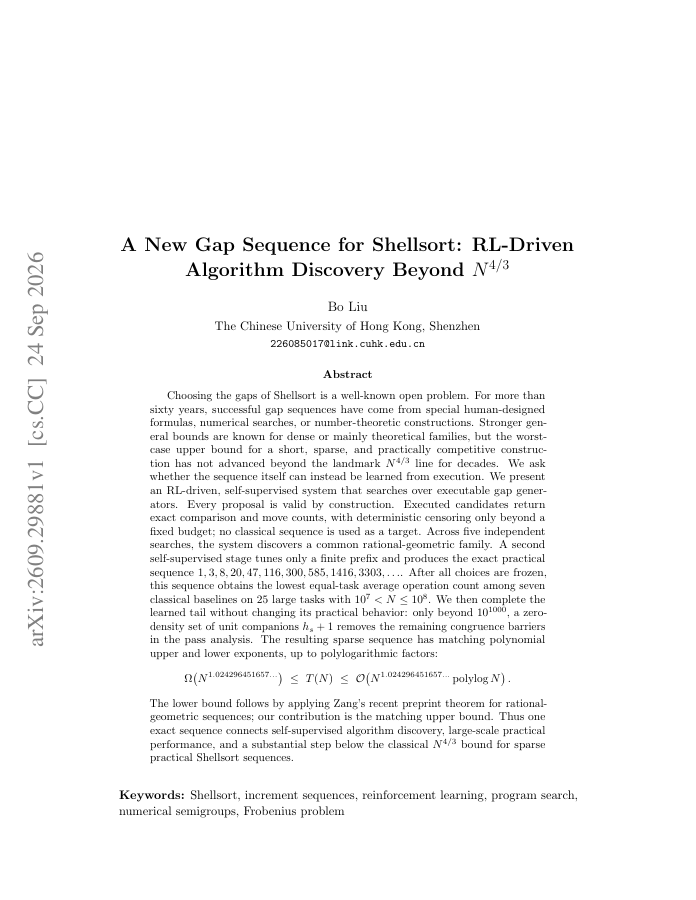
Choosing Shellsort gaps is a well-known open problem. For over sixty years, successful sequences have relied on human-designed formulas, numerical searches, or number-theoretic constructions.
24 Sep 2026
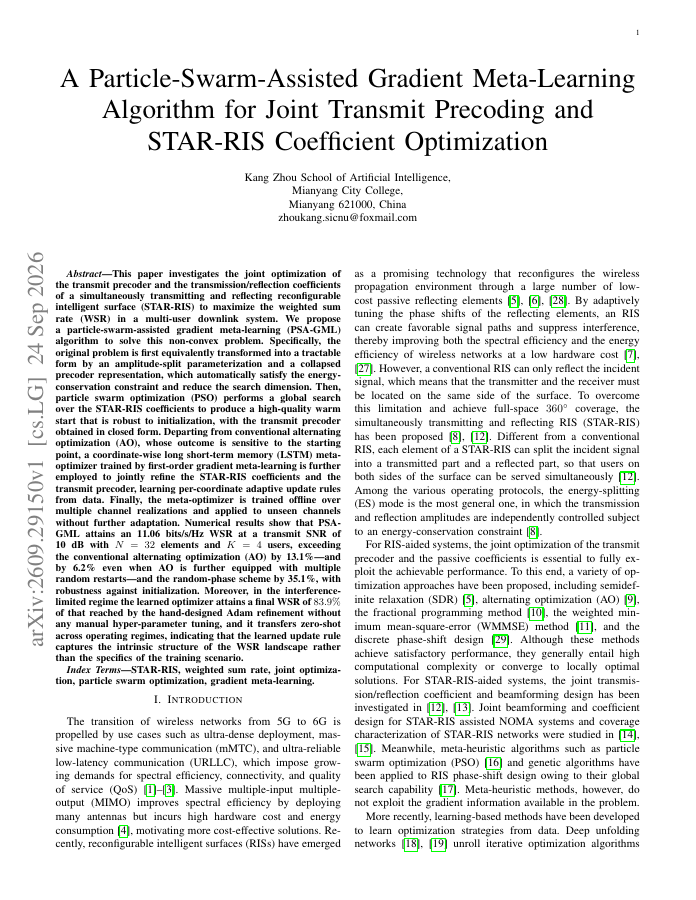
This paper investigates the joint optimization of the transmit precoder and the transmission/reflection coefficients of a simultaneously transmitting and reflecting reconfigurable intelligent surface (STAR-RIS) to maximize the weighted sum rate (WSR) in a multi-user downlink.
24 Sep 2026
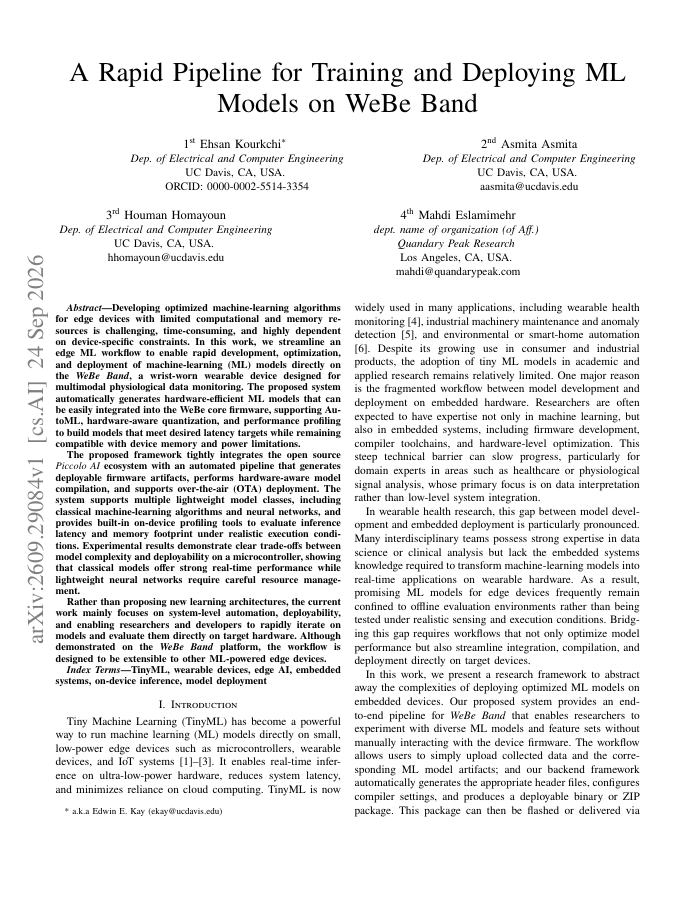
Developing optimized machine-learning algorithms for edge devices with limited computational and memory resources is challenging, time-consuming, and highly dependent on device-specific constraints.
24 Sep 2026
Generative artificial intelligence can turn learning analytics into personalized support, but feedback systems must decide when to intervene, which evidence to use, and how much assistance to provide.
24 Sep 2026
Evaluating explainable Artificial Intelligence (XAI) methods is a challenging task due to the lack of reliable evaluation procedures and, in particular, the absence of ground truth explanations.
24 Sep 2026
Automatic speech recognition is typically trained assuming that the reference transcript is the only valid labeling of an utterance, yet even nominally verbatim transcripts contain localized differences in pronunciation, spelling, or lexical realization that the acoustics do not…
24 Sep 2026
Cognitive psychology has studied how people encode, use, and learn concepts that describe categories, and how they represent, recognize, and acquire chunks for familiar patterns of elements.
24 Sep 2026
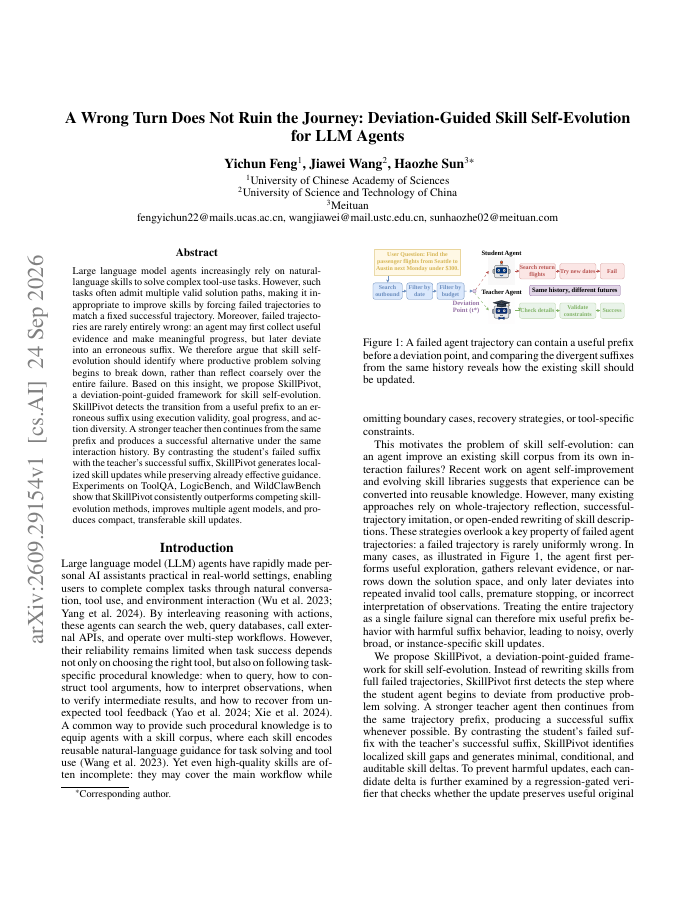
Large language model agents increasingly rely on natural-language skills to solve complex tool-use tasks. However, such tasks often admit multiple valid solution paths, making it inappropriate to improve skills by forcing failed trajectories to match a fixed successful…
23 Sep 2026
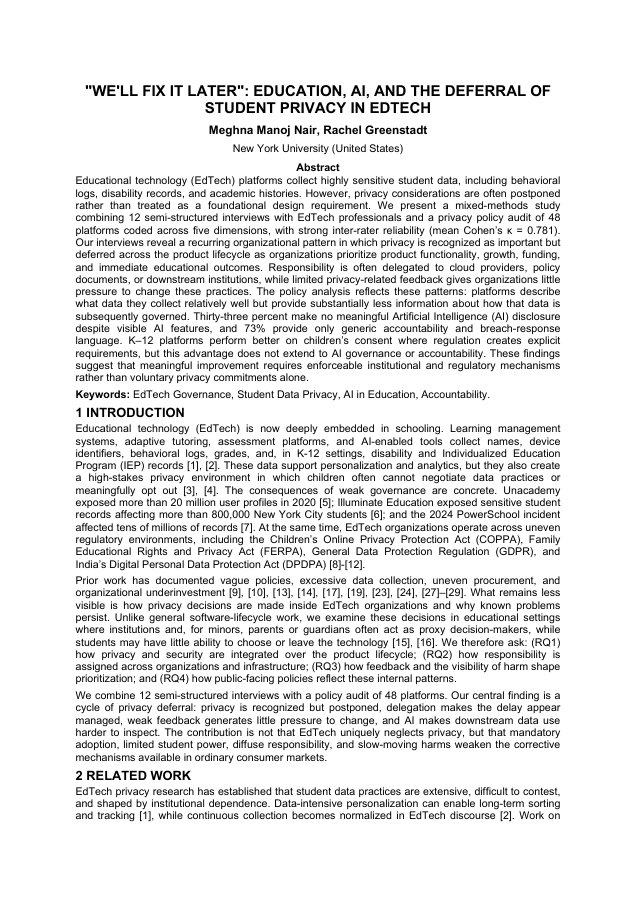
Educational technology (EdTech) platforms collect highly sensitive student data, including behavioral logs, disability records, and academic histories. However, privacy considerations are often postponed rather than treated as a foundational design requirement.
23 Sep 2026
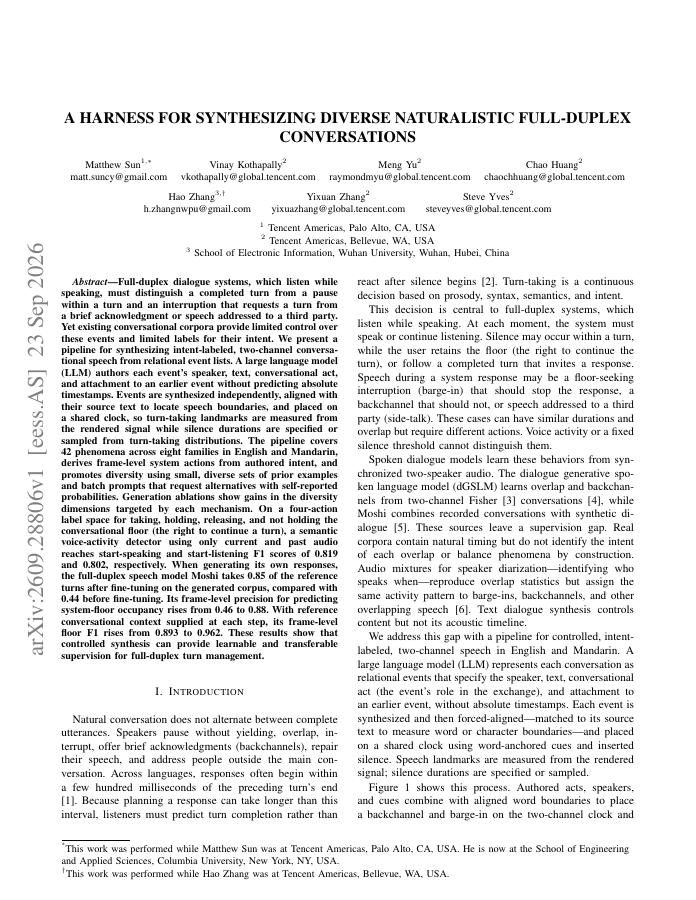
Full-duplex dialogue systems, which listen while speaking, must distinguish a completed turn from a pause within a turn and an interruption that requests a turn from a brief acknowledgment or speech addressed to a third party.
23 Sep 2026
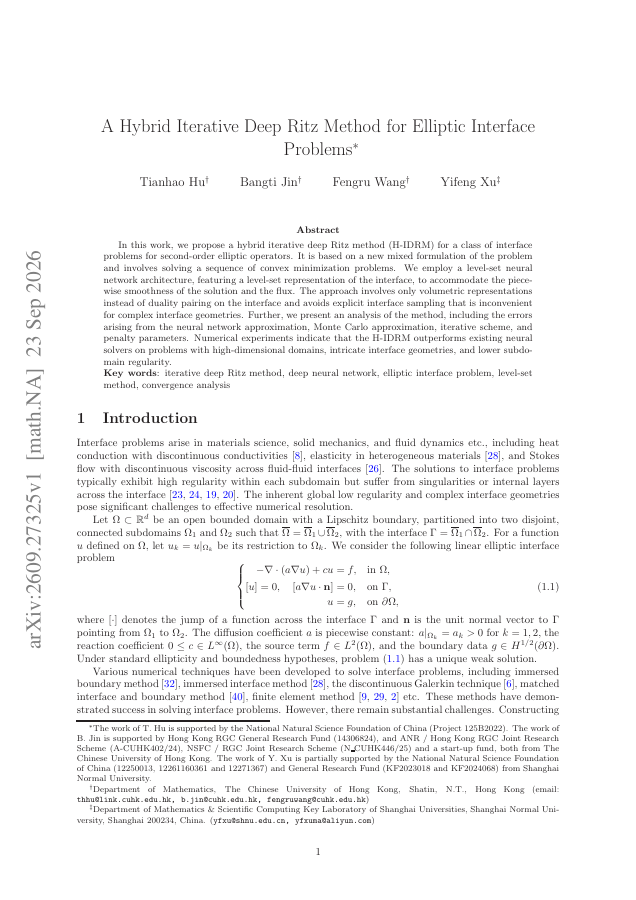
In this work, we propose a hybrid iterative deep Ritz method (H-IDRM) for a class of interface problems for second-order elliptic operators. It is based on a new mixed formulation of the problem and involves solving a sequence of convex minimization problems.
23 Sep 2026
Self-supervised speech models encode rich phonetic information, but it remains unclear how to transform this information into interpretable metrics for second-language (L2) pronunciation assessment in spontaneous speech.
23 Sep 2026
Scaling laws have guided large-model development in computer vision and natural language processing, but the relationships among data, model size, and compute remain unclear for functional magnetic resonance imaging (fMRI) foundation models.
23 Sep 2026
Sequential RecSys are central to modern personalization, exploiting user's historical interaction sequences to drive next-step decisions. Deep learning models, particularly CNN and Transformer-based architectures, have proven highly effective at capturing temporal dependencies…
22 Sep 2026
Cricket is one of the most celebrated sports world-wide, and technological advancement has become deeply embedded in how the modern game is analyzed and coached. Cricket shot classification and automated performance analysis add a further dimension to this trend.
22 Sep 2026
LLM-based user simulators aim to bridge the offline-online gap in recommender evaluation by emulating users through injected traits, where preference attributes determine what a user engages with and a behavioral activity trait governs how long they browse.