21 Oct 2026
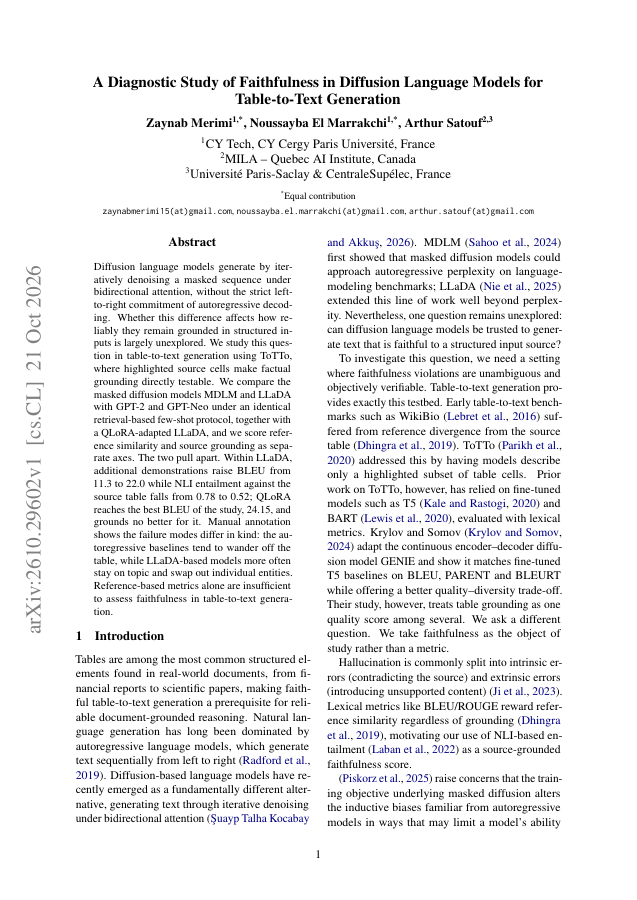
Diffusion language models generate by iteratively denoising a masked sequence under bidirectional attention, without the strict left-to-right commitment of autoregressive decoding.
Trending research and the full catalog - each paper linked to the benchmarks, methods, and models it introduces.
Filtering here covers the 2,000 most recent papers, as much as one page can hold in memory. See the full index of 22,642 papers.
21 Oct 2026
Diffusion language models generate by iteratively denoising a masked sequence under bidirectional attention, without the strict left-to-right commitment of autoregressive decoding.
21 Oct 2026
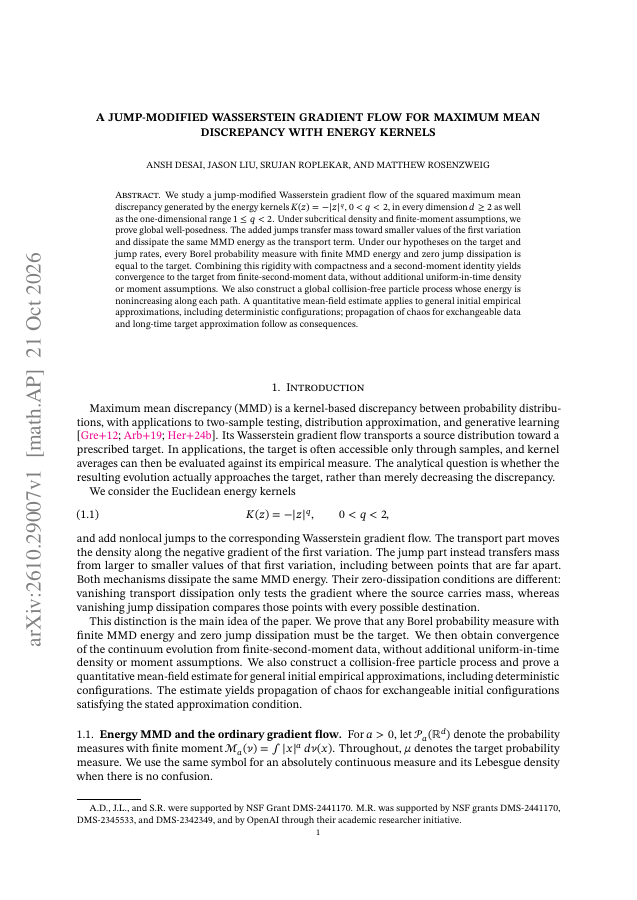
We study a jump-modified Wasserstein gradient flow of the squared maximum mean discrepancy generated by the energy kernels $K(z)=-|z|^q$, $0<q<2$, in every dimension $d\ge2$ as well as the one-dimensional range $1\le q<2$.
21 Oct 2026
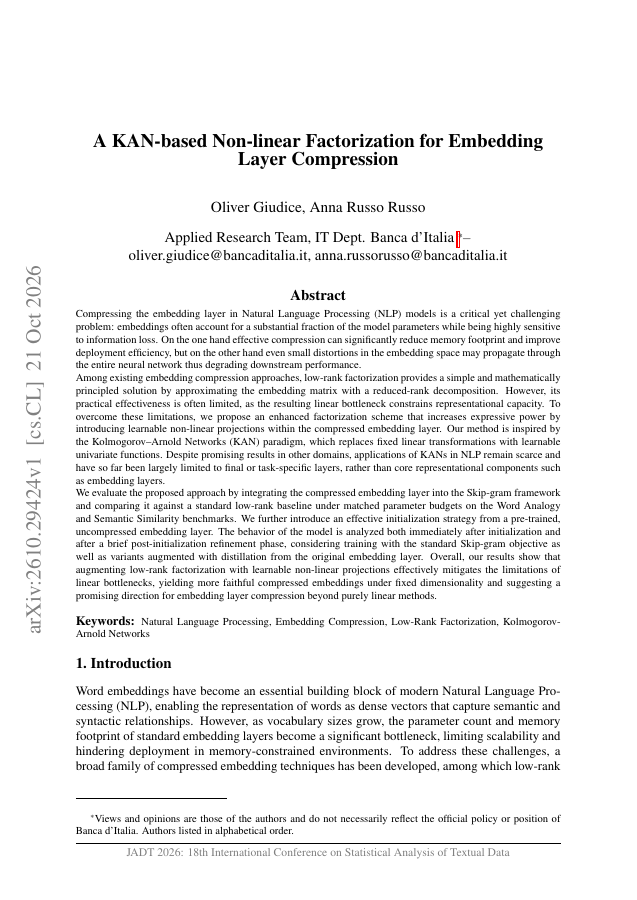
Among existing embedding compression approaches, low-rank factorization provides a simple and mathematically principled solution by approximating the embedding matrix with a reduced-rank decomposition.
21 Oct 2026
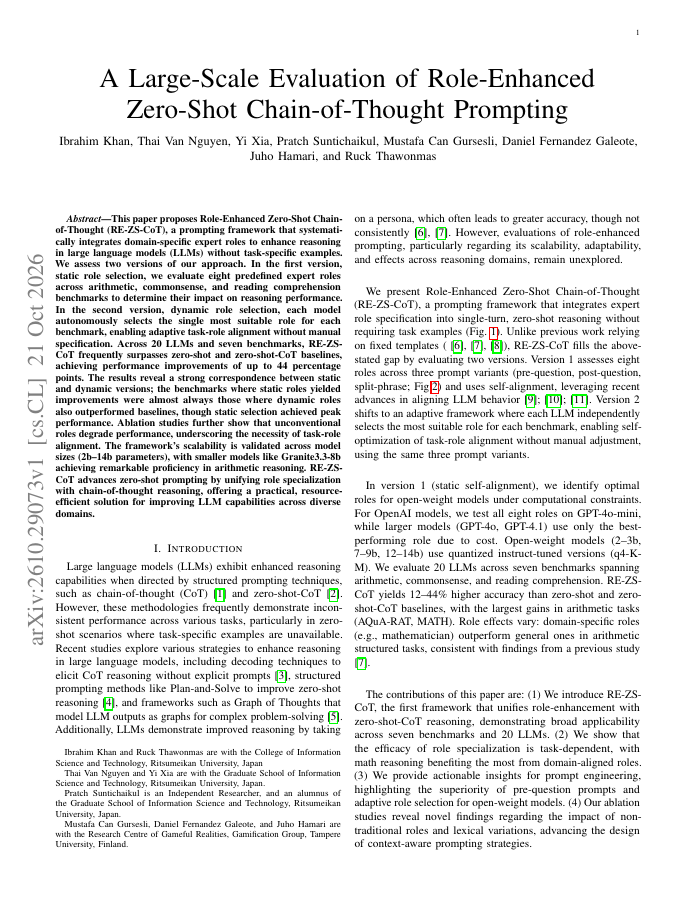
This paper proposes Role-Enhanced Zero-Shot Chain-of-Thought (RE-ZS-CoT), a prompting framework that systematically integrates domain-specific expert roles to enhance reasoning in large language models (LLMs) without task-specific examples.
21 Oct 2026
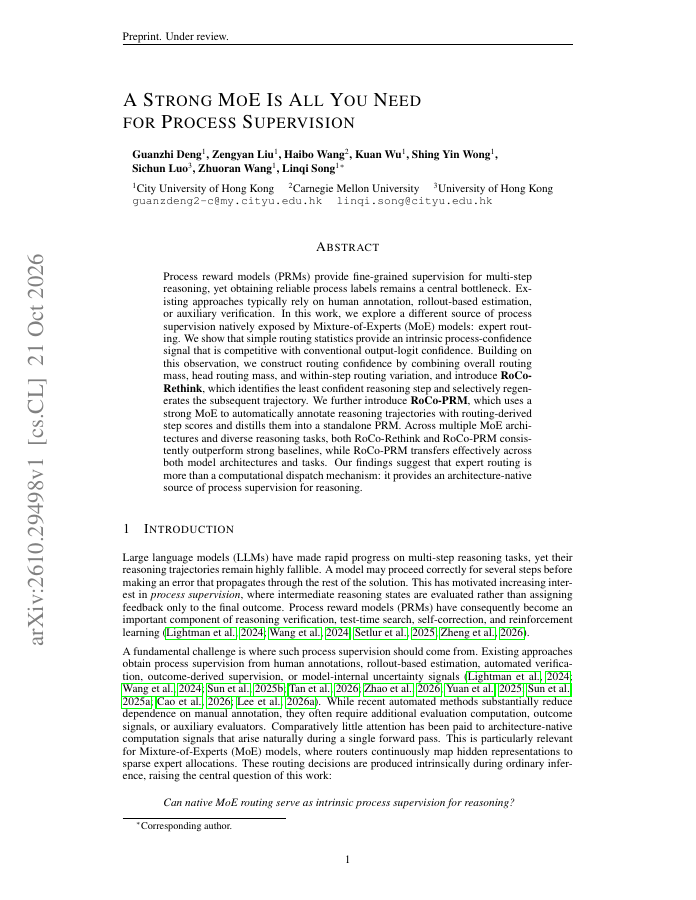
Process reward models (PRMs) provide fine-grained supervision for multi-step reasoning, yet obtaining reliable process labels remains a central bottleneck. Existing approaches typically rely on human annotation, rollout-based estimation, or auxiliary verification.
21 Oct 2026
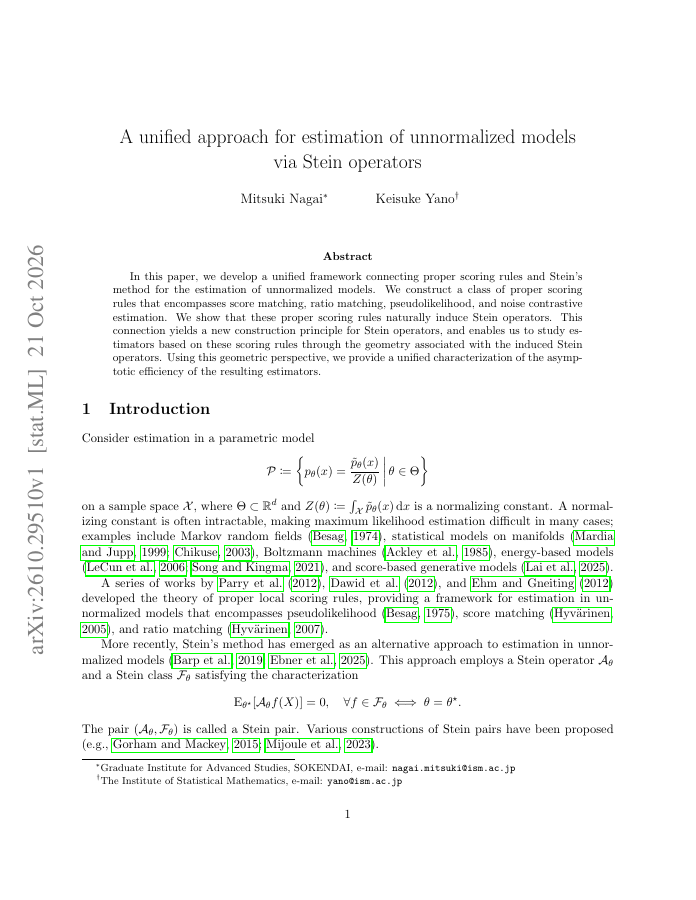
In this paper, we develop a unified framework connecting proper scoring rules and Stein's method for the estimation of unnormalized models. We construct a class of proper scoring rules that encompasses score matching, ratio matching, pseudolikelihood, and noise contrastive…
20 Oct 2026
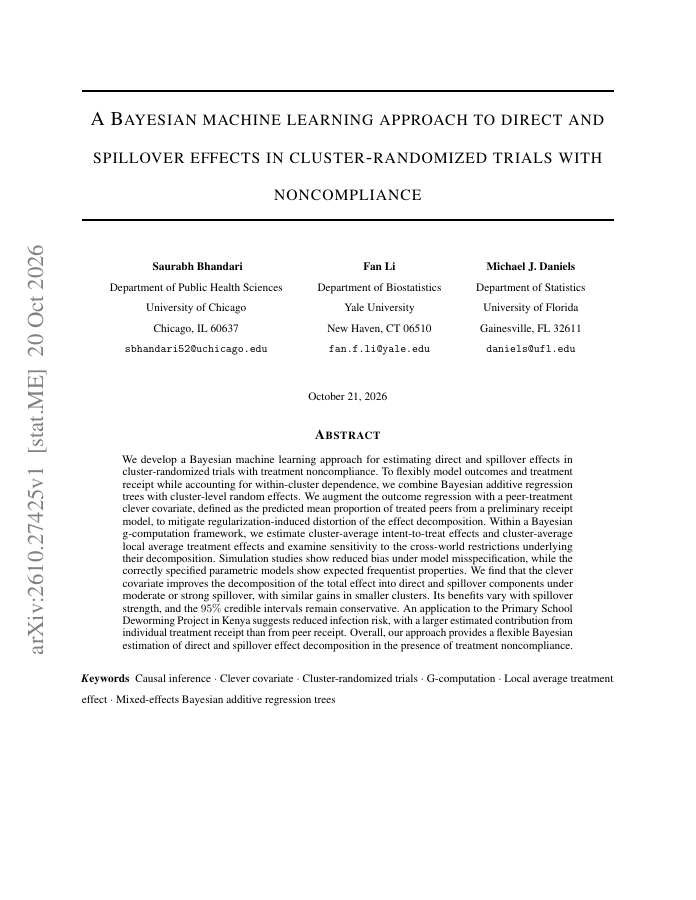
We develop a Bayesian machine learning approach for estimating direct and spillover effects in cluster-randomized trials with treatment noncompliance. To flexibly model outcomes and treatment receipt while accounting for within-cluster dependence, we combine Bayesian additive…
20 Oct 2026
Handheld demonstration devices decouple data collection from the robot, but conventional designs burden the hand with a wrist camera, cables and a pose tracker (SLAM, an IMU, a VR controller, or a fixed external camera that the collector's body occludes), and burden the pipeline…
20 Oct 2026
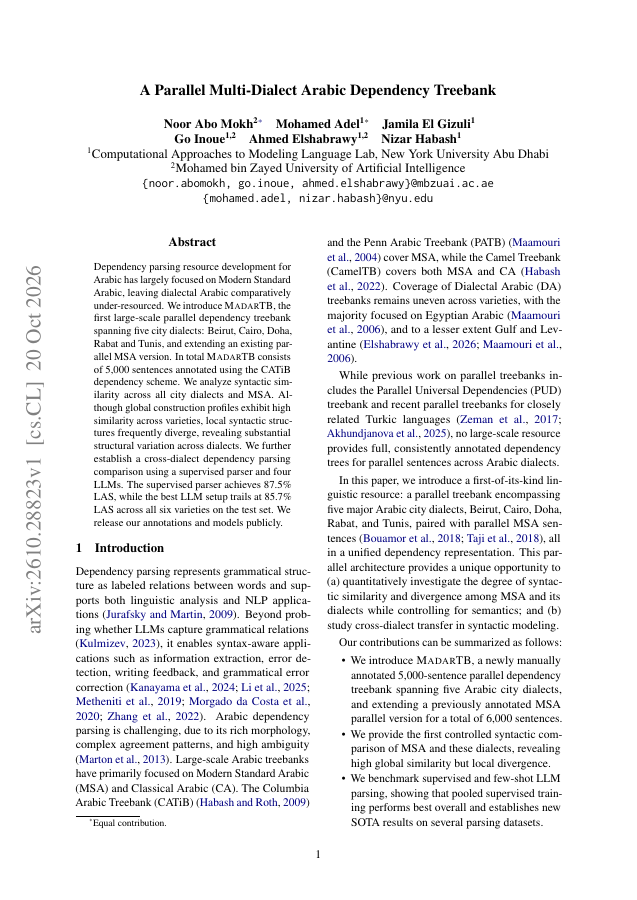
Dependency parsing resource development for Arabic has largely focused on Modern Standard Arabic, leaving dialectal Arabic comparatively under-resourced. We introduce MADARTB, the first large-scale parallel dependency treebank spanning five city dialects: Beirut, Cairo, Doha,…
20 Oct 2026
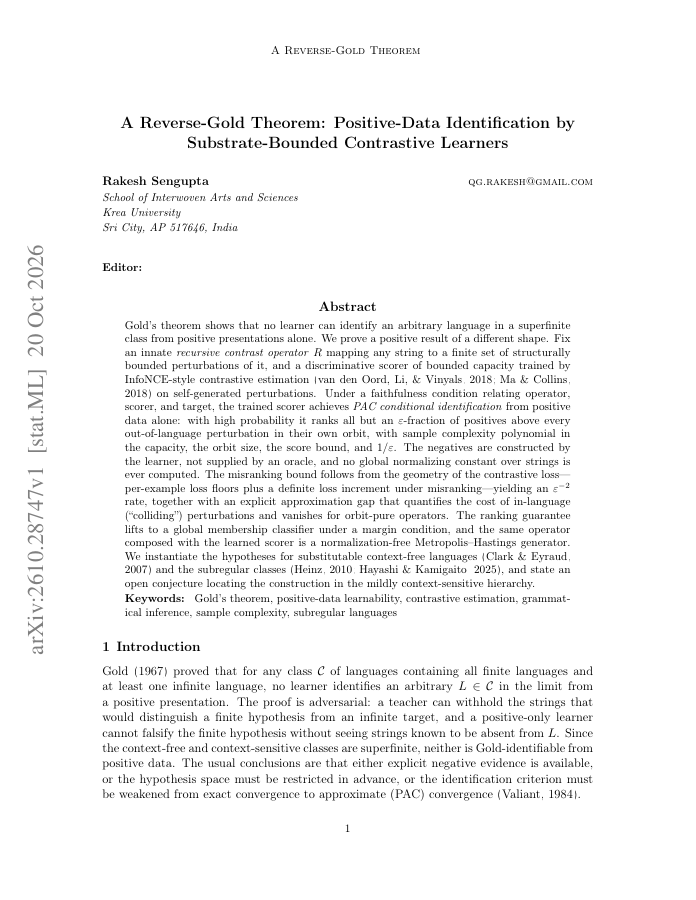
Gold's theorem shows that no learner can identify an arbitrary language in a superfinite class from positive presentations alone. We prove a positive result of a different shape.
20 Oct 2026
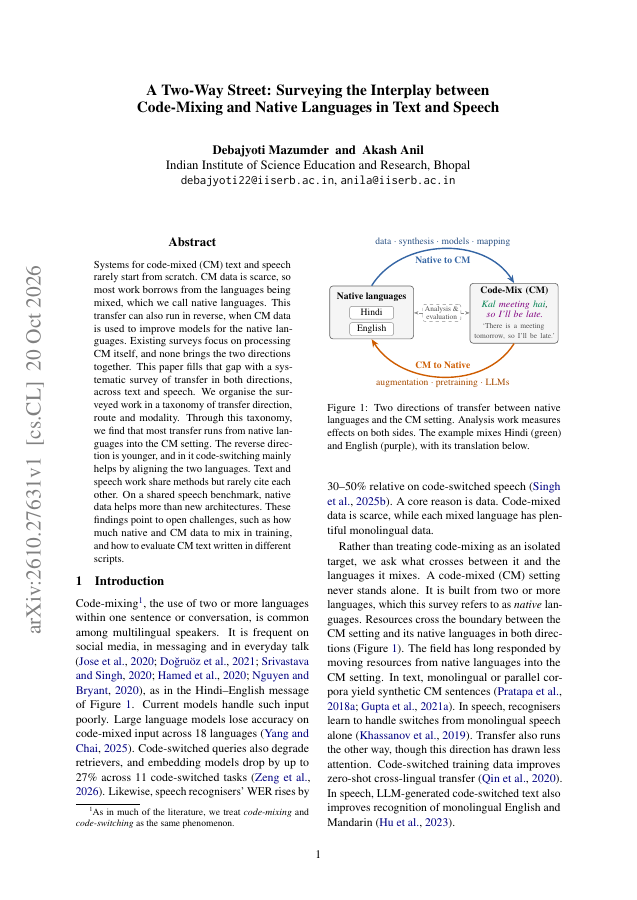
Systems for code-mixed (CM) text and speech rarely start from scratch. CM data is scarce, so most work borrows from the languages being mixed, which we call native languages. This transfer can also run in reverse, when CM data is used to improve models for the native languages.
20 Oct 2026
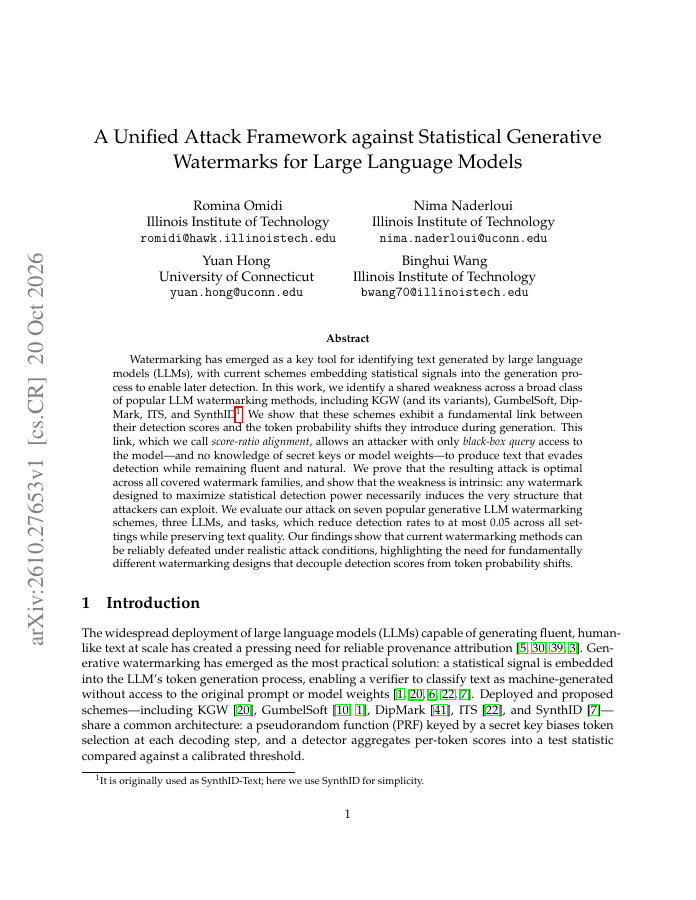
Watermarking has emerged as a key tool for identifying text generated by large language models (LLMs), with current schemes embedding statistical signals into the generation process to enable later detection.
19 Oct 2026
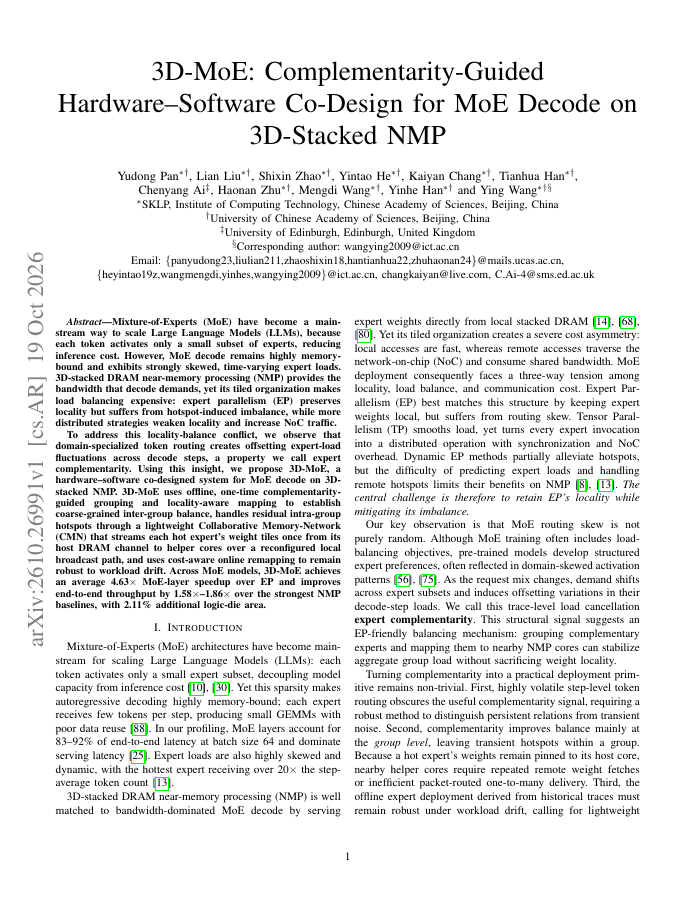
Mixture-of-Experts (MoE) have become a mainstream way to scale Large Language Models (LLMs), because each token activates only a small subset of experts, reducing inference cost.
19 Oct 2026
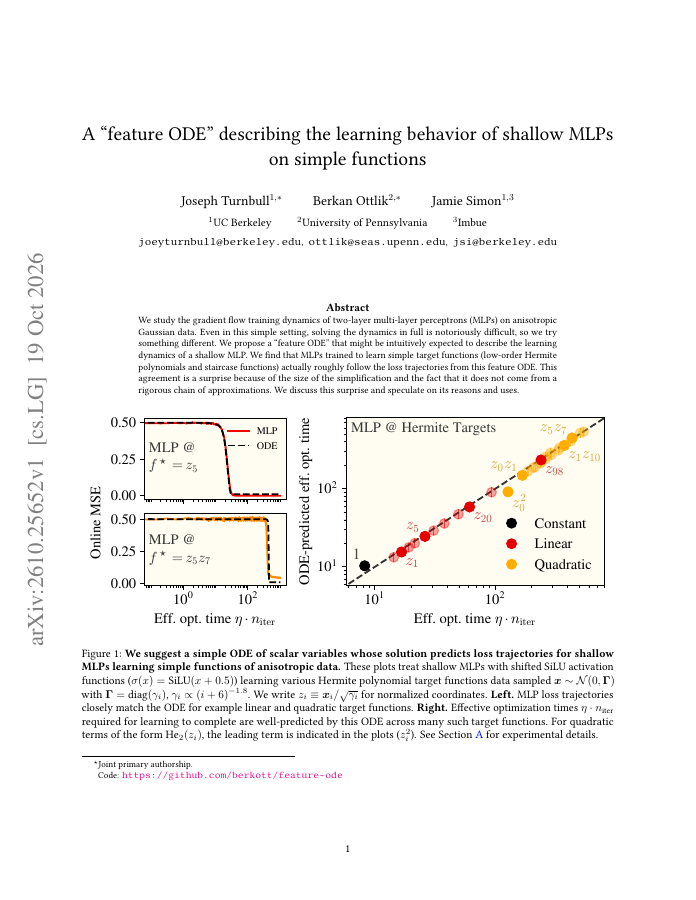
We study the gradient flow training dynamics of two-layer multi-layer perceptrons (MLPs) on anisotropic Gaussian data. Even in this simple setting, solving the dynamics in full is notoriously difficult, so we try something different.
19 Oct 2026
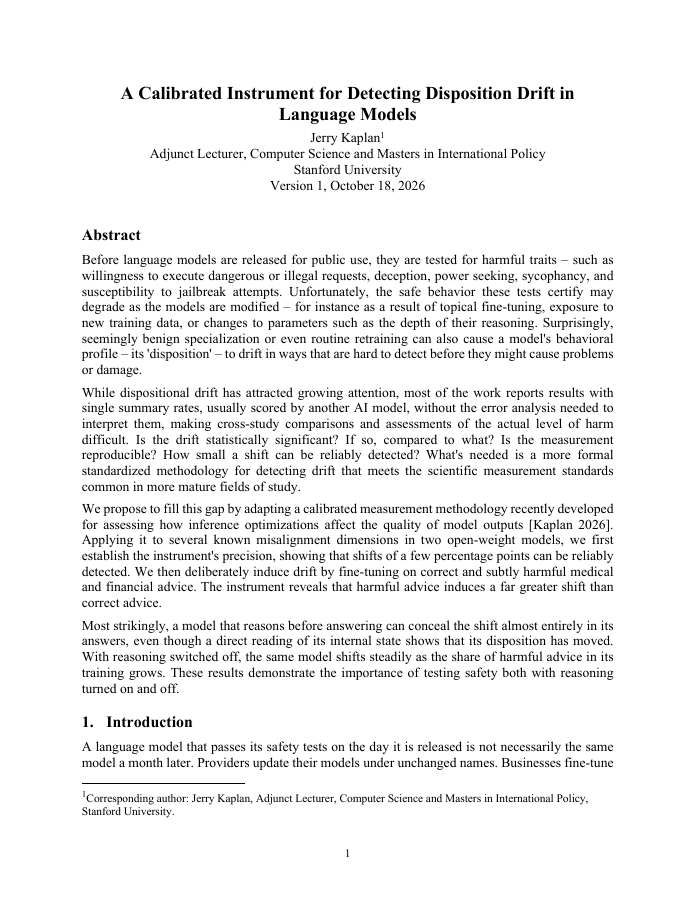
Before language models are released, they are tested for harmful traits such as willingness to carry out dangerous requests, deception, power seeking, and sycophancy. The safe behavior these tests certify may degrade as models are modified, by topical fine-tuning, new training…
19 Oct 2026
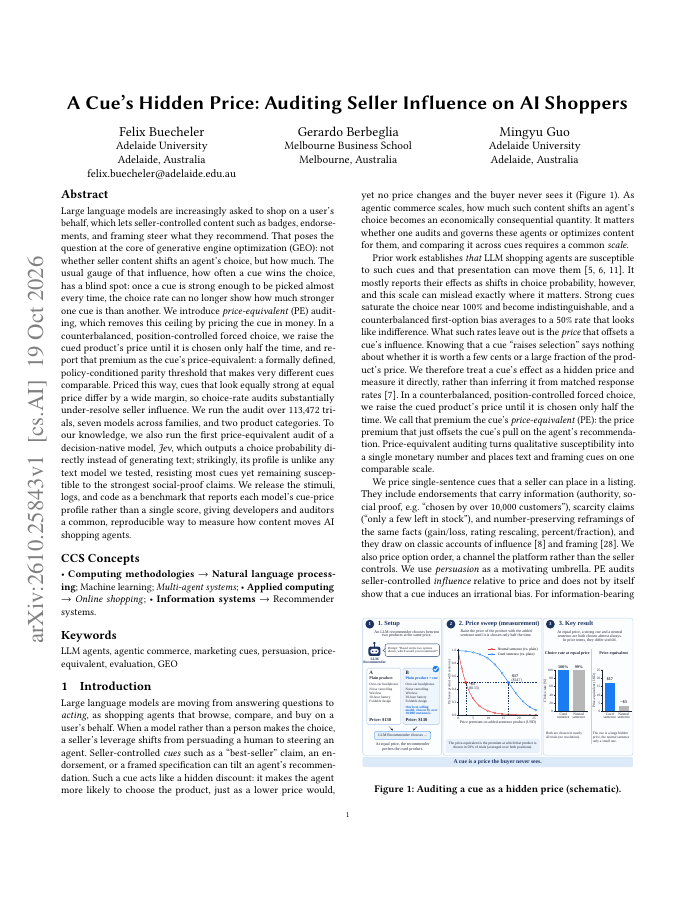
Large language models are increasingly asked to shop on a user's behalf, which lets seller-controlled content such as badges, endorsements, and framing steer what they recommend.
19 Oct 2026
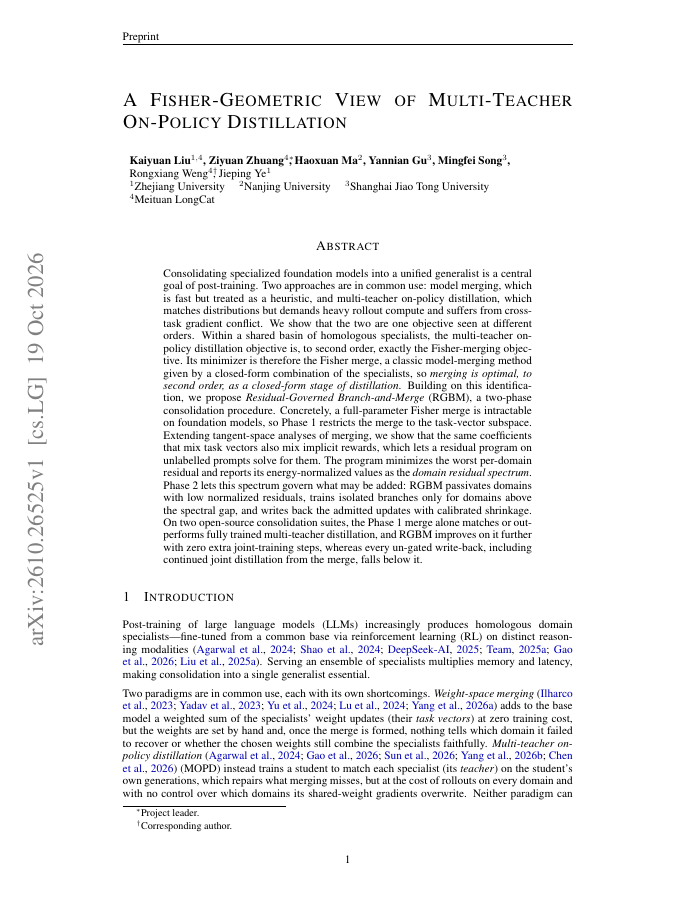
Consolidating specialized foundation models into a unified generalist is a central goal of post-training. Two approaches are in common use: model merging, which is fast but treated as a heuristic, and multi-teacher on-policy distillation, which matches distributions but demands…
19 Oct 2026
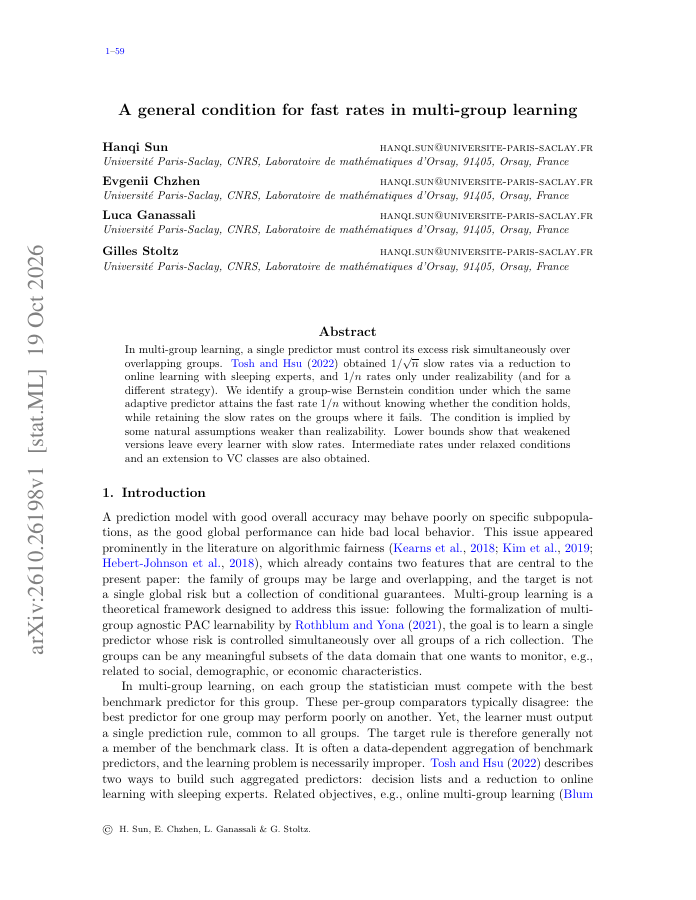
In multi-group learning, a single predictor must control its excess risk simultaneously over overlapping groups. Tosh and Hsu (2022) obtained $1/\sqrt{n}$ slow rates via a reduction to online learning with sleeping experts, and $1/n$ rates only under realizability (and for a…
19 Oct 2026
Clinical care, health-system operations and biomedical discovery depend on extracting reliable answers from patient records, yet applying diverse clinical questions across entire populations remains computationally expensive.
19 Oct 2026
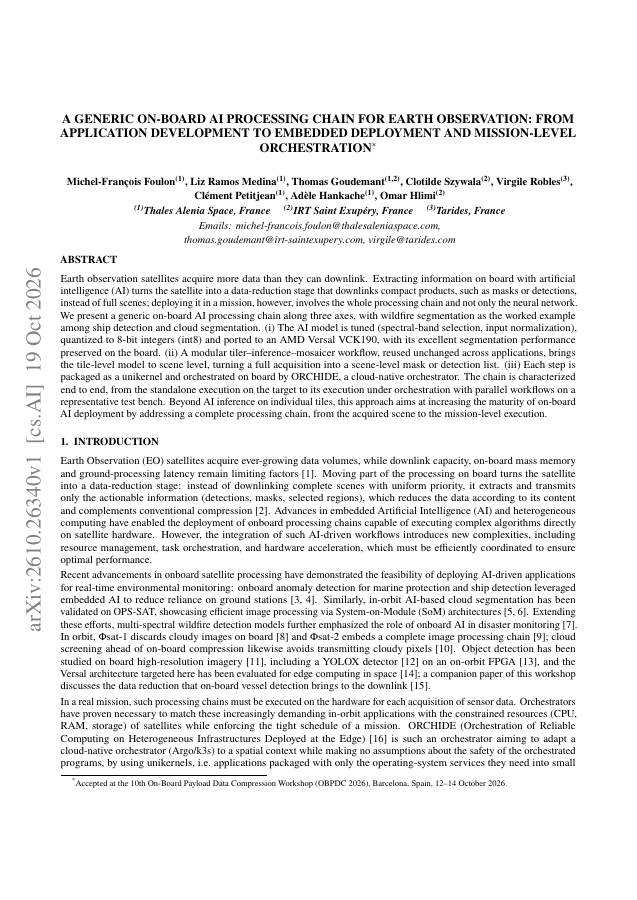
Earth observation satellites acquire more data than they can downlink. Extracting information on board with artificial intelligence (AI) turns the satellite into a data-reduction stage that downlinks compact products, such as masks or detections, instead of full scenes;…
19 Oct 2026
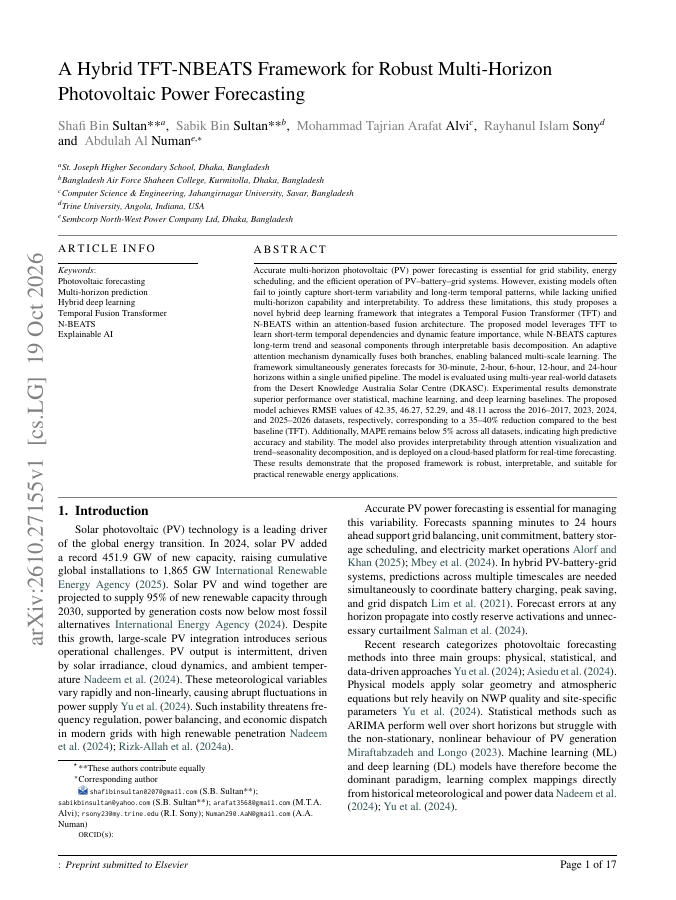
Accurate multi-horizon photovoltaic (PV) power forecasting is essential for grid stability, energy scheduling, and the efficient operation of PVbatterygrid systems. However, existing models often fail to jointly capture short-term variability and long-term temporal patterns,…
19 Oct 2026
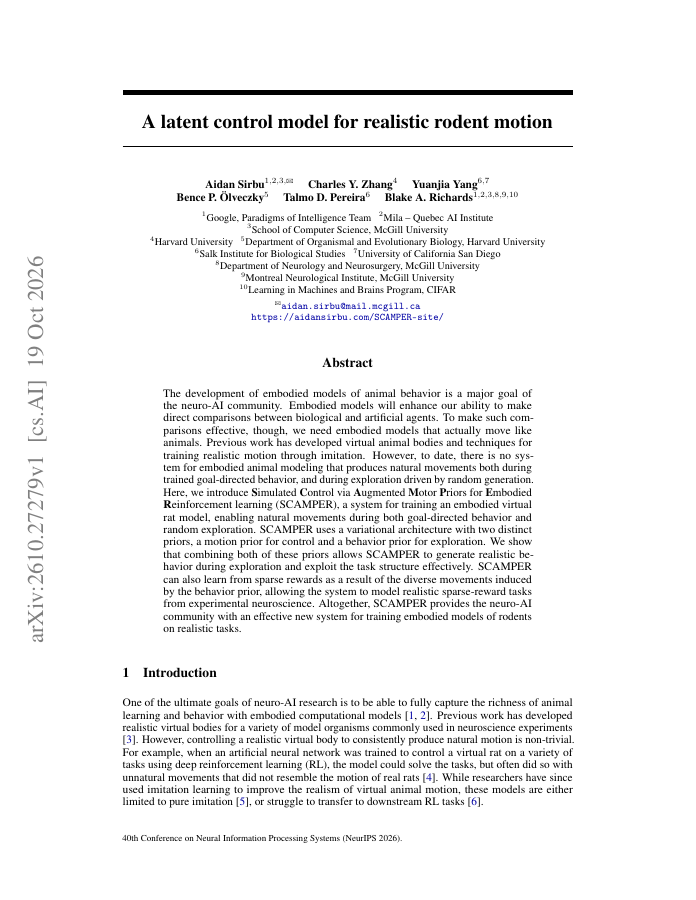
The development of embodied models of animal behavior is a major goal of the neuro-AI community. Embodied models will enhance our ability to make direct comparisons between biological and artificial agents.
19 Oct 2026
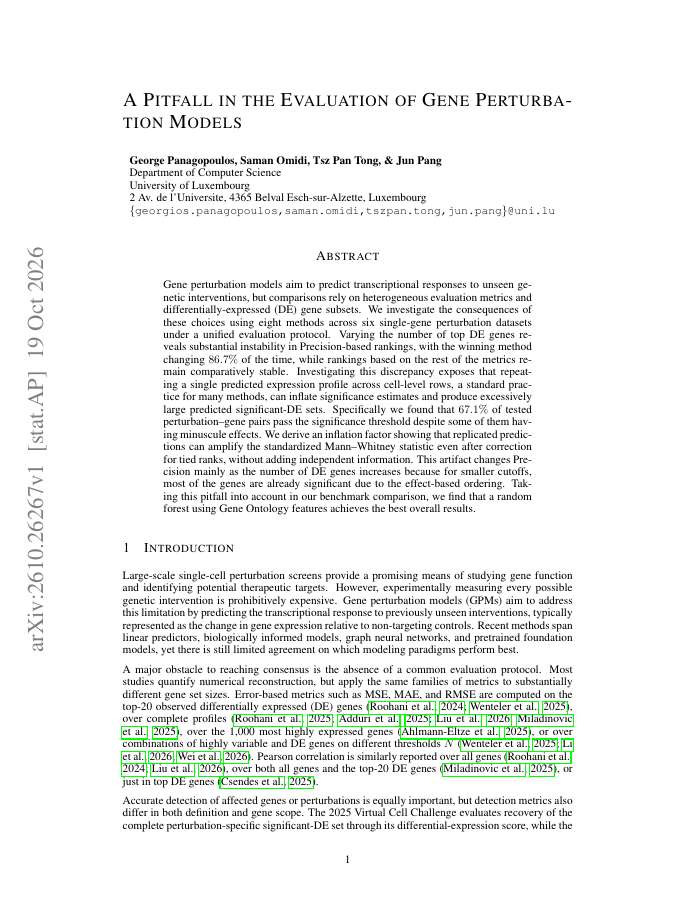
Gene perturbation models aim to predict transcriptional responses to unseen genetic interventions, but comparisons rely on heterogeneous evaluation metrics and differentially-expressed (DE) gene subsets.
19 Oct 2026
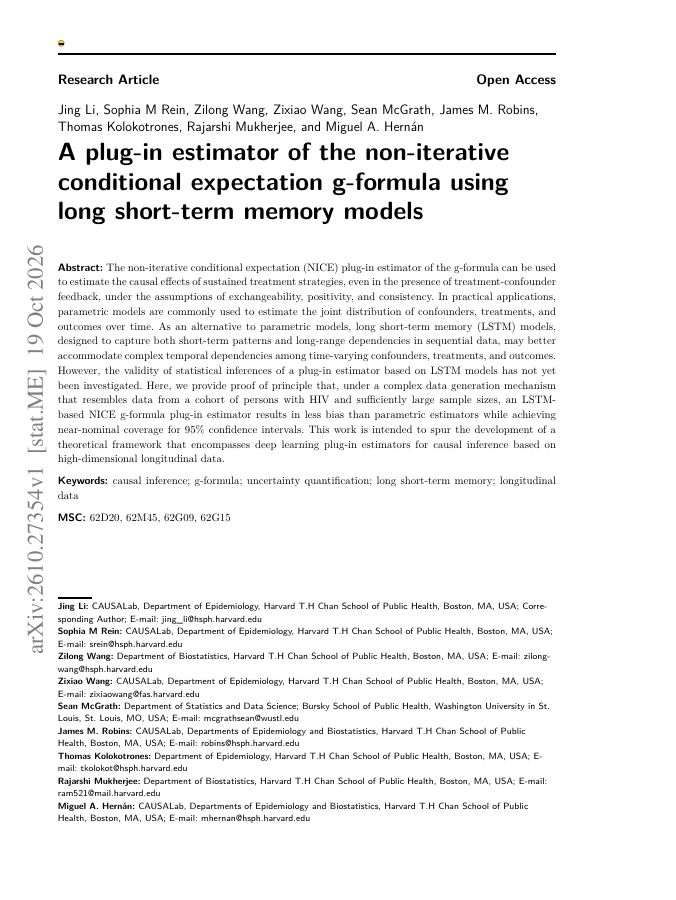
The non-iterative conditional expectation (NICE) plug-in estimator of the g-formula can be used to estimate the causal effects of sustained treatment strategies, even in the presence of treatment-confounder feedback, under the assumptions of exchangeability, positivity, and…