5 Oct 2026
Background: Measles resurged in the United States during 2025-2026, with more than 4,600 reported cases. Timely detection and transmission inference require integrated genomic, epidemiological, environmental, and clinical data.
Trending research and the full catalog - each paper linked to the benchmarks, methods, and models it introduces.
Filtering here covers the 2,000 most recent papers, as much as one page can hold in memory. See the full index of 22,947 papers.
5 Oct 2026
Background: Measles resurged in the United States during 2025-2026, with more than 4,600 reported cases. Timely detection and transmission inference require integrated genomic, epidemiological, environmental, and clinical data.
5 Oct 2026
As technology scales to smaller nodes, increasing current densities make electromigration (EM) one of the dominant reliability challenges in on-chip interconnects. Accurate transient stress analysis is needed to identify wires susceptible to EM degradation, but applying…
5 Oct 2026
An inaccurate expert can still provide useful information after correction. We study online learning to defer in which the learner chooses an expert and fixes a correction function before purchasing its answer, then applies that function to the answer received.
5 Oct 2026
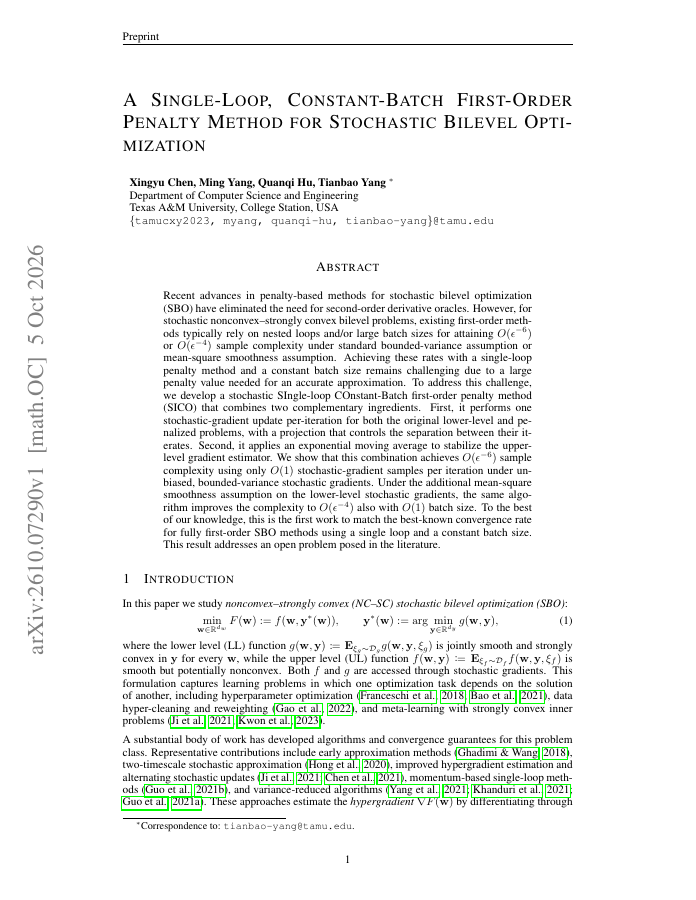
Recent advances in penalty-based methods for stochastic bilevel optimization (SBO) have eliminated the need for second-order derivative oracles. However, for stochastic nonconvex-strongly convex bilevel problems, existing first-order methods typically rely on nested loops and/or…
5 Oct 2026
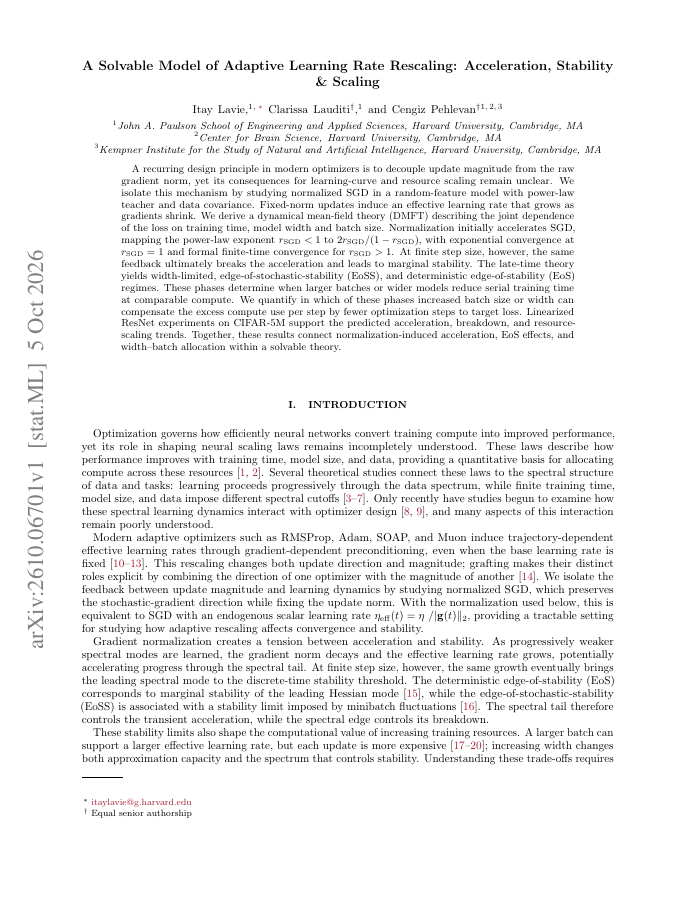
A recurring design principle in modern optimizers is to decouple update magnitude from the raw gradient norm, yet its consequences for learning-curve and resource scaling remain unclear.
5 Oct 2026
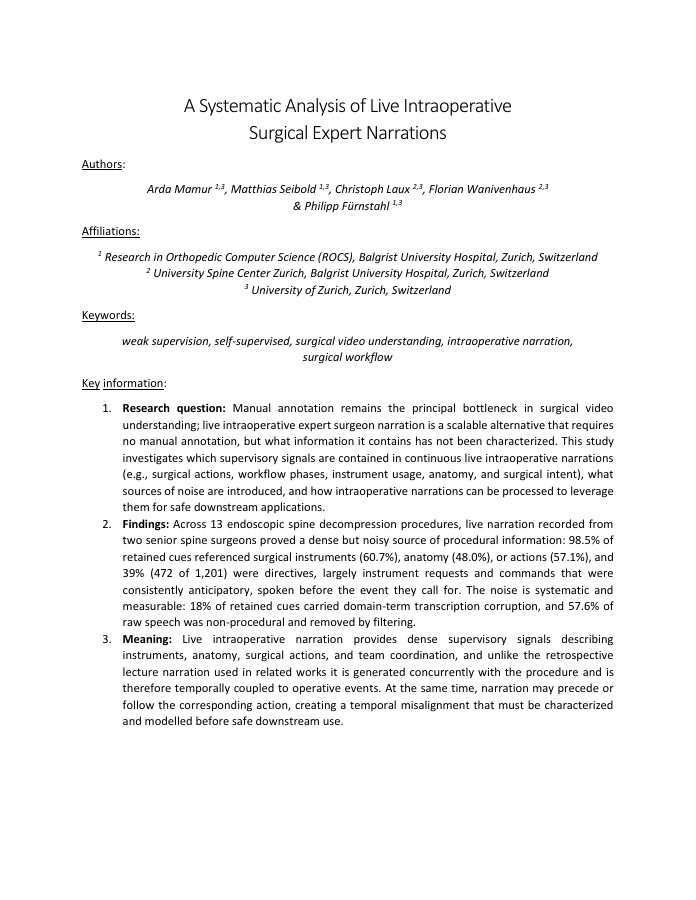
Manual annotation remains the principal bottleneck in surgical video understanding. Live intraoperative narration by the operating surgeon is a scalable alternative that requires no manual annotation, but the information it contains has not been characterized.
5 Oct 2026
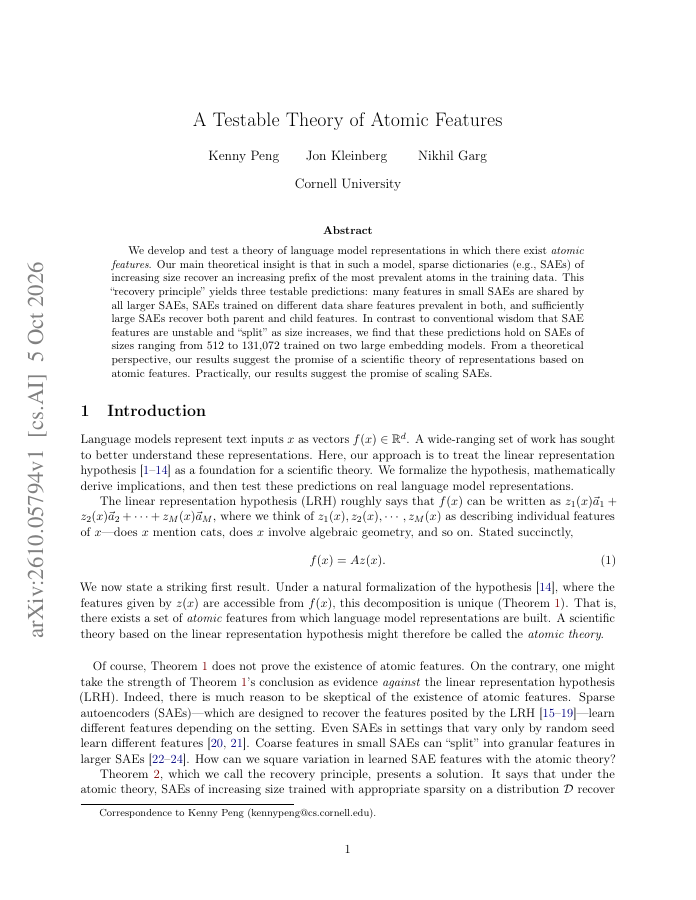
We develop and test a theory of language model representations in which there exist atomic features. Our main theoretical insight is that in such a model, sparse dictionaries (e.g., SAEs) of increasing size recover an increasing prefix of the most prevalent atoms in the training…
5 Oct 2026
Deterministic benchmark scores show that an agent received credit, but not whether that credit was earned, reported honestly, or would hold on a second run. We introduce a Trust Layer for Agent Evaluation, an additive post-hoc framework that reports, beside each recorded score,…
4 Oct 2026
An electromagnetic inversion scheme that integrates stochastic optimization (STO) and plug-and-play (PNP) regularization into contrast-source inversion (CSI), termed STO-PNP-CSI, is developed.
4 Oct 2026
Sensing technologies have advanced rapidly across industries ranging from energy to automotive manufacturing. These systems generate high-dimensional (HD) data characterized by complex nonlinear patterns and strong temporal dependencies.
4 Oct 2026
This paper presents the workflow for building an automated ArcGIS Pro tool using ArcPy to extract the Land Surface Temperature (LST) from Landsat 7, 8 and 9 datasets. The tool eliminates the need for manual band selection and repetitive raster computations by automating the…
4 Oct 2026
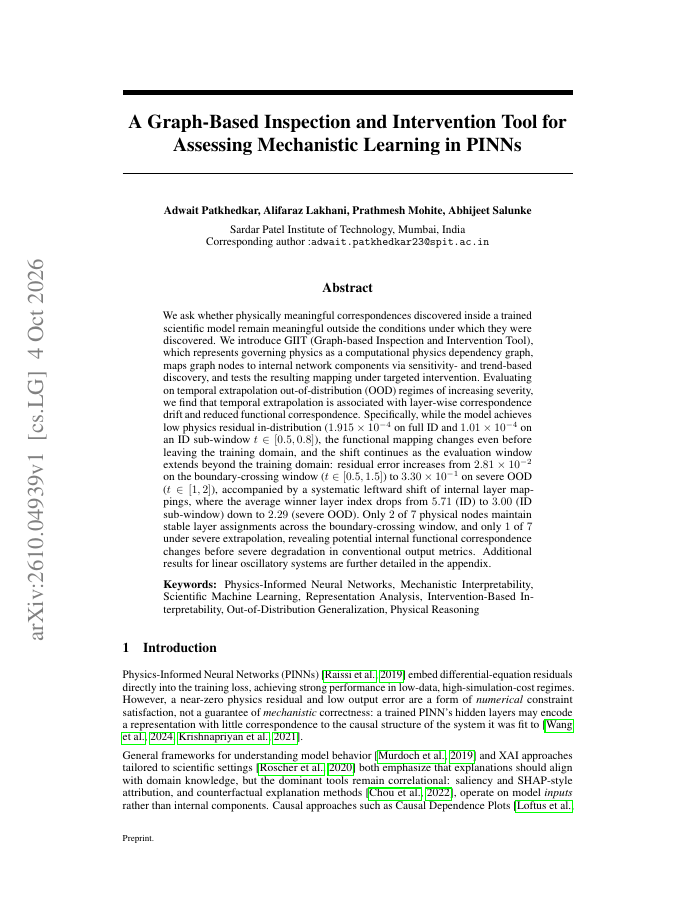
We ask whether physically meaningful correspondences discovered inside a trained scientific model remain meaningful outside the conditions under which they were discovered.
4 Oct 2026
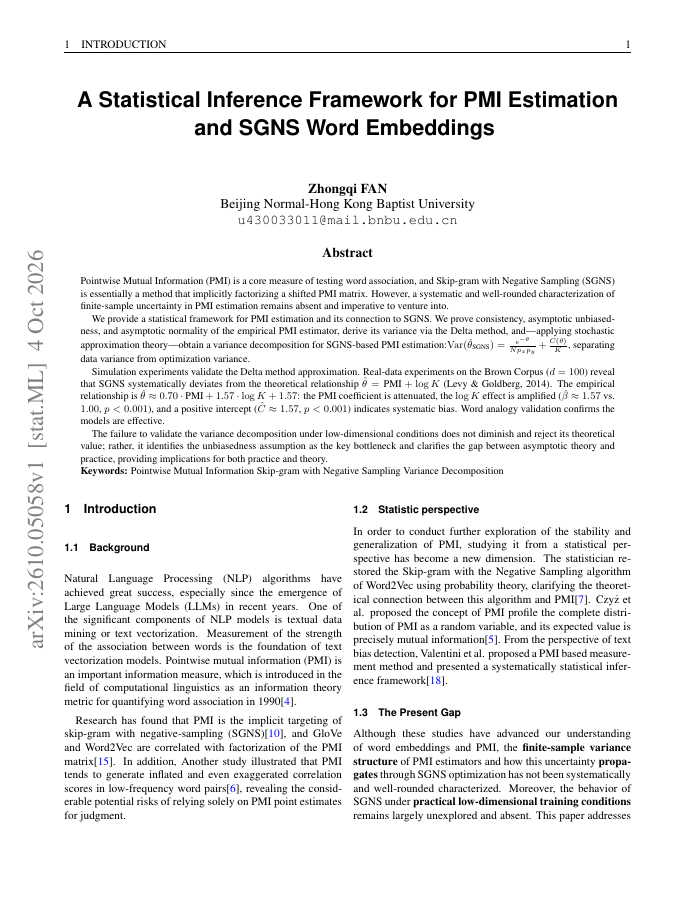
Pointwise Mutual Information (PMI) is a core measure of testing word association, and Skip-gram with Negative Sampling (SGNS) is essentially a method that implicitly factorizes a shifted PMI matrix.
4 Oct 2026
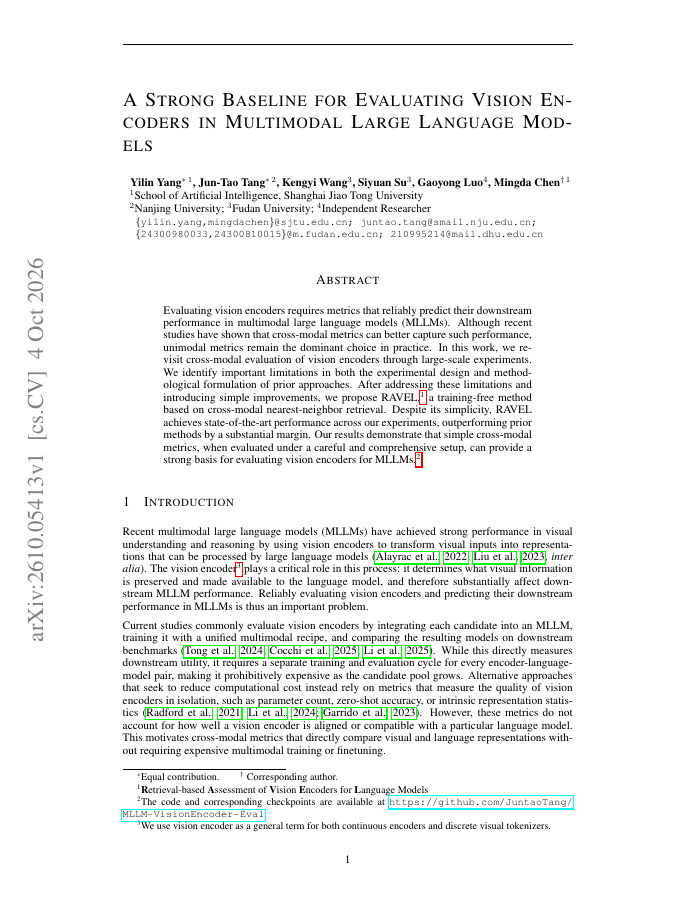
Evaluating vision encoders requires metrics that reliably predict their downstream performance in multimodal large language models (MLLMs). Although recent studies have shown that cross-modal metrics can better capture such performance, unimodal metrics remain the dominant…
4 Oct 2026
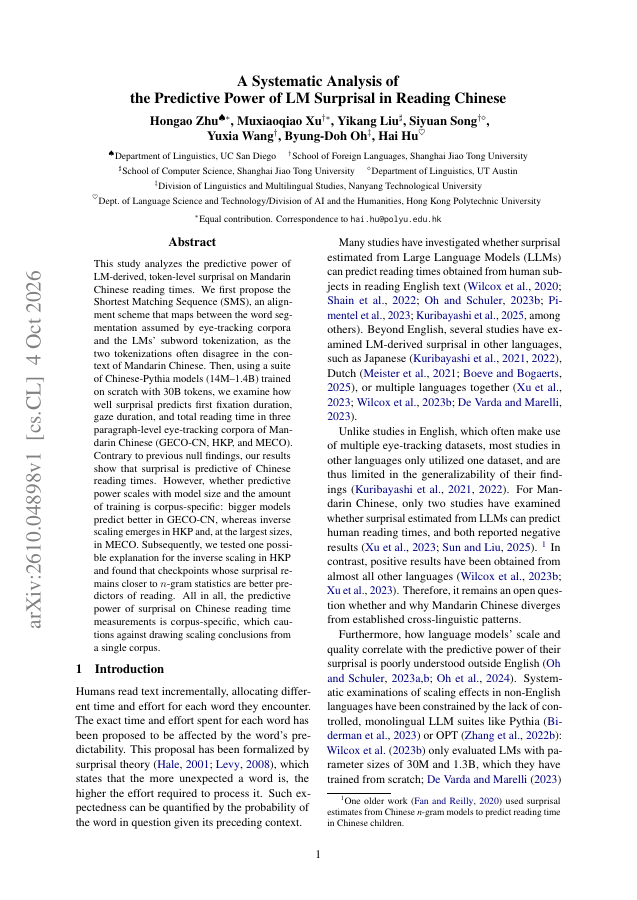
This study analyzes the predictive power of LM-derived, token-level surprisal on Mandarin Chinese reading times. Using a suite of Chinese-Pythia models (14M--1.4B) trained from scratch with 30B tokens, we examine how well surprisal predicts first fixation duration, gaze…
4 Oct 2026
Reinforcement learning controllers for underwater vehicles are usually trained against one physics representation and deployed against another, so reported performance does not always describe behavior outside training.
4 Oct 2026
We develop a Unified Scaling Law and a Unified Theory of Time Series Learning to understand how model capacity and historical information support forecasting. Across different lookback lengths and forecast horizons, we analyze 18,768 experimental cells from 21 checkpoints on 23…
3 Oct 2026
We propose $\mathrm{TRIZ}^{a}$ (TRIZ exponentiated by an agent), a general R\&D automation paradigm that combines TRIZ inventive theory with LLM-driven agent evolutionary search.
3 Oct 2026
Designing effective reward functions in RL typically requires substantial expertise and trial and error. Recent work automates this process with LLM-based systems that generate and iteratively improve reward code using policy feedback.
3 Oct 2026
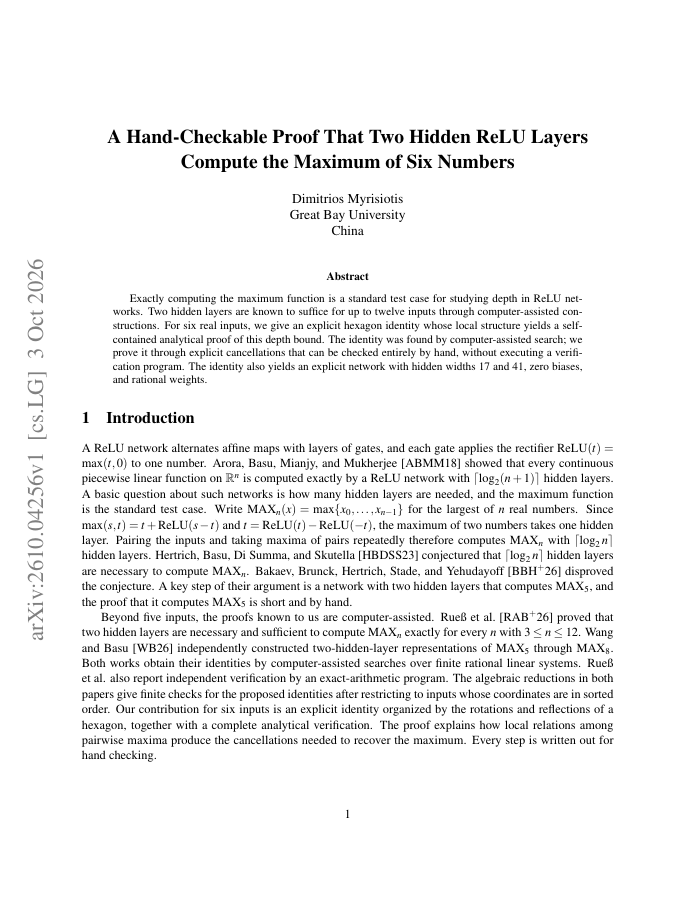
Exactly computing the maximum function is a standard test case for studying depth in ReLU networks. Two hidden layers are known to suffice for up to twelve inputs through computer-assisted constructions.
3 Oct 2026
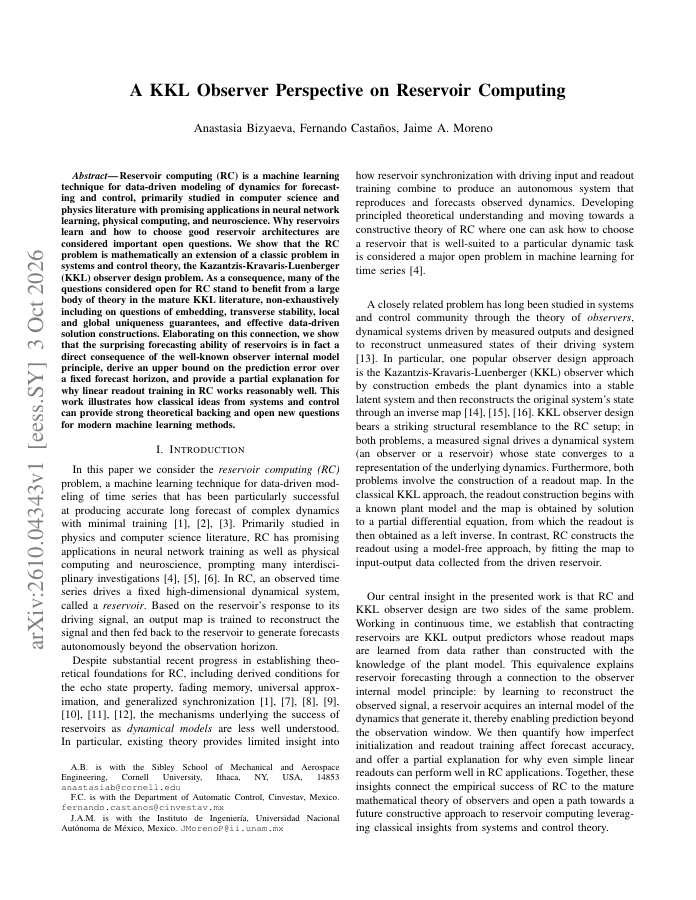
Reservoir computing (RC) is a machine learning technique for data-driven modeling of dynamics for forecasting and control, primarily studied in computer science and physics literature with promising applications in neural network learning, physical computing, and neuroscience.
3 Oct 2026
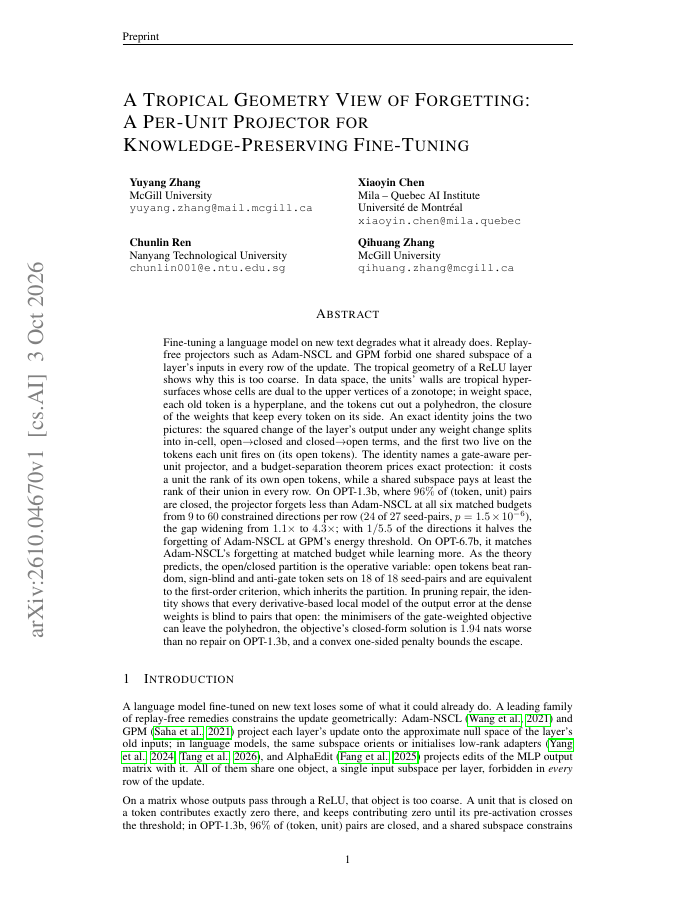
Fine-tuning a language model on new text degrades what it already does. Replay-free projectors such as Adam-NSCL and GPM forbid one shared subspace of a layer's inputs in every row of the update. The tropical geometry of a ReLU layer shows why this is too coarse.
2 Oct 2026
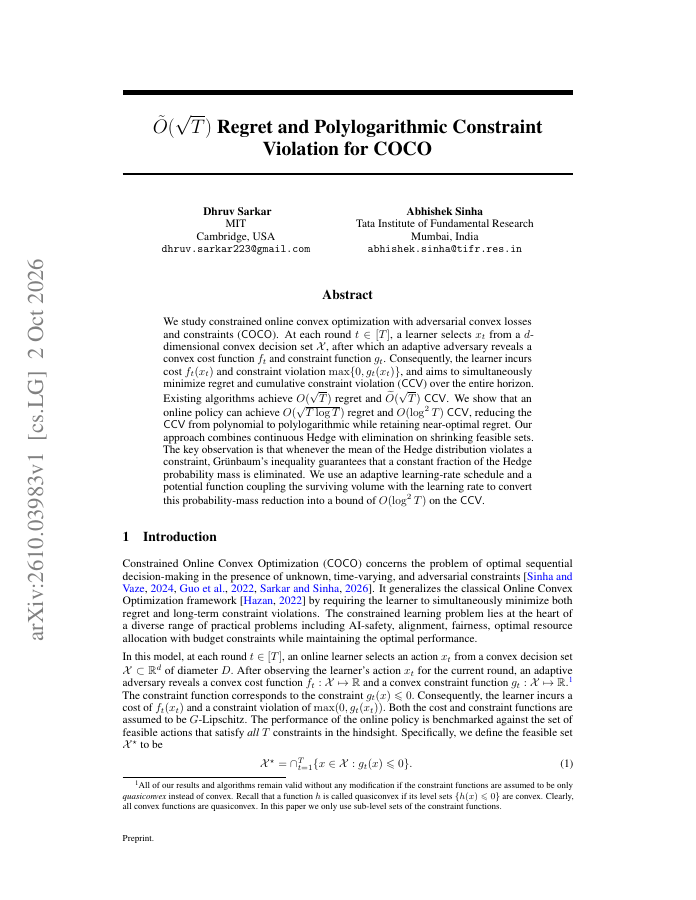
We study constrained online convex optimization with adversarial convex costs and constraints ($\mathsf{COCO}$). At each round $t\in[T]$, a learner selects $x_t$ from a $d$-dimensional convex decision set $X$, after which an adaptive adversary reveals a convex cost function…
2 Oct 2026
To deploy deep neural networks on edge hardware, highly efficient inference schemes are necessary that retain high accuracy. This work presents W16A16, a high precision (16-bit), fast speed, low energy quantization method.