6 Oct 2026
Large language models (LLMs) are increasingly used to judge how well an advertisement matches a query, but the fairness of these judgments has received limited attention.
Trending research and the full catalog - each paper linked to the benchmarks, methods, and models it introduces.
Filtering here covers the 2,000 most recent papers, as much as one page can hold in memory. See the full index of 23,060 papers.
6 Oct 2026
Large language models (LLMs) are increasingly used to judge how well an advertisement matches a query, but the fairness of these judgments has received limited attention.
6 Oct 2026
Generative Information Retrieval (GIR) has emerged as a transformative paradigm, shifting document retrieval from a traditional "retrieve-and-rank" workflow to sequence-to-sequence generation, where a model directly predicts document identifiers (DocIDs).
6 Oct 2026
Endpoint accuracy on abstract-reasoning benchmarks does not reveal whether a language model has acquired a transferable rule or fit distribution-specific regularities. We study this distinction in small language models on the ARC-TGI benchmark, which organizes abstract grid…
6 Oct 2026
Deep learning models for brain tumor diagnosis need to do more than achieve high classification accuracy. For practical use, they should also provide understandable predictions, recognize unsuitable inputs, and work within a usable clinical system.
5 Oct 2026
Statistically valid estimation of racial and ethnic disparities often requires inferring group membership probabilities from names and geographic locations. The standard method, Bayesian Improved Surname Geocoding (BISG), requires group frequencies for each name.
5 Oct 2026
Field-effect transistor (FET) layouts on exfoliated two-dimensional flakes are typically drawn by hand for each flake, placing contacts and gates to match its position and outline in optical micrographs.
5 Oct 2026
Modern text-to-speech (TTS) systems can clone a target speaker from a short reference clip or be fine-tuned on a target voice, yet their behaviour on morphologically rich, lower-resource languages such as Turkish remain under-characterised.
5 Oct 2026
Low-Rank Adaptation (LoRA) has become a standard approach for parameter-efficient fine-tuning, yet a fundamental practical question remains unresolved: how should the adapter rank be chosen? An overly small rank may lead to a poorly conditioned optimization landscape, whereas an…
5 Oct 2026
Background: Measles resurged in the United States during 2025-2026, with more than 4,600 reported cases. Timely detection and transmission inference require integrated genomic, epidemiological, environmental, and clinical data.
5 Oct 2026
As technology scales to smaller nodes, increasing current densities make electromigration (EM) one of the dominant reliability challenges in on-chip interconnects. Accurate transient stress analysis is needed to identify wires susceptible to EM degradation, but applying…
5 Oct 2026
An inaccurate expert can still provide useful information after correction. We study online learning to defer in which the learner chooses an expert and fixes a correction function before purchasing its answer, then applies that function to the answer received.
5 Oct 2026
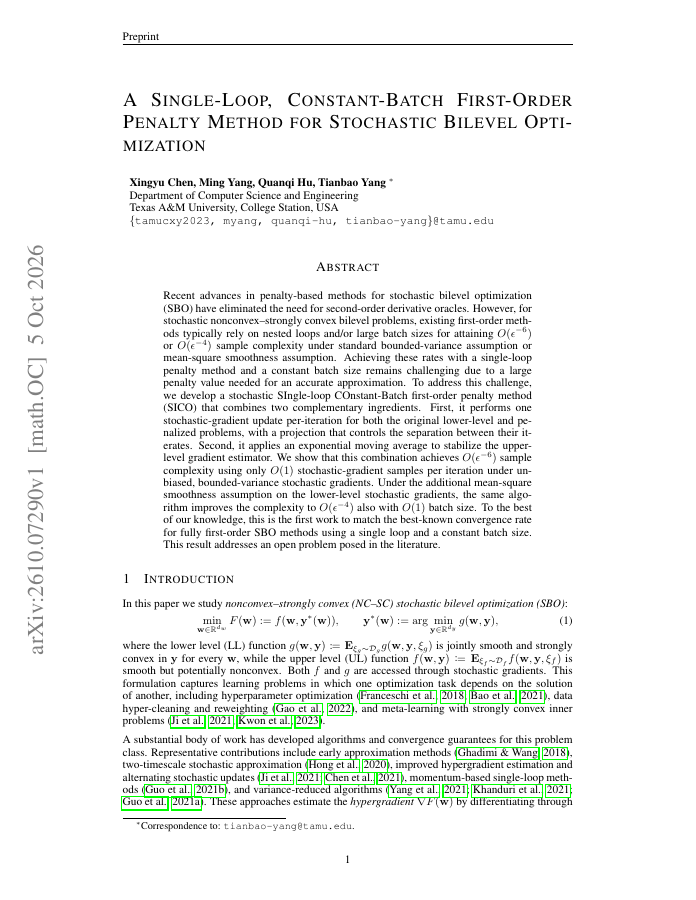
Recent advances in penalty-based methods for stochastic bilevel optimization (SBO) have eliminated the need for second-order derivative oracles. However, for stochastic nonconvex-strongly convex bilevel problems, existing first-order methods typically rely on nested loops and/or…
5 Oct 2026
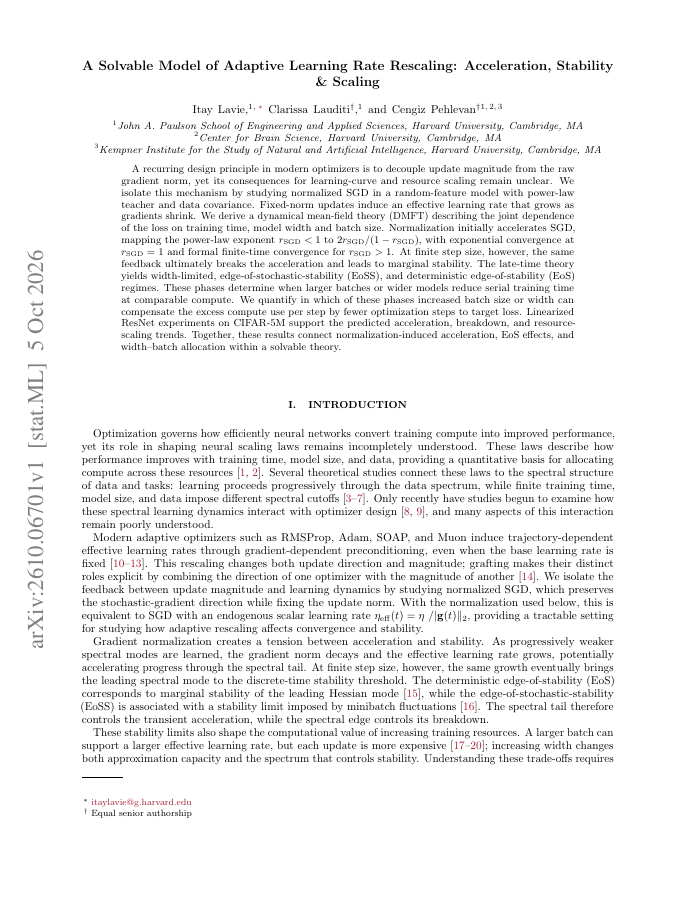
A recurring design principle in modern optimizers is to decouple update magnitude from the raw gradient norm, yet its consequences for learning-curve and resource scaling remain unclear.
5 Oct 2026
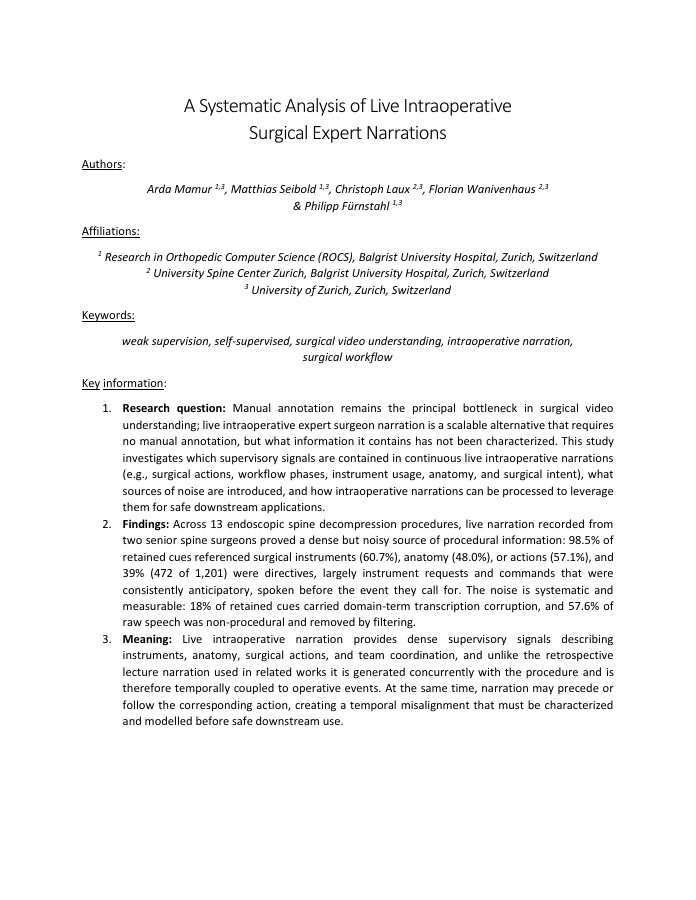
Manual annotation remains the principal bottleneck in surgical video understanding. Live intraoperative narration by the operating surgeon is a scalable alternative that requires no manual annotation, but the information it contains has not been characterized.
5 Oct 2026
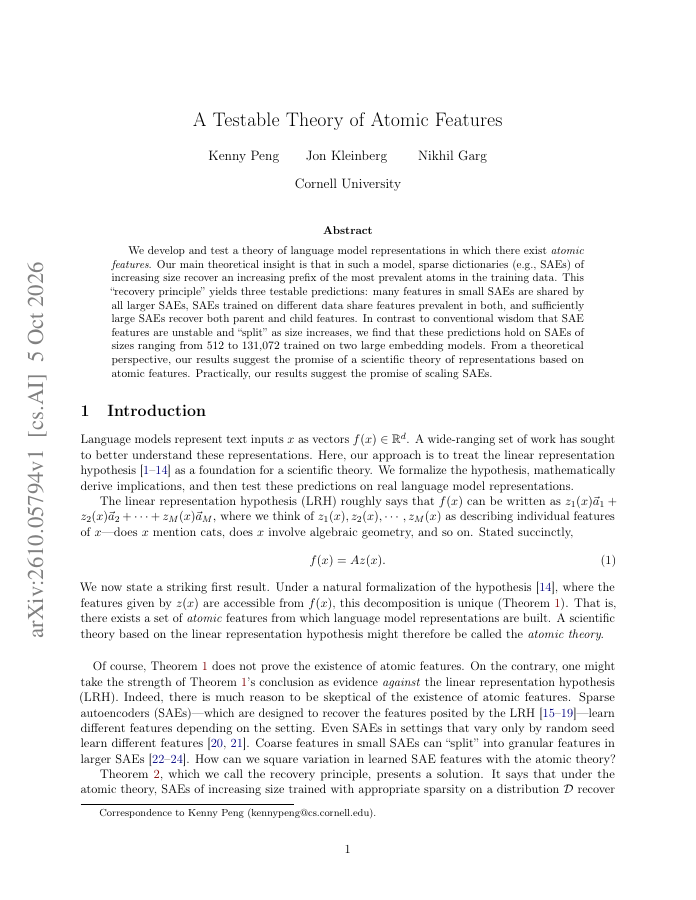
We develop and test a theory of language model representations in which there exist atomic features. Our main theoretical insight is that in such a model, sparse dictionaries (e.g., SAEs) of increasing size recover an increasing prefix of the most prevalent atoms in the training…
5 Oct 2026
Deterministic benchmark scores show that an agent received credit, but not whether that credit was earned, reported honestly, or would hold on a second run. We introduce a Trust Layer for Agent Evaluation, an additive post-hoc framework that reports, beside each recorded score,…
4 Oct 2026
An electromagnetic inversion scheme that integrates stochastic optimization (STO) and plug-and-play (PNP) regularization into contrast-source inversion (CSI), termed STO-PNP-CSI, is developed.
4 Oct 2026
Sensing technologies have advanced rapidly across industries ranging from energy to automotive manufacturing. These systems generate high-dimensional (HD) data characterized by complex nonlinear patterns and strong temporal dependencies.
4 Oct 2026
This paper presents the workflow for building an automated ArcGIS Pro tool using ArcPy to extract the Land Surface Temperature (LST) from Landsat 7, 8 and 9 datasets. The tool eliminates the need for manual band selection and repetitive raster computations by automating the…
4 Oct 2026
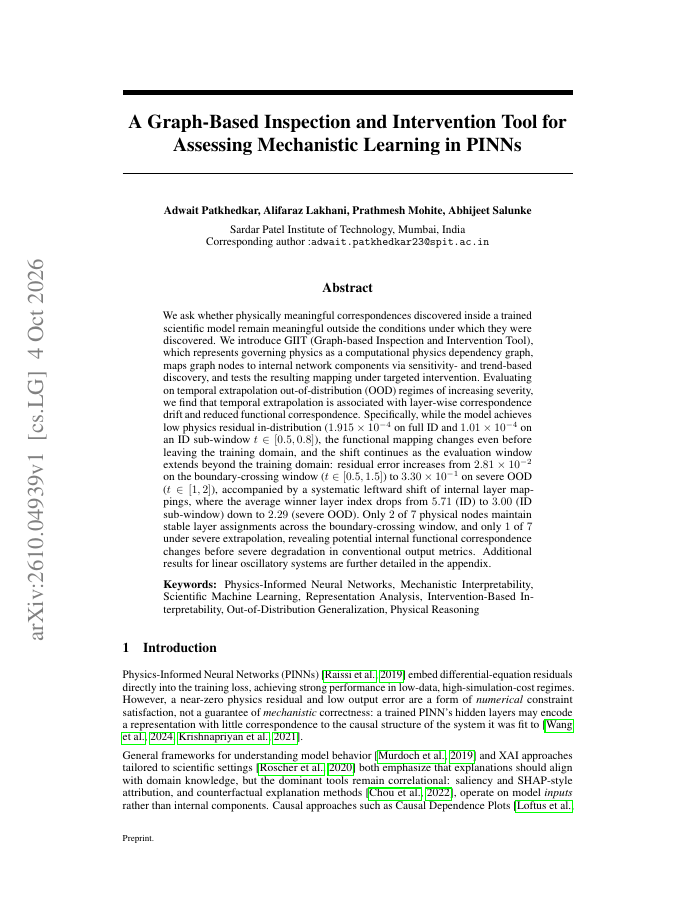
We ask whether physically meaningful correspondences discovered inside a trained scientific model remain meaningful outside the conditions under which they were discovered.
4 Oct 2026
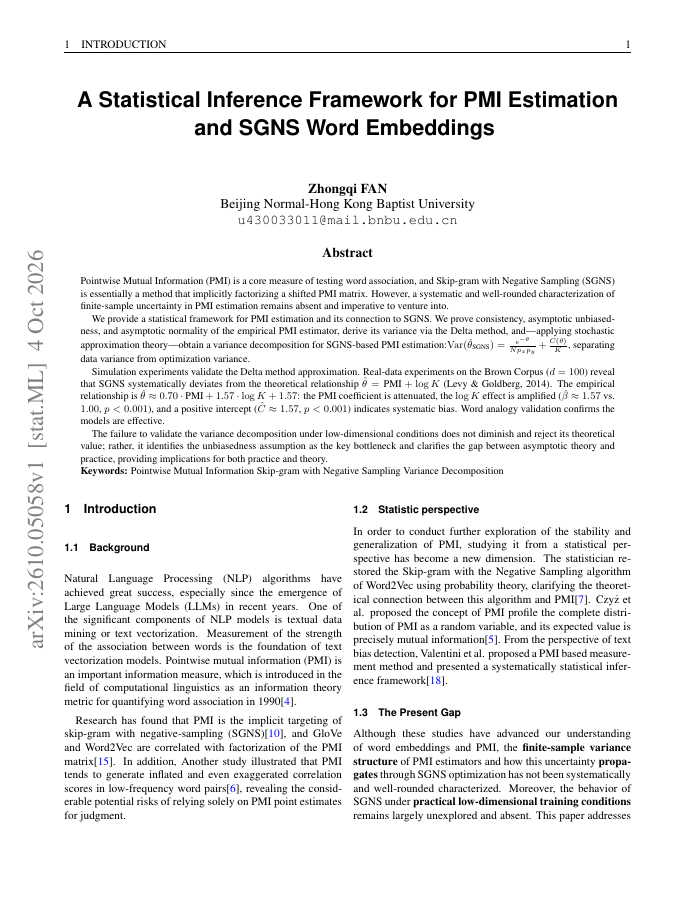
Pointwise Mutual Information (PMI) is a core measure of testing word association, and Skip-gram with Negative Sampling (SGNS) is essentially a method that implicitly factorizes a shifted PMI matrix.
4 Oct 2026
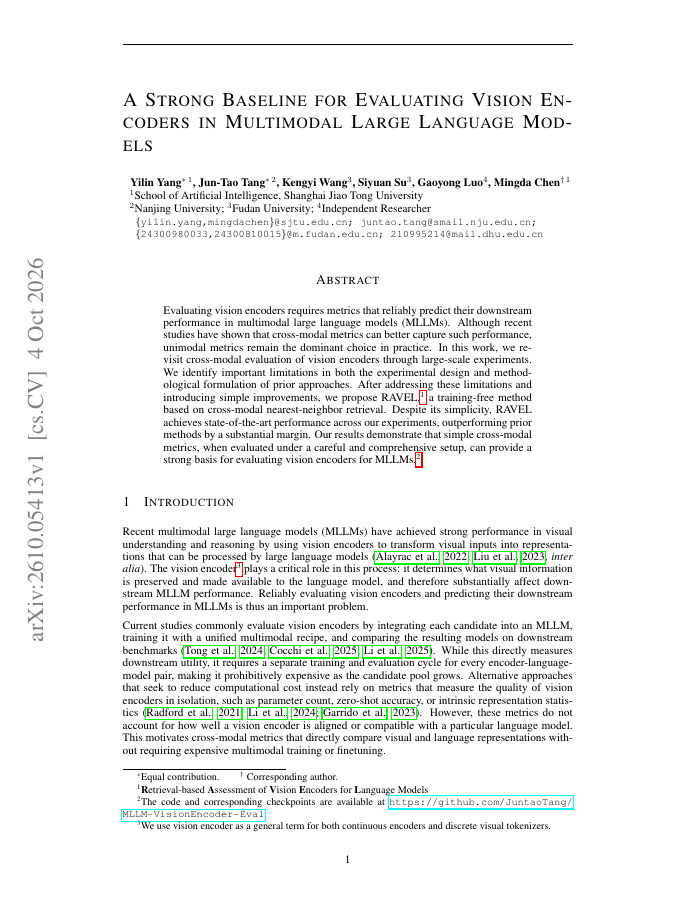
Evaluating vision encoders requires metrics that reliably predict their downstream performance in multimodal large language models (MLLMs). Although recent studies have shown that cross-modal metrics can better capture such performance, unimodal metrics remain the dominant…
4 Oct 2026
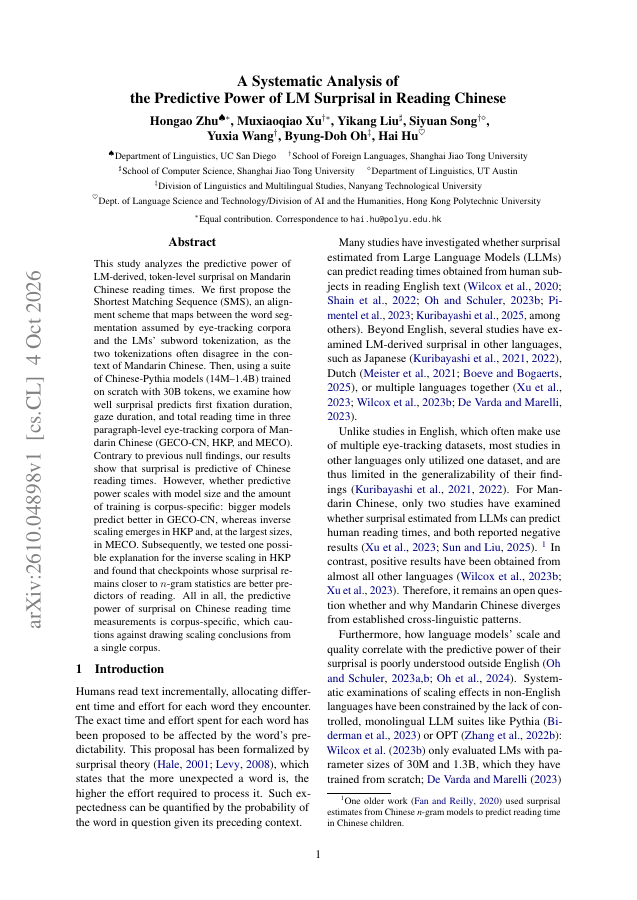
This study analyzes the predictive power of LM-derived, token-level surprisal on Mandarin Chinese reading times. Using a suite of Chinese-Pythia models (14M--1.4B) trained from scratch with 30B tokens, we examine how well surprisal predicts first fixation duration, gaze…
3 Oct 2026
We propose $\mathrm{TRIZ}^{a}$ (TRIZ exponentiated by an agent), a general R\&D automation paradigm that combines TRIZ inventive theory with LLM-driven agent evolutionary search.