5 Aug 2026
Integrated Sensing and Communication (ISAC) combines sensing and communication to efficiently utilize wireless resources and is emerging as a key paradigm for next-generation wireless networks.
Trending research and the full catalog - each paper linked to the benchmarks, methods, and models it introduces.
Filtering here covers the 2,000 most recent papers, as much as one page can hold in memory. See the full index of 22,736 papers.
5 Aug 2026
Integrated Sensing and Communication (ISAC) combines sensing and communication to efficiently utilize wireless resources and is emerging as a key paradigm for next-generation wireless networks.
5 Aug 2026
Large Language Models (LLMs) are accelerating biological research, yet this same capability poses a critical biosecurity threat: models that assist in protein engineering can equally be prompted to generate predicted toxin-like sequences, potentially lowering the barrier to…
5 Aug 2026
As AI systems become increasingly integrated into diverse interfaces and applications, model-centric audits are insufficient to address risks arising from interactions among system components and deployment environments.
5 Aug 2026
Prenatal ultrasound imaging is key for assessing fetal health, but AI progress is limited by scarce, privacy-restricted, and hard-to-annotate datasets. We propose a high-resolution fetal ultrasound synthesis framework based on the EDM2 diffusion architecture, trained on multiple…
5 Aug 2026
The emergence of the ISO standard GQL introduces a powerful query language extending first-order logic with controlled recursion, raising the question of its applicability to evaluation of ontology-mediated queries (OMQs).
5 Aug 2026
We propose a deep learning framework for image restoration from images degraded by both multiplicative Gamma noise and blur. Unlike conventional deep equilibrium (DEQ) models that rely on implicit neural regularization, the proposed method learns an explicit and interpretable…
5 Aug 2026
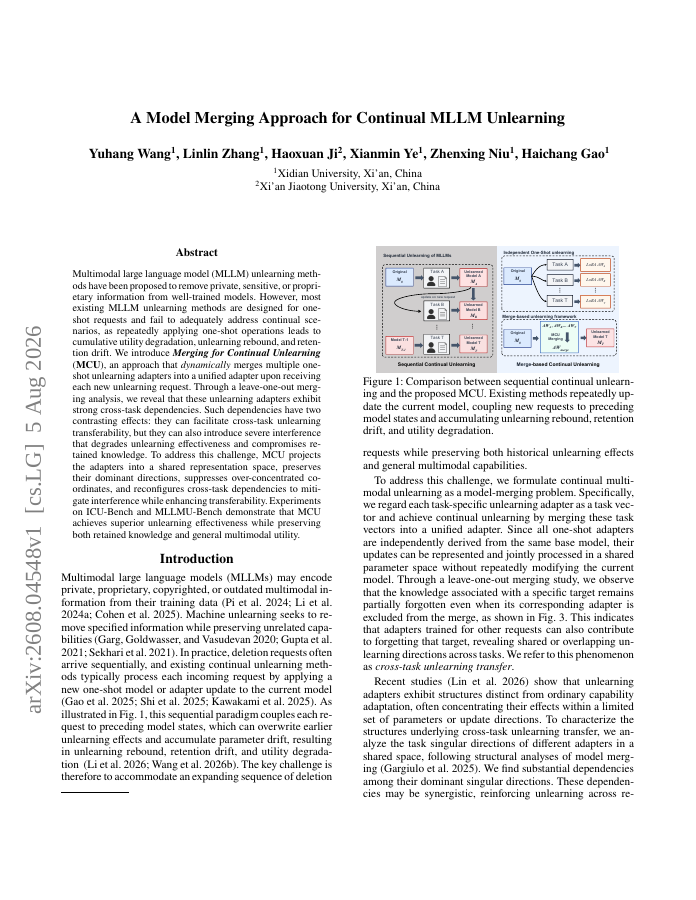
Multimodal large language model (MLLM) unlearning methods have been proposed to remove private, sensitive, or proprietary information from well-trained models. However, most existing MLLM unlearning methods are designed for one-shot requests and fail to adequately address…
5 Aug 2026
Part-of-speech tagging for low-resource languages remains challenging due to limited annotated data, especially for linguistically complex languages. Gaidhlig (Scottish Gaelic) is a morphologically rich and endangered language with limited digital resources, making it suitable…
5 Aug 2026
We developed a unified covariate-adjusted causal inference framework for estimating the desirability of outcome ranking (DOOR) probability for benefit-risk evaluation in randomized trials and observational studies.
4 Aug 2026
This article analyses narrative mechanisms that are common in dialogues with LLM chatbots. In combination, these mechanisms produce an interactional strategy for maximising user engagement, which we call affirmative narration.
4 Aug 2026
Reasoning-based large language model (LLM) safeguards improve safety classification accuracy by generating explicit rationales before making decisions. However, generating explicit rationales adds substantial decoding overhead to every safety decision, while readable…
4 Aug 2026
Feature selection is a critical step in electronic health record (EHR)-based predictive modeling, where input variables are often high-dimensional, sparse, noisy, and redundant.
4 Aug 2026
For a Markov kernel $T$ with an invariant probability measure $π$, we give a self-contained proof of the Markov chain convergence theorem via a criterion called asymptotic equivalence with the target.
4 Aug 2026
We develop a fully nonlinear structural vector autoregressive framework in which the contemporaneous structural mapping may be nonlinear and non-additive. Identification is achieved by exploiting variation in the conditional distributions of the mutually independent structural…
4 Aug 2026
As autonomous agents powered by foundation models are increasingly integrated into social and economic systems, understanding the principles governing their collective behavior is essential for ensuring safety and cooperation.
4 Aug 2026
Pretrained large language models (LLMs) have demonstrated in-context learning (ICL) capabilities for numerical inference over sequences serialized as text. Prior work has identified and characterized this form of numerical inference primarily through output-level evaluations…
4 Aug 2026
Diffusion policies have shown strong performance in learning complex, multi-modal behaviors for robotic manipulation. However, their application to contact-rich disassembly tasks remains limited by a key trade-off: the iterative denoising process introduces inference latencies…
4 Aug 2026
Sign language recognition (SLR) enhances communication between hearing and hearing-impaired individuals. Although deep learning (DL) has achieved promising performance in SLR, its high computational cost limits deployment on edge devices.
4 Aug 2026
The personal archive of Konstantin Tsiolkovsky (1857-1935) is held as fond 555 of the Archive of the Russian Academy of Sciences. The archive scanned the fond and published the images, but with no queryable catalogue, no full-text search and no dataset: the holdings can only be…
4 Aug 2026
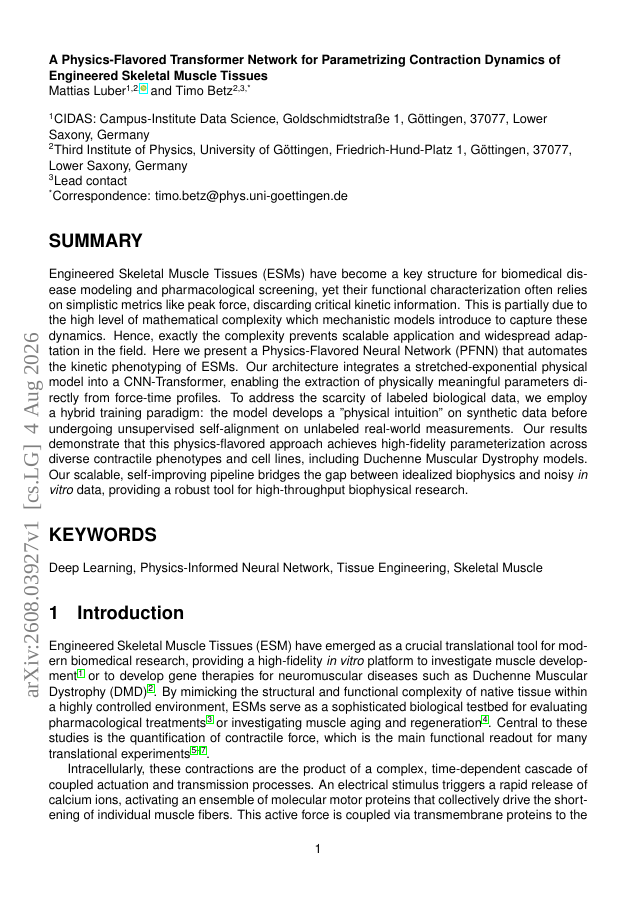
Engineered Skeletal Muscle Tissues (ESMs) have become a key structure for biomedical disease modeling and pharmacological screening, yet their functional characterization often relies on simplistic metrics like peak force, discarding critical kinetic information.
4 Aug 2026
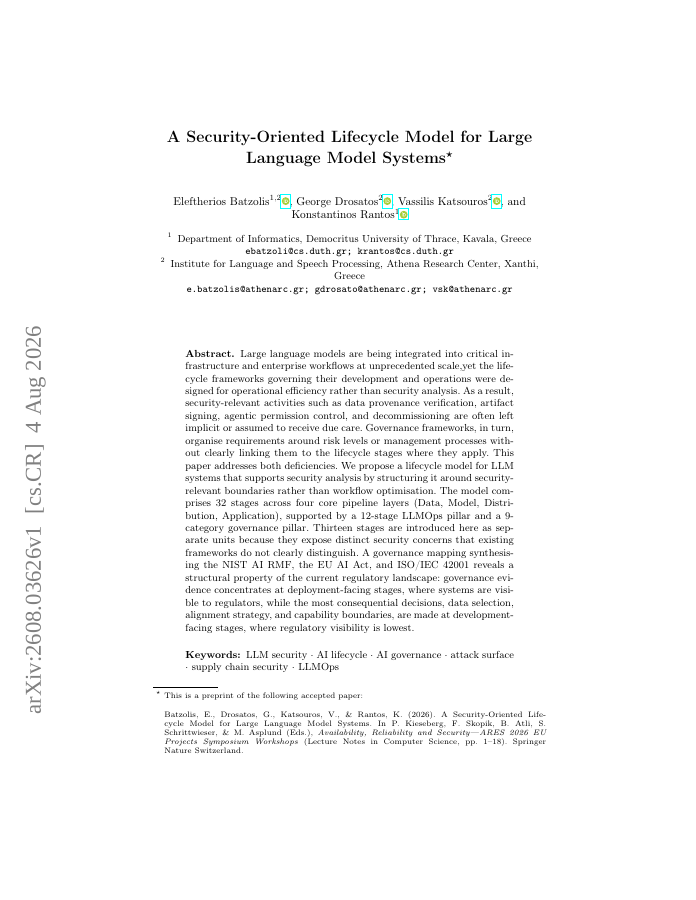
Large language models are being integrated into critical infrastructure and enterprise workflows at unprecedented scale,yet the lifecycle frameworks governing their development and operations were designed for operational efficiency rather than security analysis.
4 Aug 2026
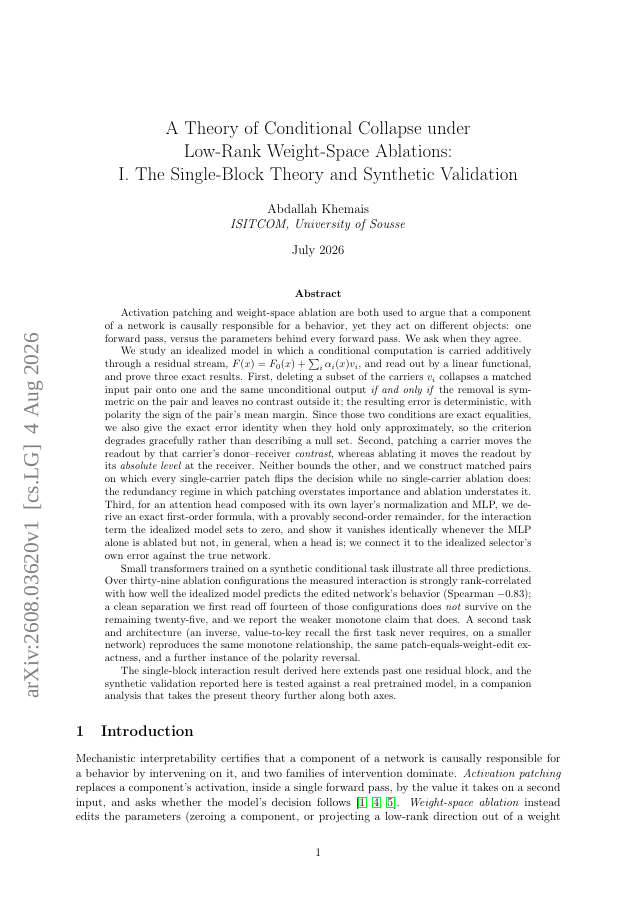
Activation patching and weight-space ablation both claim a component is causally responsible for a behavior, yet they act on different objects: one forward pass versus the parameters behind every forward pass. We ask when they agree.
4 Aug 2026
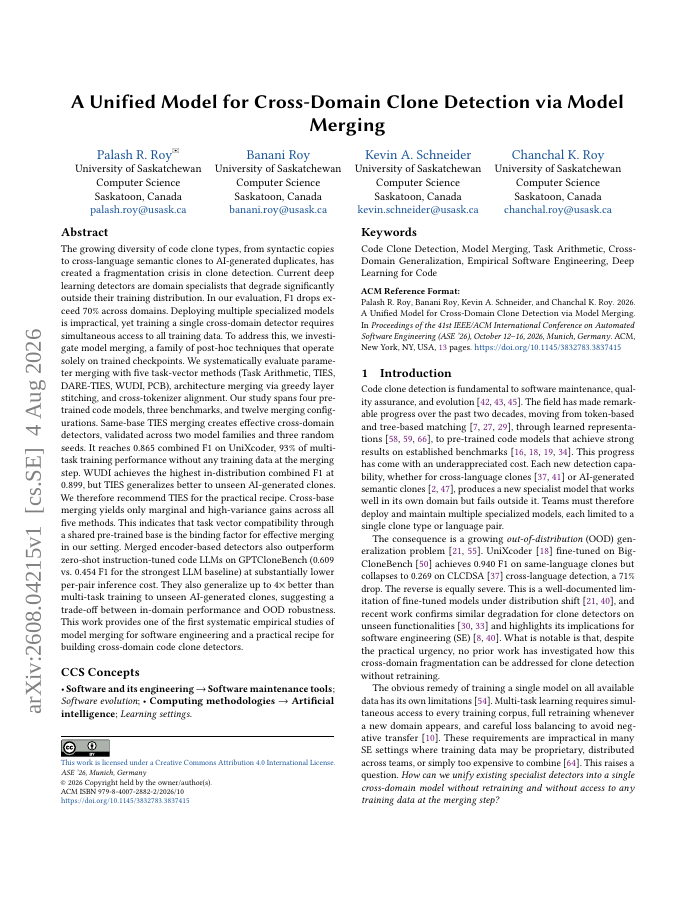
The growing diversity of code clone types, from syntactic copies to cross-language semantic clones to AI-generated duplicates, has created a fragmentation crisis in clone detection.
3 Aug 2026
Large Language Model (LLM) agents rely on multi-stage agentic workflows, with stages such as memory, planning, and tool execution, to accomplish complex tasks. However, risks may emerge at different stages, propagate across steps, and become difficult to detect and mitigate.