27 Aug 2026
The recently introduced block-sparse featurizer (BSF; Fel et al., 2026) is similar to a sparse autoencoder (SAE), but its atomic unit is a small subspace (a block of directions) rather than a single direction.
Trending research and the full catalog - each paper linked to the benchmarks, methods, and models it introduces.
Filtering here covers the 2,000 most recent papers, as much as one page can hold in memory. See the full index of 22,381 papers.
27 Aug 2026
The recently introduced block-sparse featurizer (BSF; Fel et al., 2026) is similar to a sparse autoencoder (SAE), but its atomic unit is a small subspace (a block of directions) rather than a single direction.
27 Aug 2026
Quantile temporal-difference learning (QTD) is an effective method for learning return distributions through quantile approximation, yet its finite-time behavior remains poorly understood.
27 Aug 2026
Predictive Process Monitoring (PPM) of collaborative, inter-organizational processes requires reasoning over multiple interdependent entities, including participants, messages, local executions, and the global collaboration case.
27 Aug 2026
Small language models (sLLMs) are nowadays hosted on devices with limited memory and computational budget. In an autoregressive setup, inference is memory-bandwidth bound: uniform quantization is often detrimental to such models, since their architecture has limited redundancies…
27 Aug 2026
In the present work an efficient border control management procedure is proposed. Compared to operational queue management systems, whose operations are based on mostly static data, the proposed work takes into account dynamic traffic conditions, thus enabling optimal…
27 Aug 2026
Adverse drug reactions (ADRs) are a major, largely preventable source of patient harm. In high-income settings, electronic health records store a patient's allergy history and warn prescribers when a contraindicated drug is ordered; in rural Bangladeshi public hospitals no such…
27 Aug 2026
Model merging enables combining multiple fine-tuned models without additional training, but its safety implications remain poorly understood. Prior work primarily attributes merging risks to unsafe constituent models, implicitly assuming that merging individually aligned models…
27 Aug 2026
Reinforcement learning from human feedback (RLHF) has become the dominant paradigm for aligning large language models (LLMs) with human preferences. However, traditional RLHF relies on scalar reward signals that lack interpretability and fail to capture the multifaceted nature…
27 Aug 2026
Answering questions over real-world documents requires processing long inputs that interleave text with tables. Optical context compression, which represents context as images, promises to reduce token cost, but its effect on table understanding remains unclear.
27 Aug 2026
Model selection becomes particularly challenging under strong predictor dependence and model-class uncertainty, especially when there are exponentially many models. We propose a Descriptive-Complexity Information Criterion (DCIC) that regularizes large candidate model…
27 Aug 2026
Decentralized learning systems aim to collaboratively train models across multiple clients without relying on a central coordinator. While decentralization improves scalability, privacy, and robustness, it also exacerbates three fundamental challenges: statistical heterogeneity…
27 Aug 2026
Control system design is critical for modern industry, such as chemical process temperature regulation and aero-engine control. However,traditional control design workflows rely heavily on expert knowledge and extensive manual parameter tuning, resulting in limited efficiency…
26 Aug 2026
Reasoning in language allows foundation models to spend more test-time compute on hard problems, such as those requiring decomposition, constraint tracking, and prediction of future consequences.
26 Aug 2026
Generative video models now synthesize footage nearly indistinguishable from reality. Their promise as interactive tools hinges on fine-grained control of how objects and the camera move over time, yet each existing approach captures only part of this: camera-parameter methods…
26 Aug 2026
We present a six-stage framework for auditing the reproducibility of scientific claims across a research literature within the computer science domain, and instantiate our framework for the neuro-symbolic AI (NSAI) subdomain.
26 Aug 2026
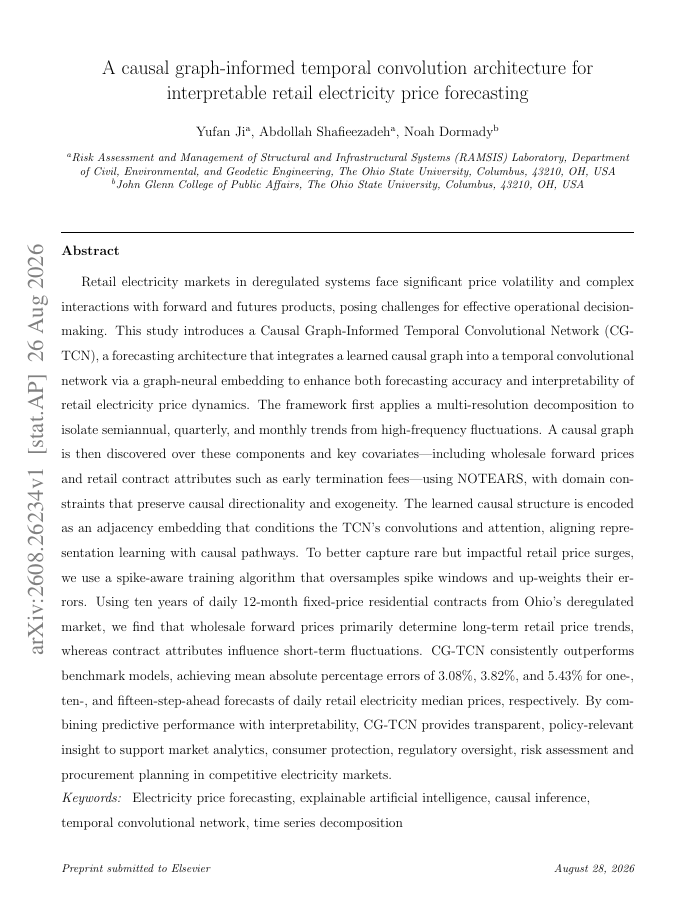
Retail electricity markets in deregulated systems face significant price volatility and complex interactions with forward and futures products, posing challenges for effective operational decision-making.
26 Aug 2026
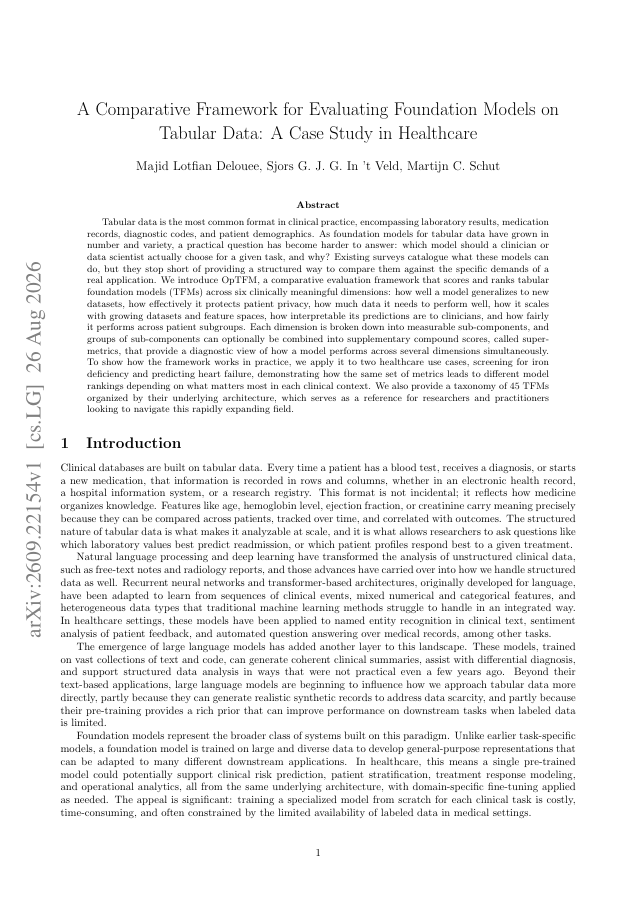
Tabular data is the most common format in clinical practice, encompassing laboratory results, medication records, diagnostic codes, and patient demographics. As foundation models for tabular data have grown in number and variety, a practical question has become harder to answer:…
26 Aug 2026
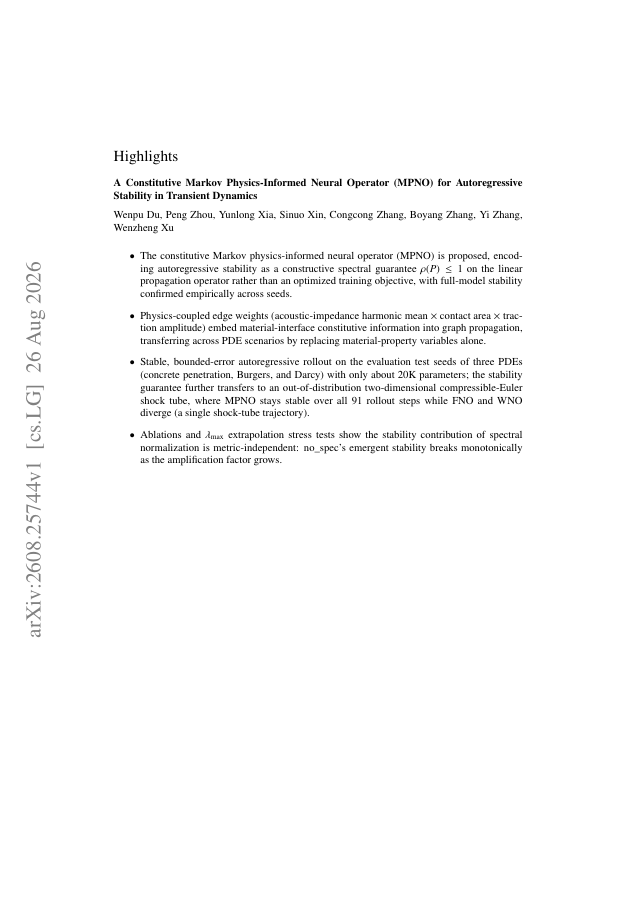
Neural operators applied to transient-dynamics PDEs with strong discontinuities exhibit autoregressive instability: in concrete-penetration stress-field prediction, the wavelet neural operator (WNO) diverges in autoregressive rollout, while MeshGraphNets collapse to zero…
26 Aug 2026
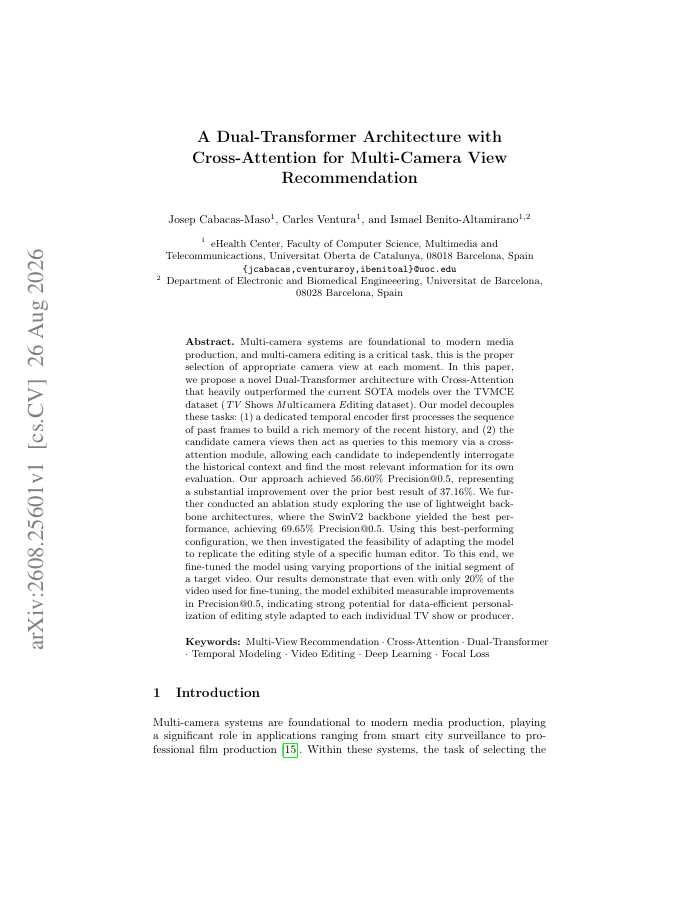
Multi-camera systems are foundational to modern media production, and multi-camera editing is a critical task. This involves the proper selection of the appropriate camera view at each moment.
26 Aug 2026
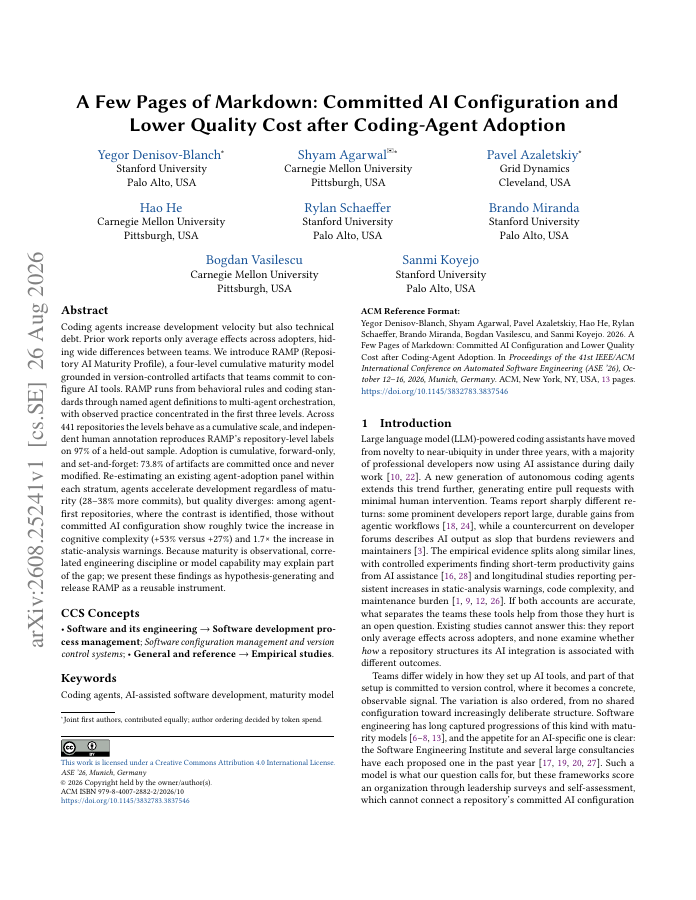
Coding agents increase development velocity but also technical debt. Prior work reports only average effects across adopters, hiding wide differences between teams. We introduce RAMP (Repository AI Maturity Profile), a four-level cumulative maturity model grounded in…
26 Aug 2026
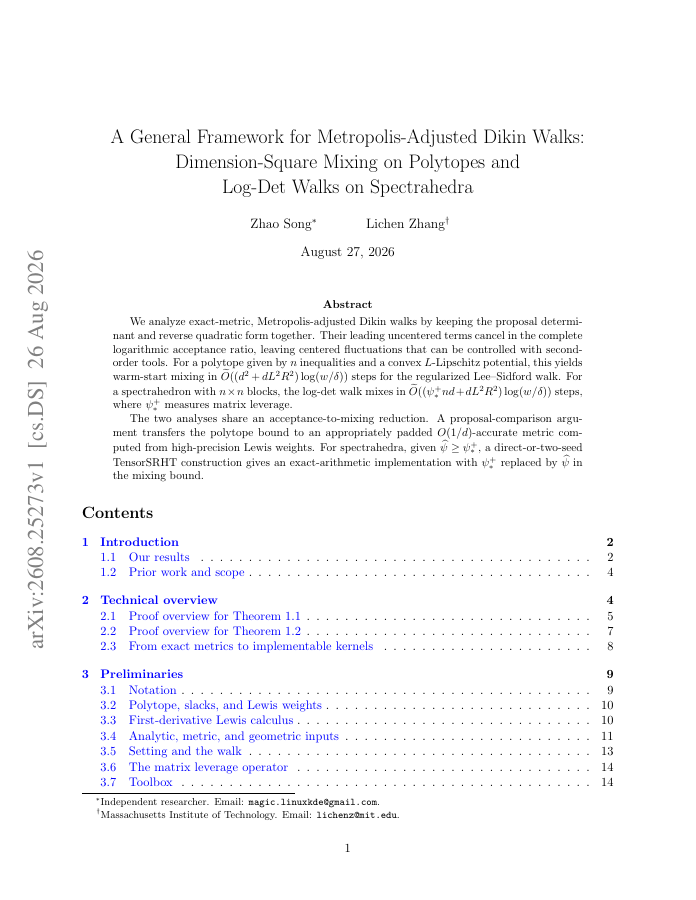
We analyze exact-metric, Metropolis-adjusted Dikin walks by keeping the proposal determinant and reverse quadratic form together. Their leading uncentered terms cancel in the complete logarithmic acceptance ratio, leaving centered fluctuations that can be controlled with…
26 Aug 2026
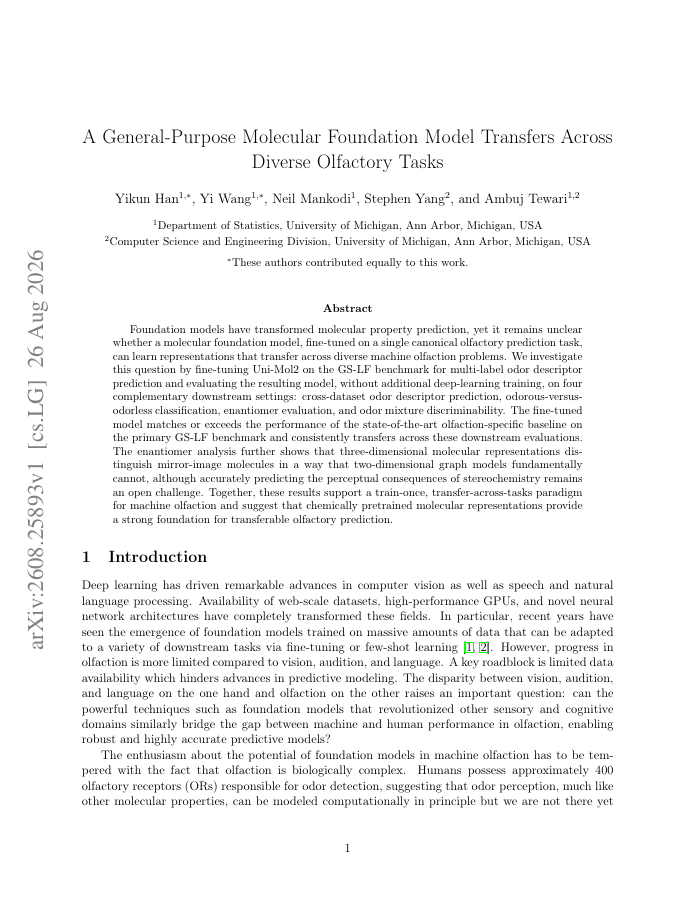
Foundation models have transformed molecular property prediction, yet it remains unclear whether a molecular foundation model, fine-tuned on a single canonical olfactory prediction task, can learn representations that transfer across diverse machine olfaction problems.
26 Aug 2026
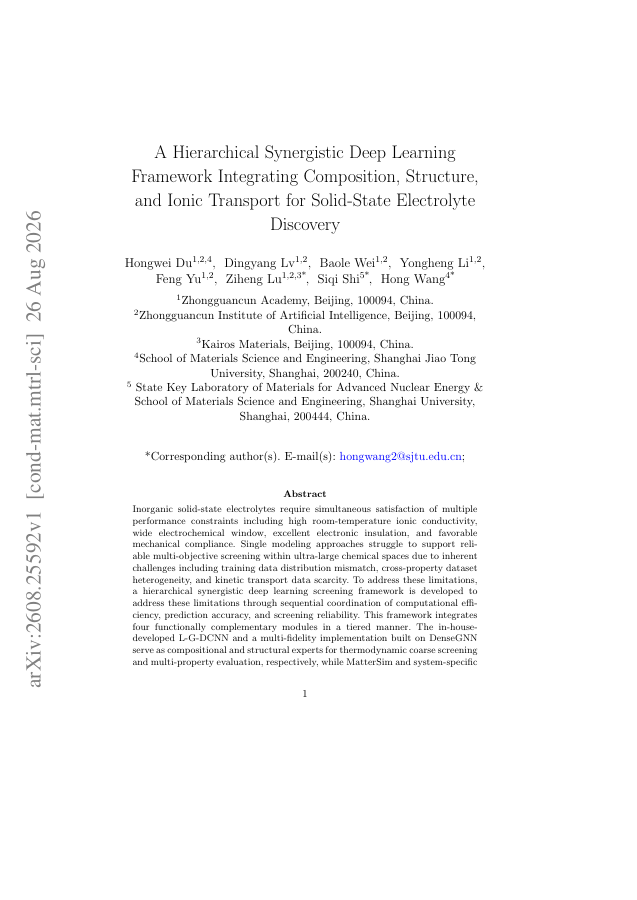
Inorganic solid-state electrolytes must combine high room-temperature ionic conductivity, a wide electrochemical window, excellent electronic insulation, and favorable mechanical compliance.
26 Aug 2026
The success of any mobile application relies on its usefulness and rating is considered as an important measure in this regard. This research work focuses on identifying usability factors, which contribute significantly towards the rating of M-commerce apps.