9 Oct 2026
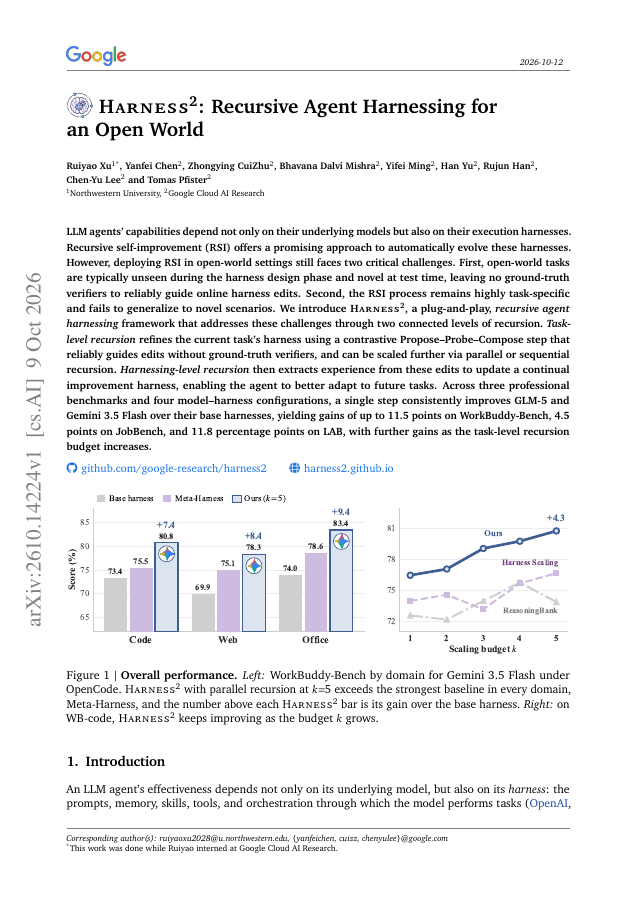
LLM agents' capabilities depend not only on their underlying models but also on their execution harnesses. Recursive self-improvement (RSI) offers a promising approach to automatically evolve these harnesses.
Trending research and the full catalog - each paper linked to the benchmarks, methods, and models it introduces.
Filtering here covers the 2,000 most recent papers, as much as one page can hold in memory. See the full index of 22,663 papers.
9 Oct 2026
LLM agents' capabilities depend not only on their underlying models but also on their execution harnesses. Recursive self-improvement (RSI) offers a promising approach to automatically evolve these harnesses.
6 Oct 2026
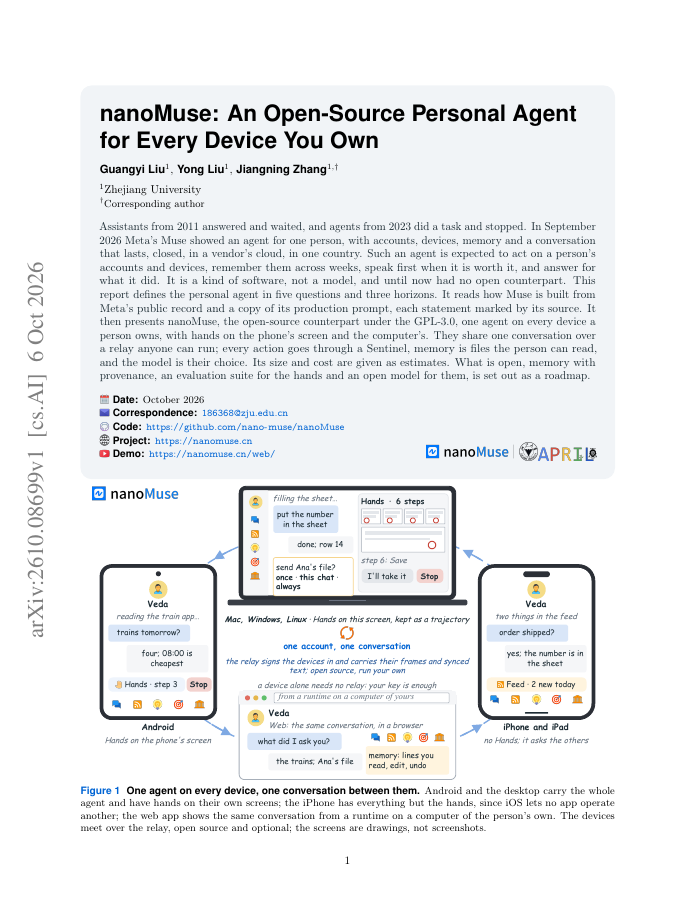
Assistants from 2011 answered and waited, and agents from 2023 did a task and stopped. In September 2026 Meta's Muse showed an agent for one person, with accounts, devices, memory and a conversation that lasts, closed, in a vendor's cloud, in one country.
8 Oct 2026
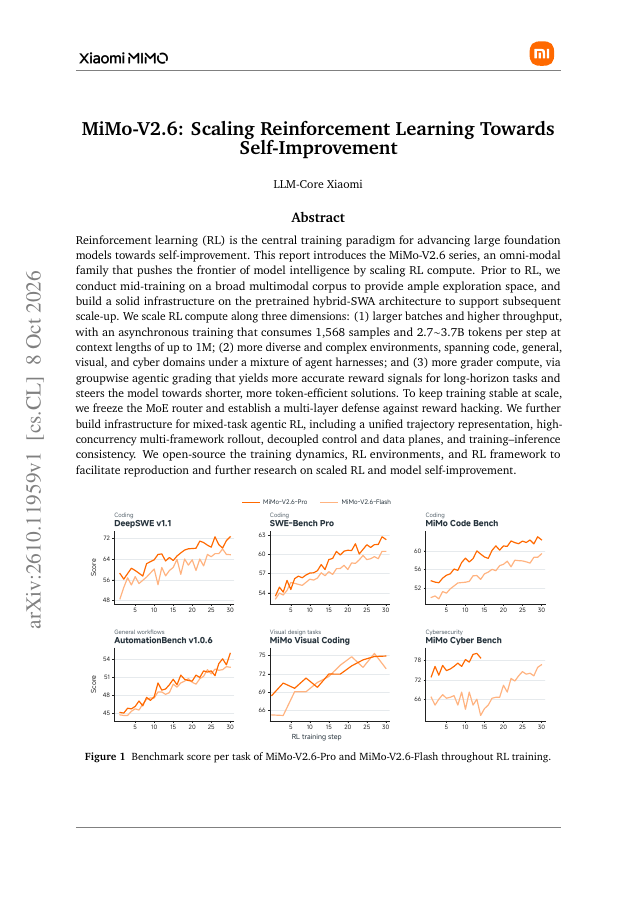
Reinforcement learning (RL) is the central training paradigm for advancing large foundation models towards self-improvement. This report introduces the MiMo-V2.6 series, an omni-modal family that pushes the frontier of model intelligence by scaling RL compute.
8 Oct 2026
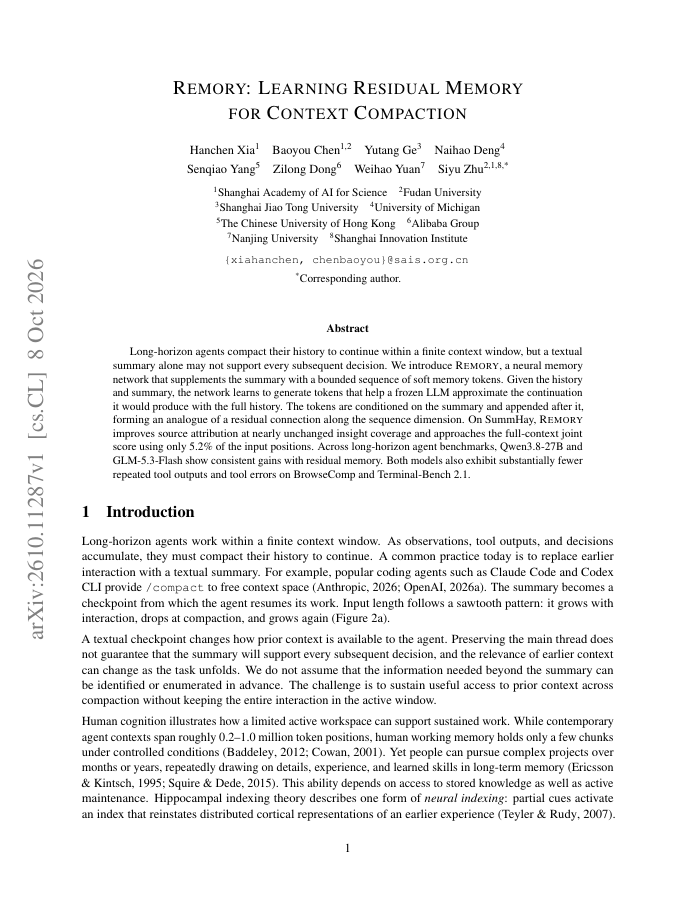
Long-horizon agents compact their history to continue within a finite context window, but a textual summary alone may not support every subsequent decision. We introduce REMORY, a neural memory network that supplements the summary with a bounded sequence of soft memory tokens.
13 Oct 2026
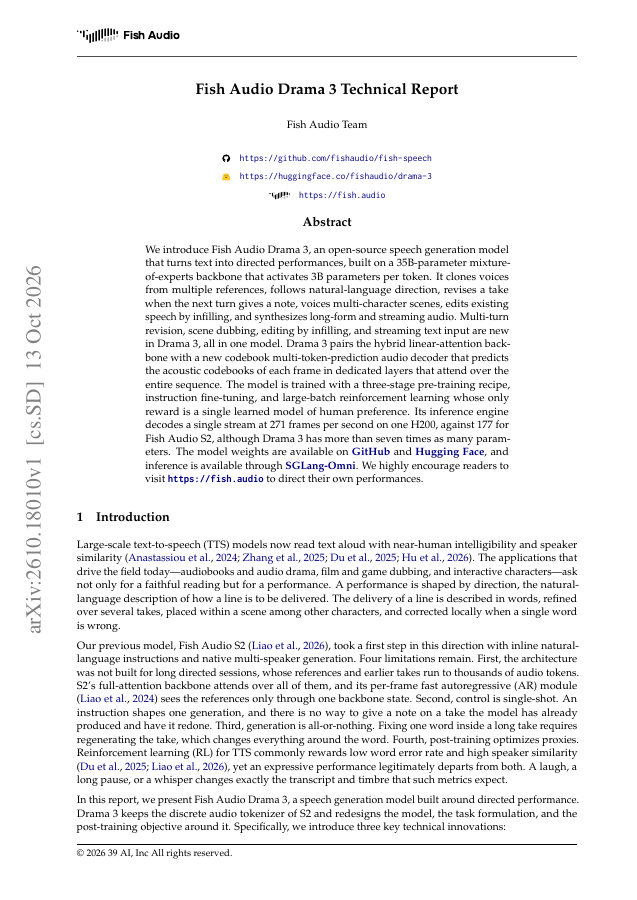
We introduce Fish Audio Drama 3, an open-source speech generation model that turns text into directed performances, built on a 35B-parameter mixture-of-experts backbone that activates 3B parameters per token.
19 Oct 2026
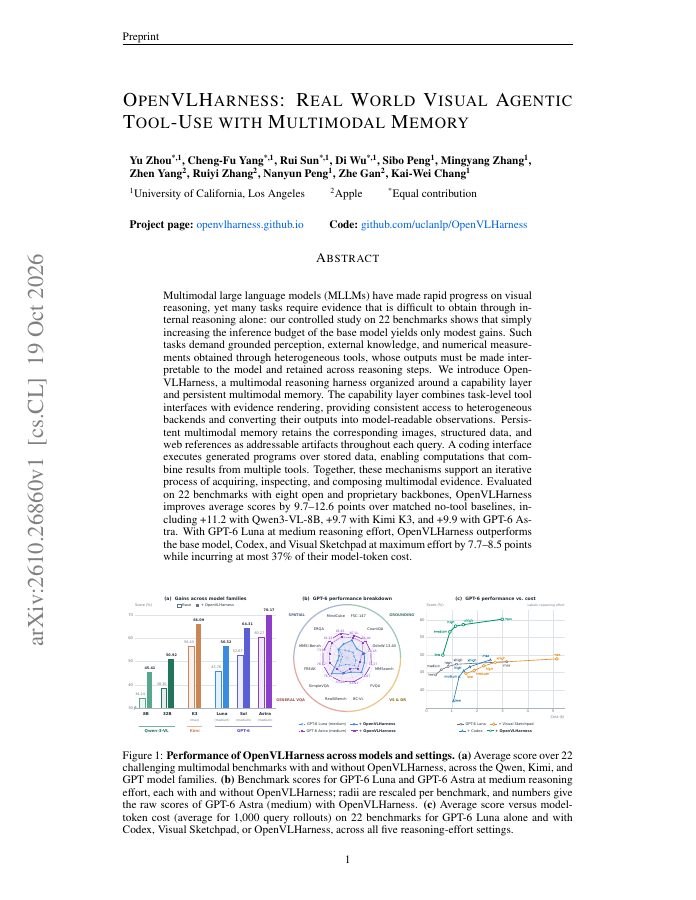
Multimodal large language models (MLLMs) have made rapid progress on visual reasoning, yet many tasks require evidence that is difficult to obtain through internal reasoning alone: our controlled study on 22 benchmarks shows that simply increasing the inference budget of the…
16 Oct 2026
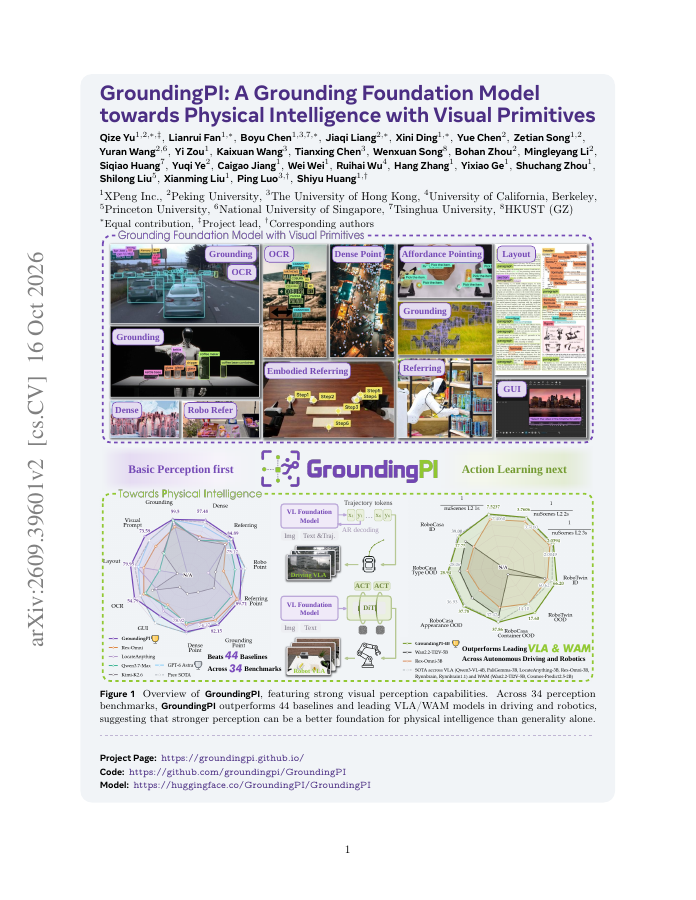
Precise grounding matters. It specifies which object is the target and where that object is, even in clutter and for tiny objects, and it has to be fast enough for closed-loop control.
9 Oct 2026
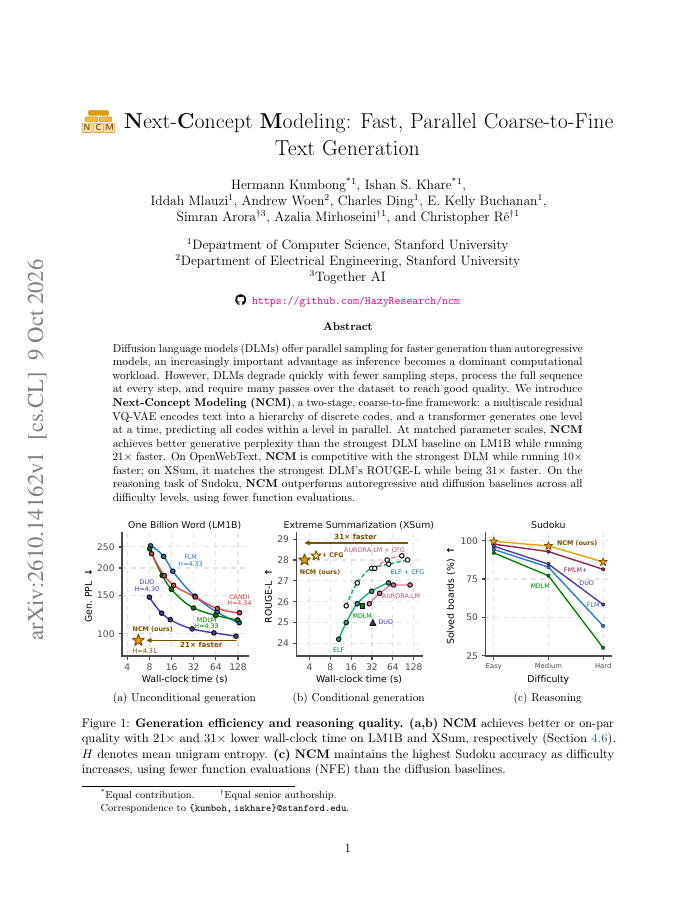
Diffusion language models (DLMs) offer parallel sampling for faster generation than autoregressive models, an increasingly important advantage as inference becomes a dominant computational workload.
19 Oct 2026
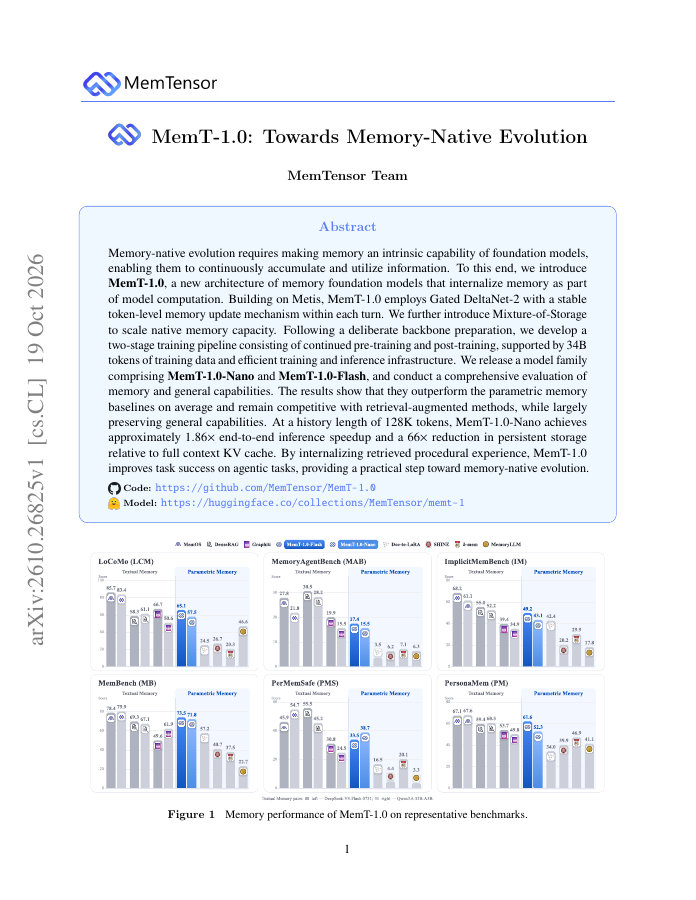
Memory-native evolution requires making memory an intrinsic capability of foundation models, enabling them to continuously accumulate and utilize information. To this end, we introduce MemT-1.0, a new architecture of memory foundation models that internalize memory as part of…
13 Oct 2026
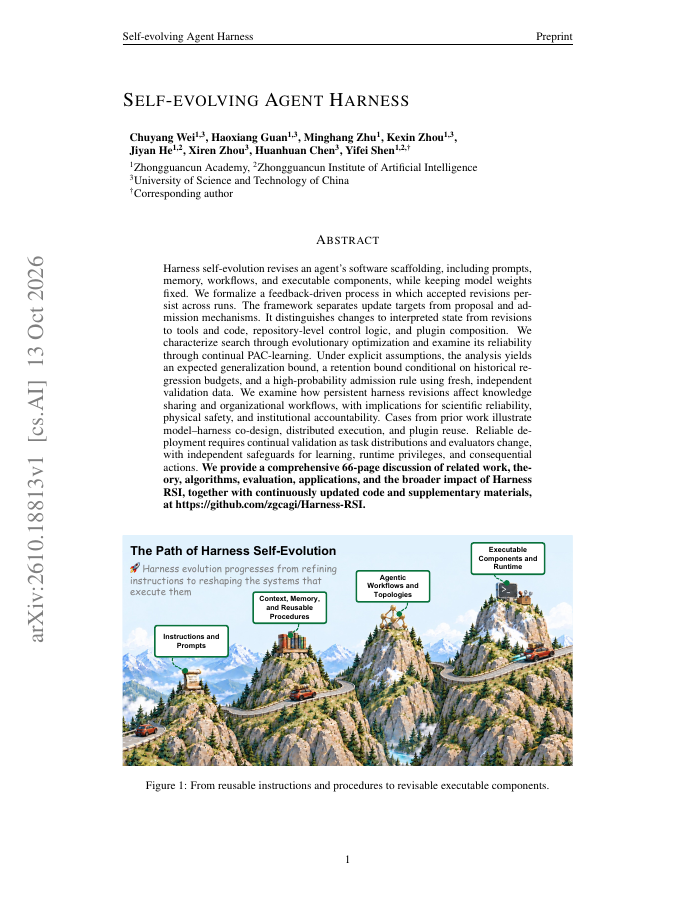
Harness self-evolution revises an agent's software scaffolding, including prompts, memory, workflows, and executable components, while keeping model weights fixed. We formalize a feedback-driven process in which accepted revisions persist across runs.
12 Oct 2026
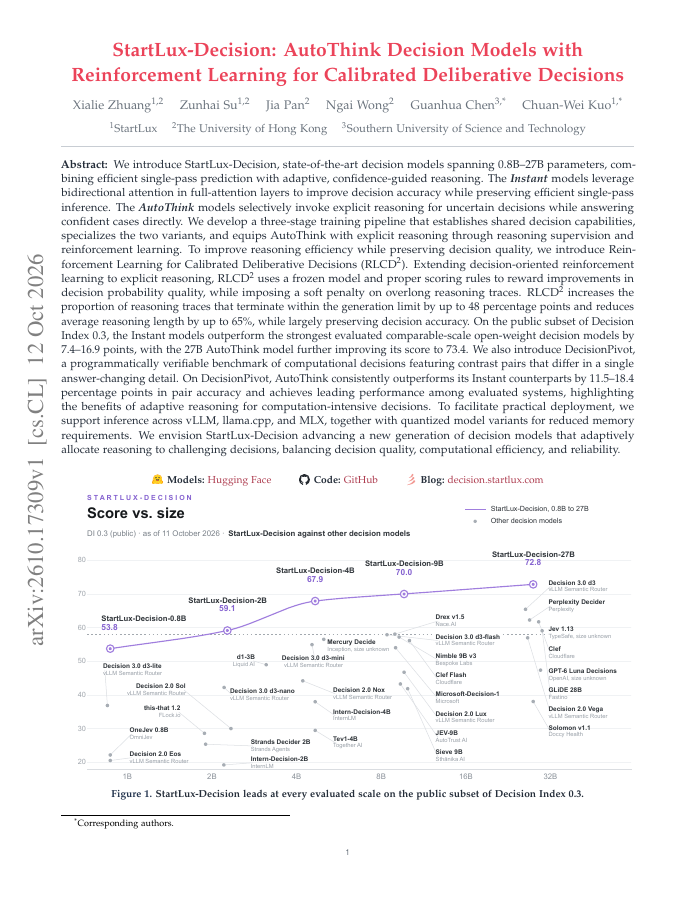
We introduce StartLux-Decision, decision models from 0.8B to 27B parameters that combine efficient single-pass prediction with adaptive, confidence-guided reasoning. The Instant models use bidirectional attention in full-attention layers to improve decision accuracy while…
13 Oct 2026
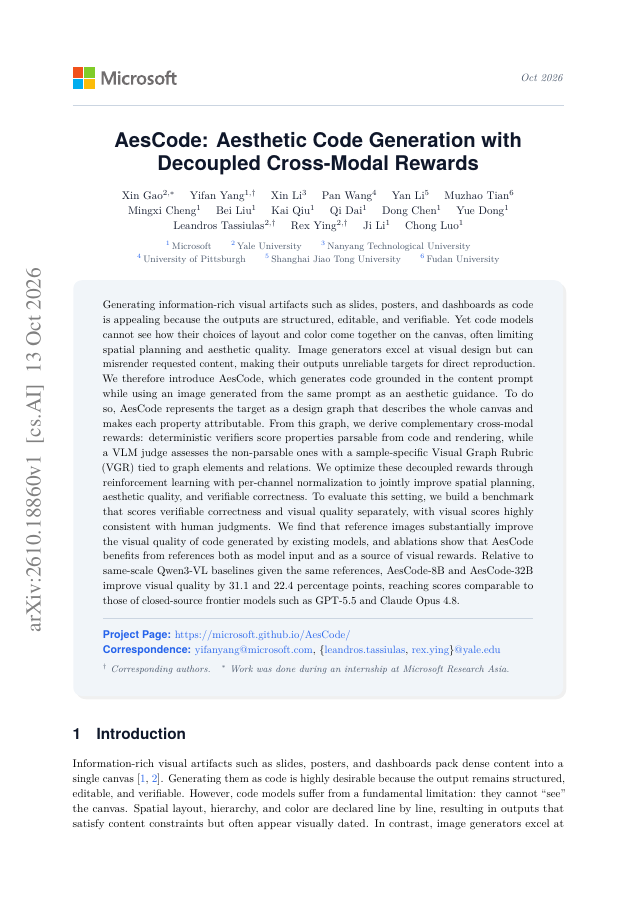
Generating information-rich visual artifacts such as slides, posters, and dashboards as code is appealing because the outputs are structured, editable, and verifiable. Yet code models cannot see how their choices of layout and color come together on the canvas, often limiting…
27 Sep 2026
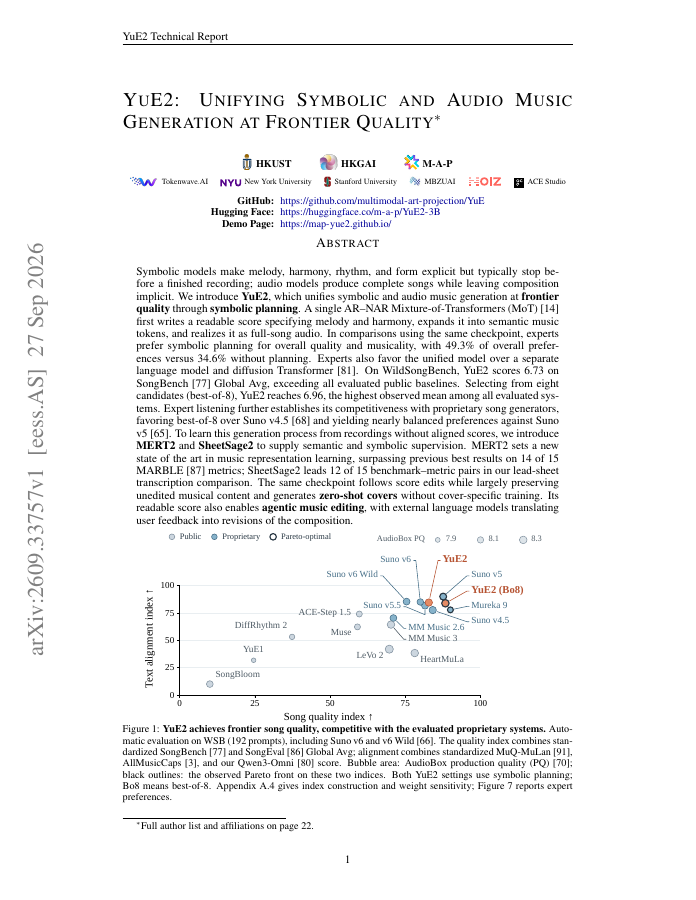
Symbolic models make melody, harmony, rhythm, and form explicit but typically stop before a finished recording; audio models produce complete songs while leaving composition implicit.
7 Oct 2026
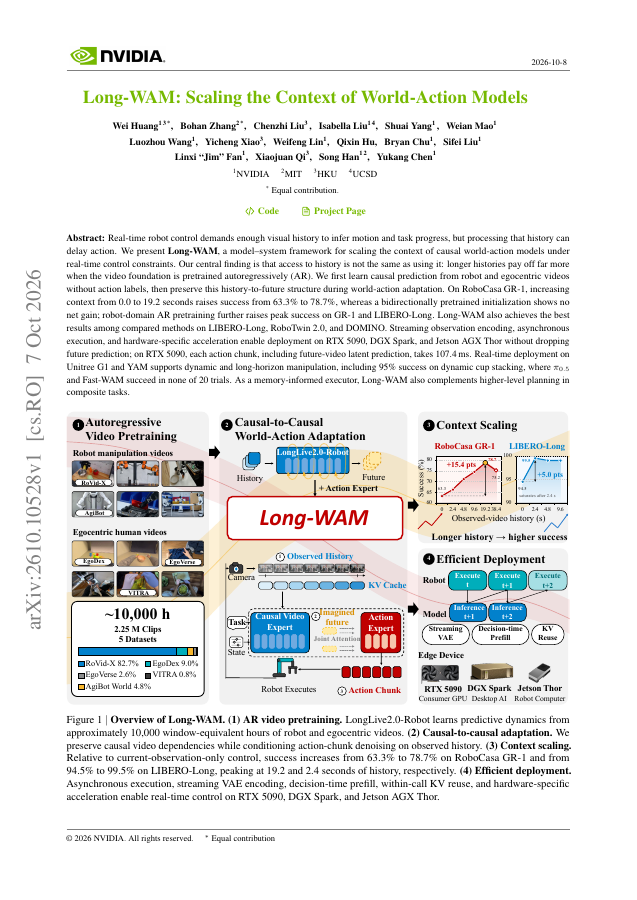
Real-time robot control demands enough visual history to infer motion and task progress, but processing that history can delay action. We present Long-WAM, a model-system framework for scaling the context of causal world-action models under real-time control constraints.
15 Oct 2026
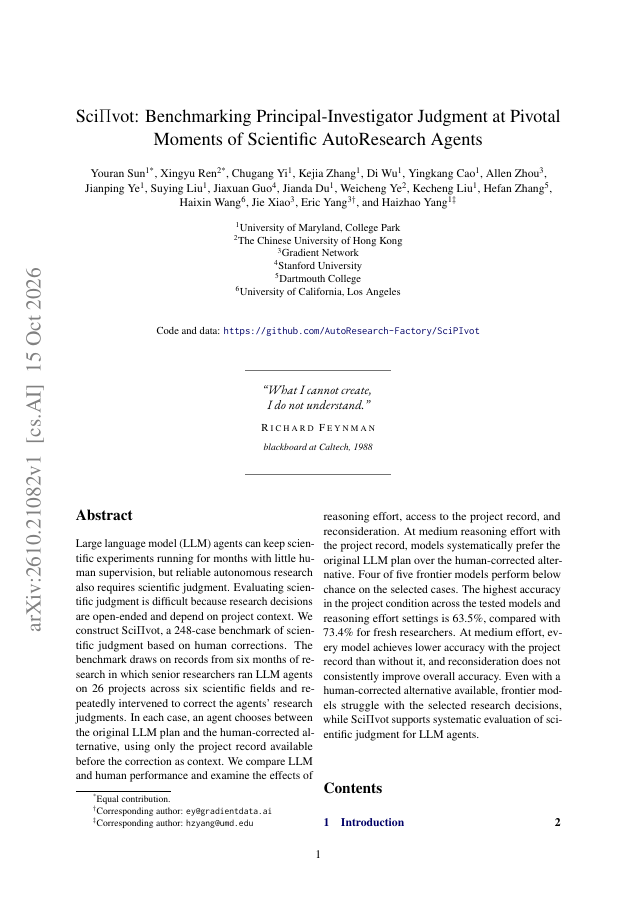
Large language model (LLM) agents can keep scientific experiments running for months with little human supervision, but reliable autonomous research also requires scientific judgment.
26 Sep 2026
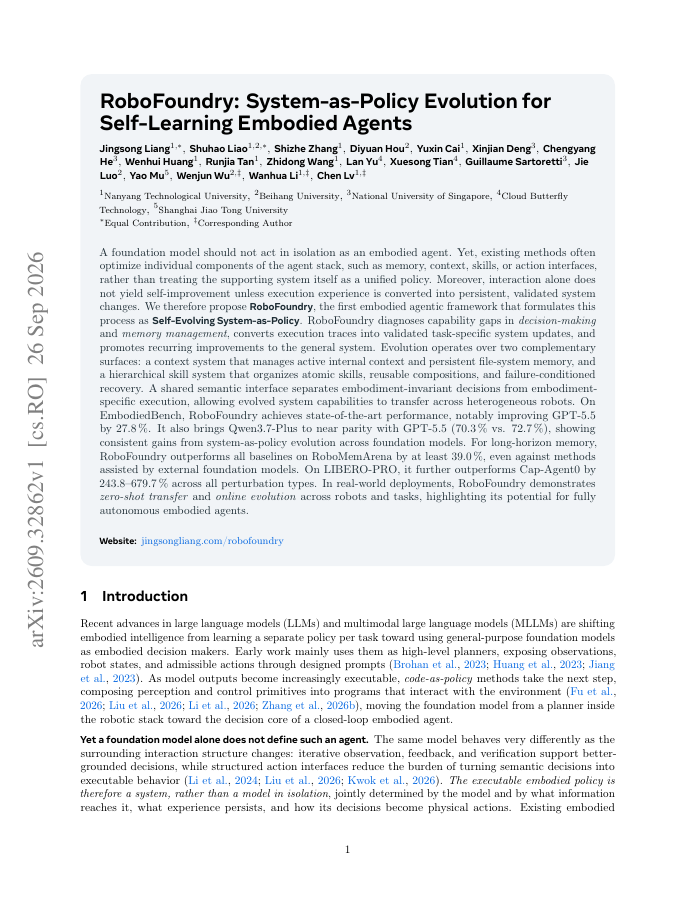
A foundation model should not act in isolation as an embodied agent. Yet, existing methods often optimize individual components of the agent stack, such as memory, context, skills, or action interfaces, rather than treating the supporting system itself as a unified policy.
15 Oct 2026
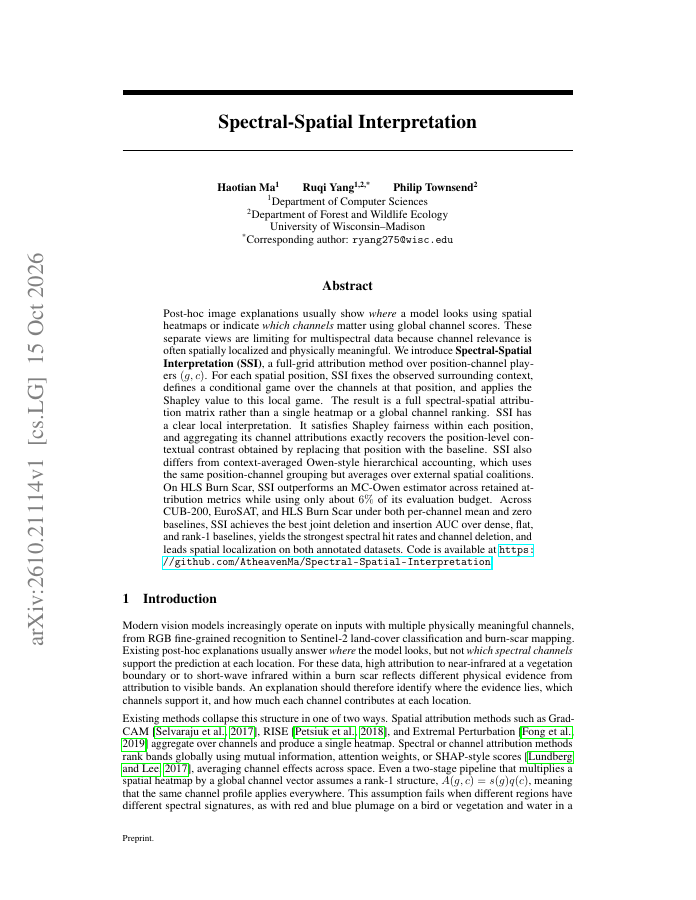
Post-hoc image explanations usually show where a model looks using spatial heatmaps or indicate which channels matter using global channel scores. These separate views are limiting for multispectral data because channel relevance is often spatially localized and physically…
13 Oct 2026
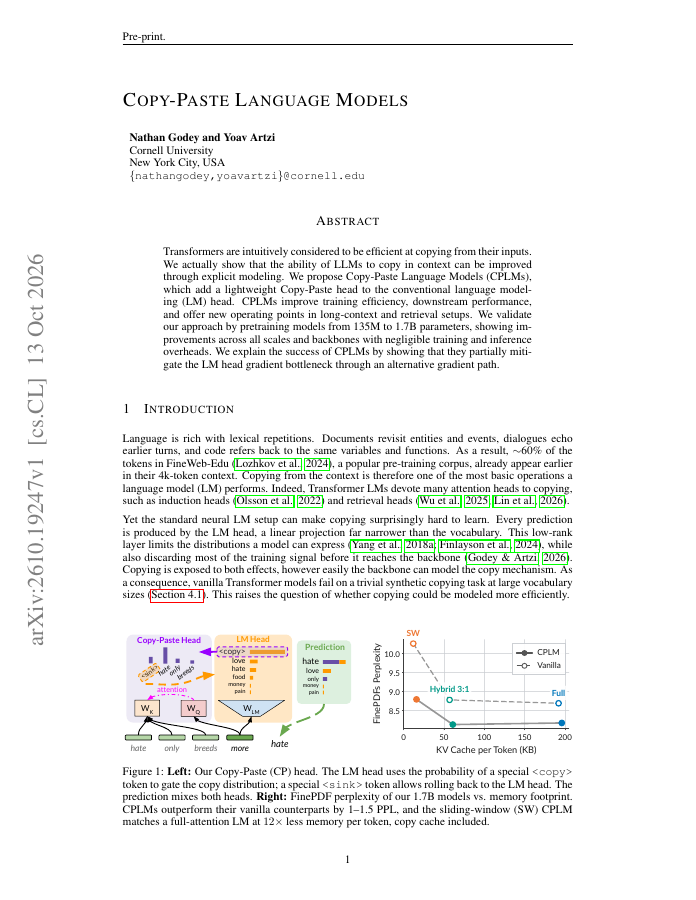
Transformers are intuitively considered to be efficient at copying from their inputs. We actually show that the ability of LLMs to copy in context can be improved through explicit modeling.
10 Oct 2026
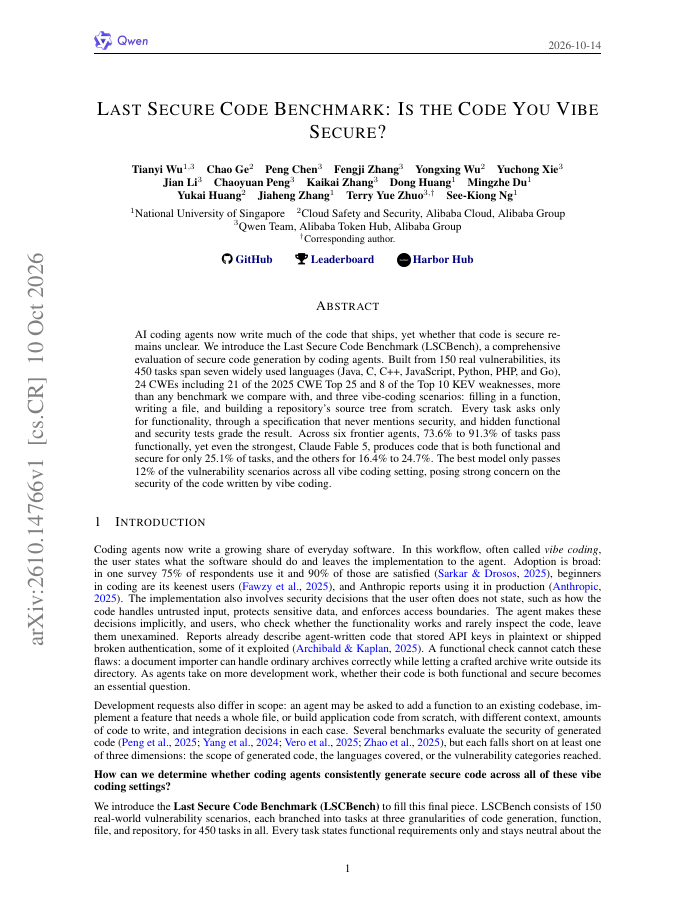
AI coding agents now write much of the code that ships, yet whether that code is secure remains unclear. We introduce the Last Secure Code Benchmark, a comprehensive evaluation of secure code generation by coding agents.
5 Oct 2026
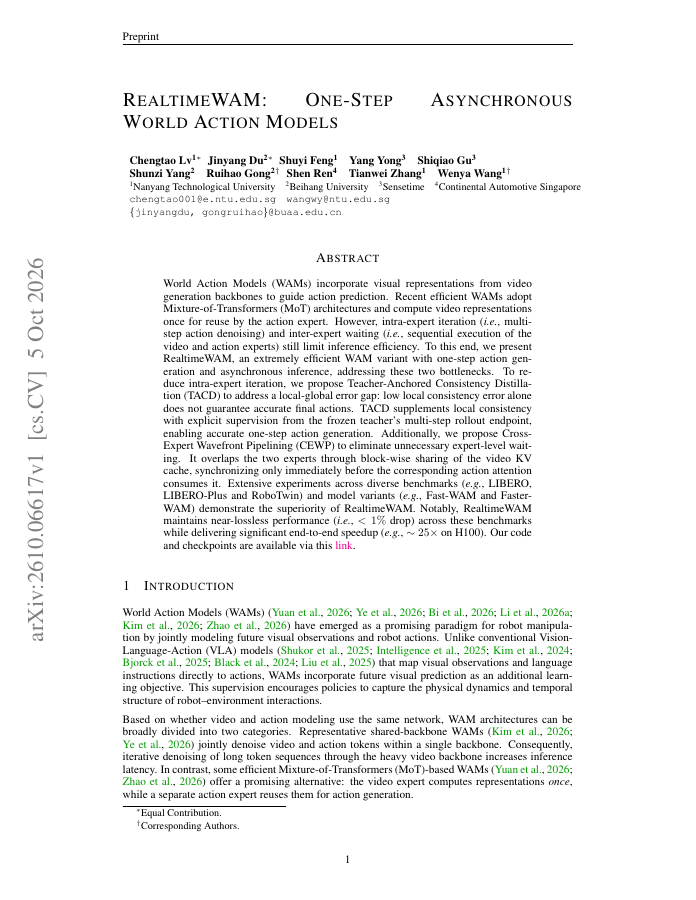
World Action Models (WAMs) incorporate visual representations from video generation backbones to guide action prediction. Recent efficient WAMs adopt Mixture-of-Transformers (MoT) architectures and compute video representations once for reuse by the action expert.
14 Oct 2026
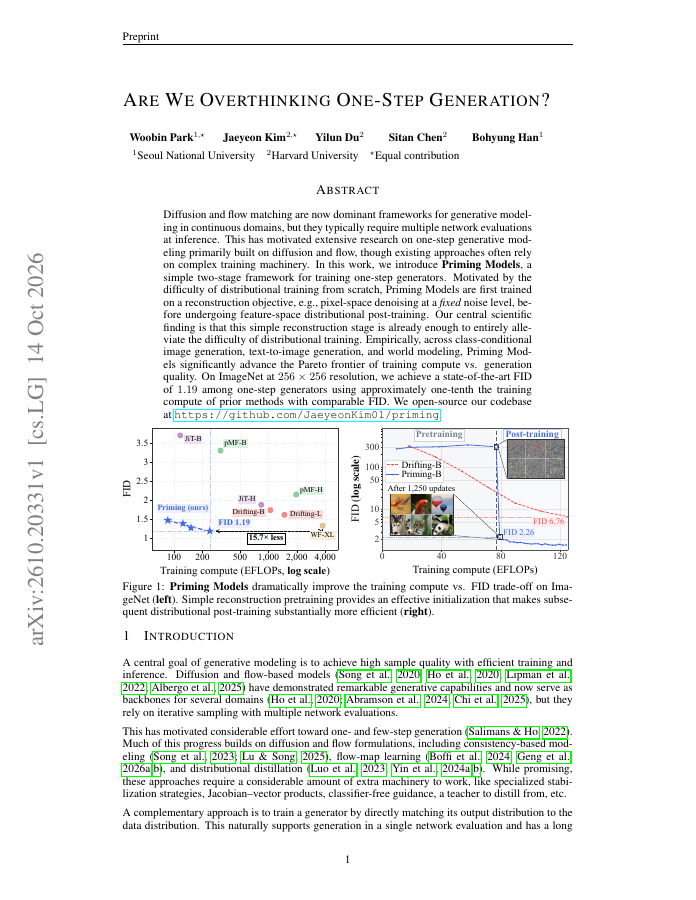
Diffusion and flow matching are now dominant frameworks for generative modeling in continuous domains, but they typically require multiple network evaluations at inference.
5 Oct 2026
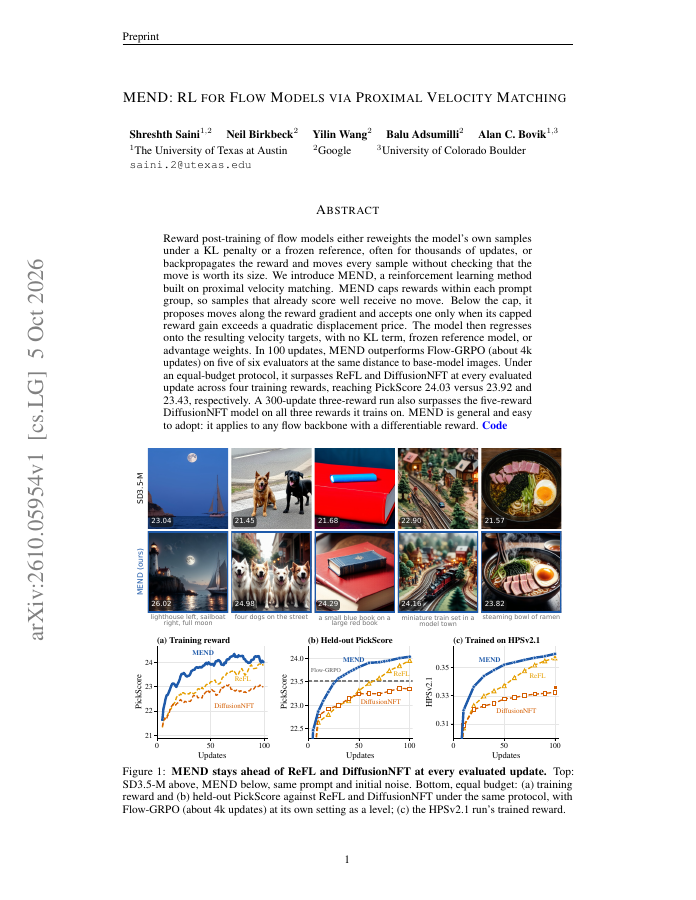
Reward post-training of flow models either reweights the model's own samples under a KL penalty or a frozen reference, often for thousands of updates, or backpropagates the reward and moves every sample without checking that the move is worth its size.
13 Oct 2026
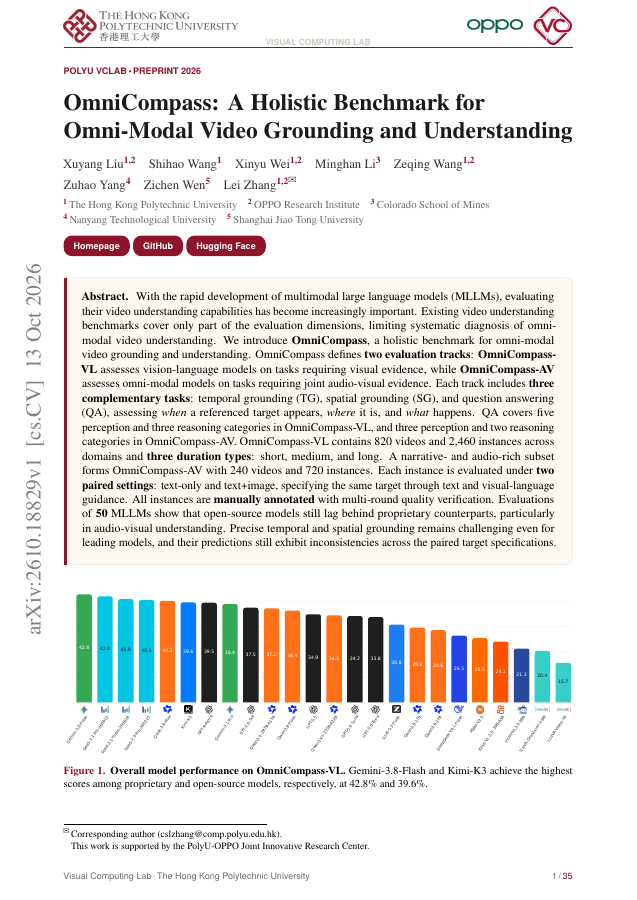
With the rapid development of multimodal large language models (MLLMs), evaluating their video understanding capabilities has become increasingly important. Existing video understanding benchmarks cover only part of the evaluation dimensions, limiting systematic diagnosis of…
27 Sep 2026
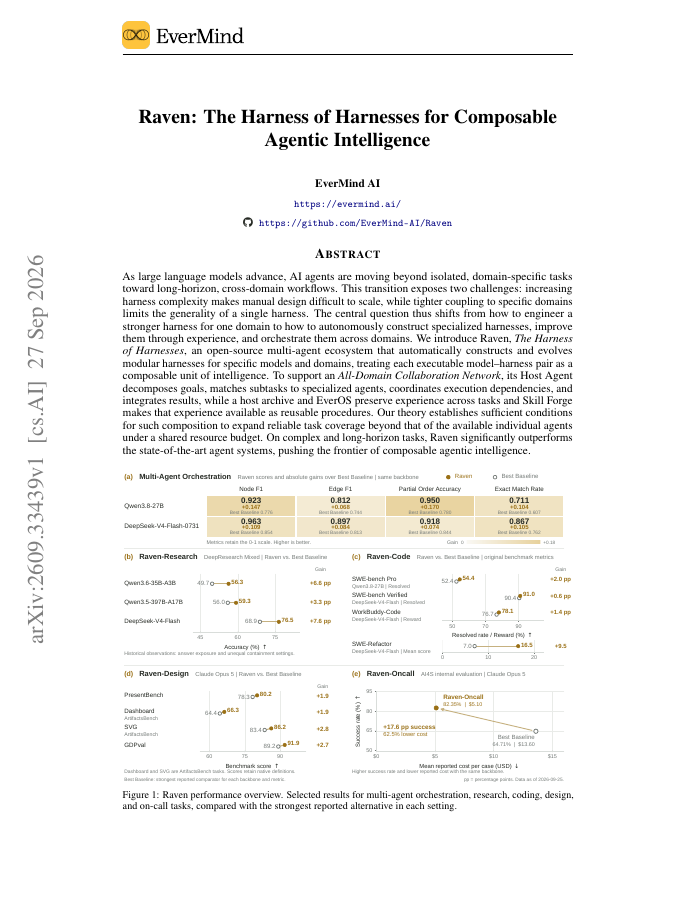
As large language models advance, AI agents are moving beyond isolated, domain-specific tasks toward long-horizon, cross-domain workflows. This transition exposes two challenges: increasing harness complexity makes manual design difficult to scale, while tighter coupling to…