9 Oct 2026
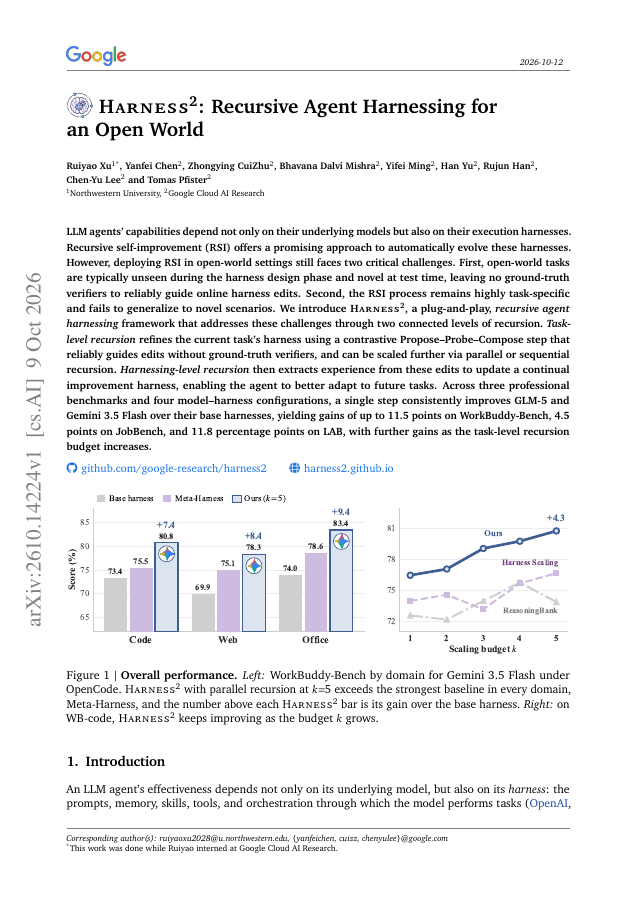
LLM agents' capabilities depend not only on their underlying models but also on their execution harnesses. Recursive self-improvement (RSI) offers a promising approach to automatically evolve these harnesses.
Trending research and the full catalog - each paper linked to the benchmarks, methods, and models it introduces.
Filtering here covers the 2,000 most recent papers, as much as one page can hold in memory. See the full index of 22,688 papers.
9 Oct 2026
LLM agents' capabilities depend not only on their underlying models but also on their execution harnesses. Recursive self-improvement (RSI) offers a promising approach to automatically evolve these harnesses.
9 Oct 2026
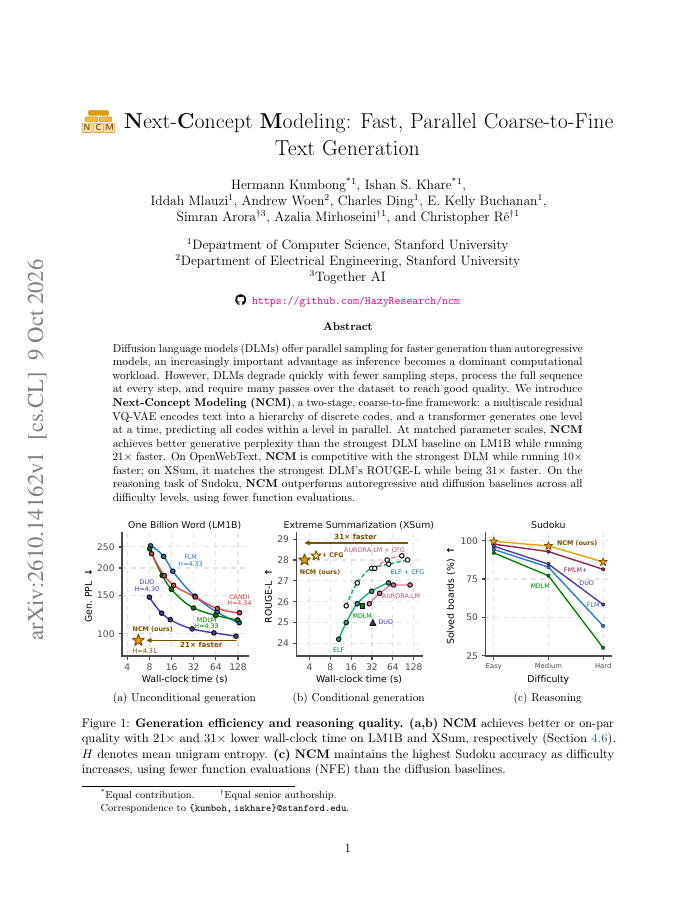
Diffusion language models (DLMs) offer parallel sampling for faster generation than autoregressive models, an increasingly important advantage as inference becomes a dominant computational workload.
8 Oct 2026
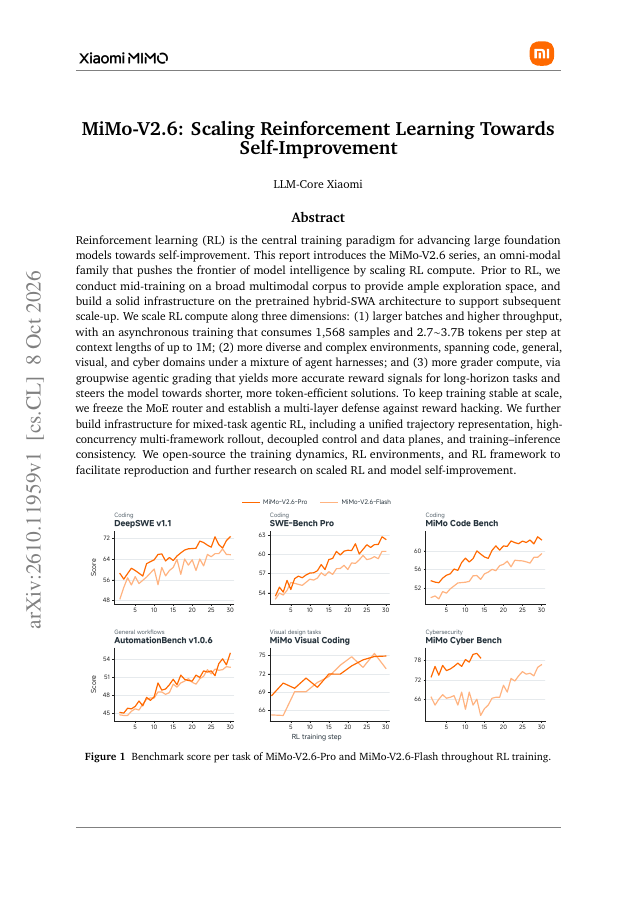
Reinforcement learning (RL) is the central training paradigm for advancing large foundation models towards self-improvement. This report introduces the MiMo-V2.6 series, an omni-modal family that pushes the frontier of model intelligence by scaling RL compute.
20 Oct 2026
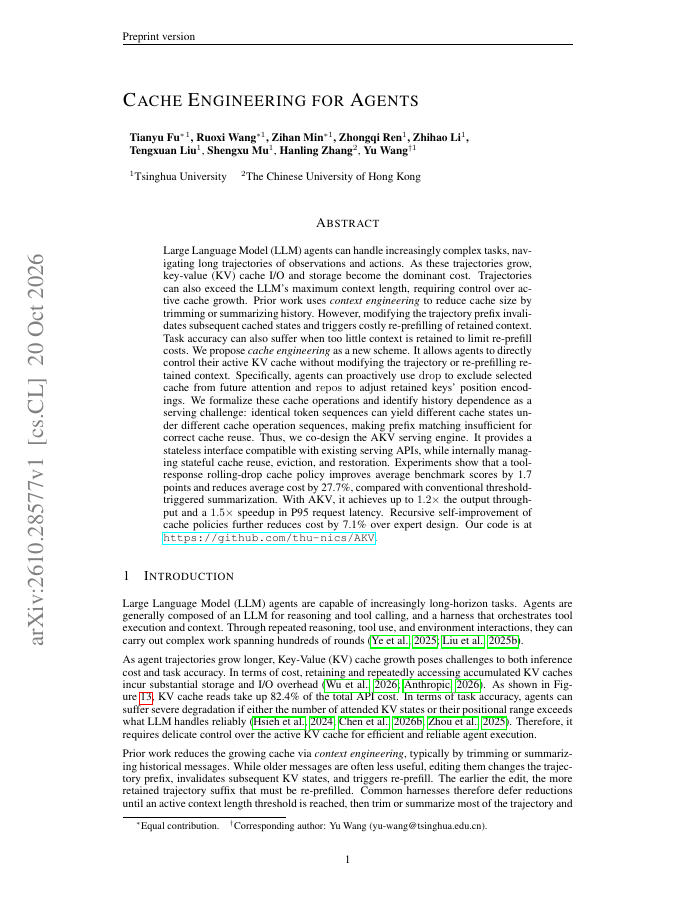
Large Language Model (LLM) agents can handle increasingly complex tasks, navigating long trajectories of observations and actions. As these trajectories grow, key-value (KV) cache I/O and storage become the dominant cost.
8 Oct 2026
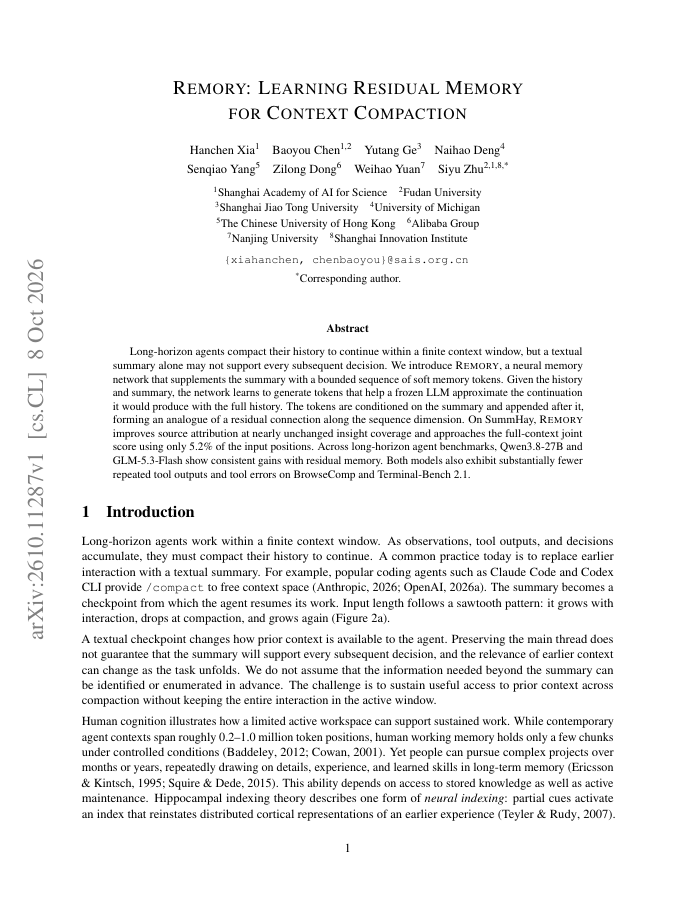
Long-horizon agents compact their history to continue within a finite context window, but a textual summary alone may not support every subsequent decision. We introduce REMORY, a neural memory network that supplements the summary with a bounded sequence of soft memory tokens.
21 Oct 2026
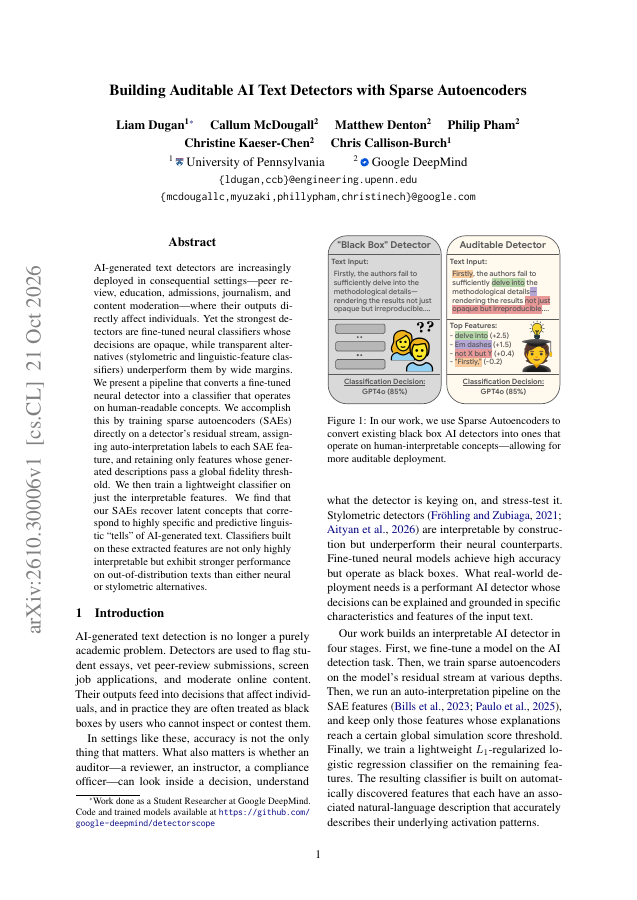
AI-generated text detectors are increasingly deployed in consequential settings---peer review, education, admissions, journalism, and content moderation---where their outputs directly affect individuals.
20 Oct 2026
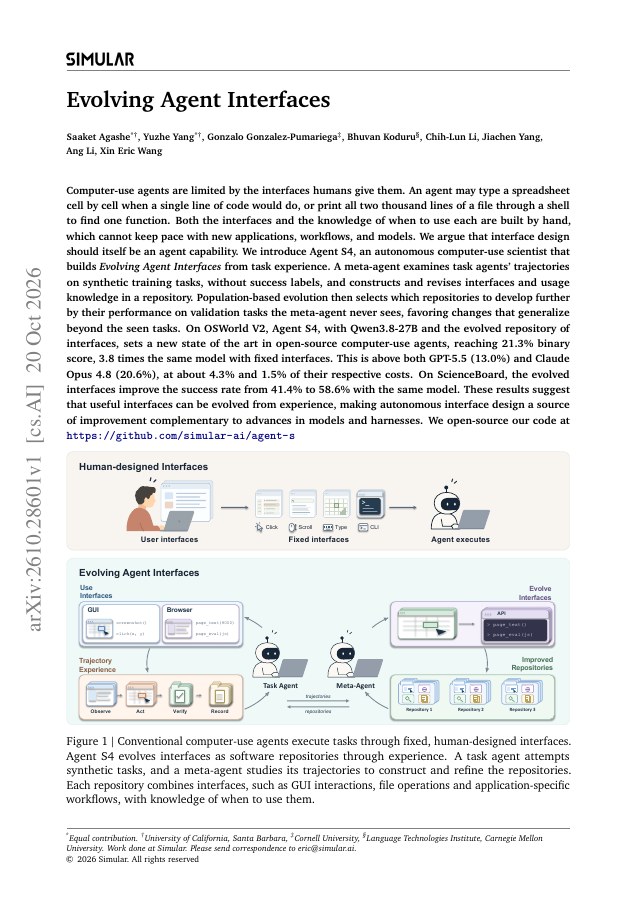
Computer-use agents are limited by the interfaces humans give them. An agent may type a spreadsheet cell by cell when a single line of code would do, or print all two thousand lines of a file through a shell to find one function.
19 Oct 2026
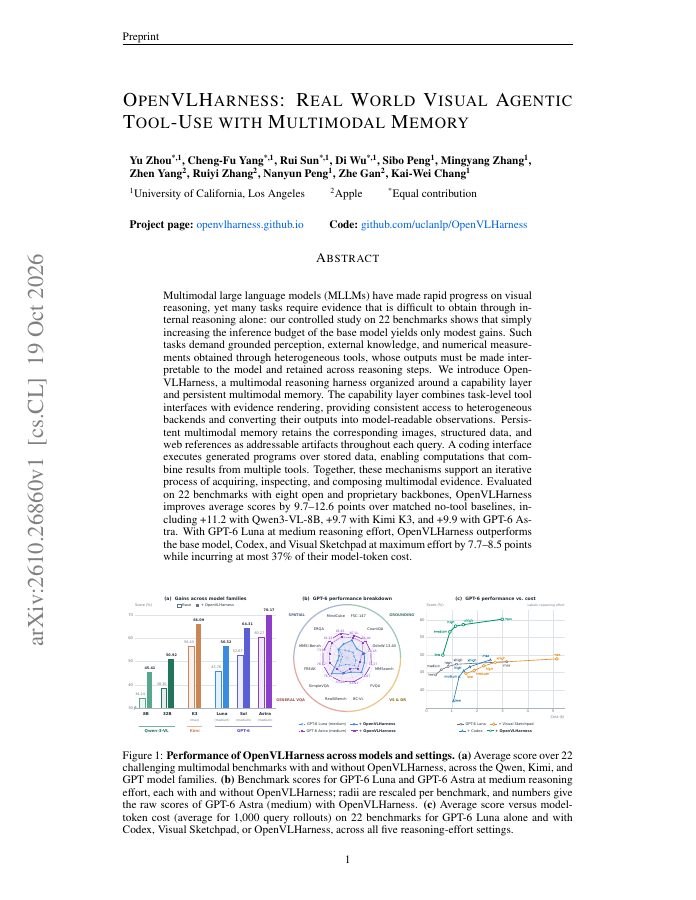
Multimodal large language models (MLLMs) have made rapid progress on visual reasoning, yet many tasks require evidence that is difficult to obtain through internal reasoning alone: our controlled study on 22 benchmarks shows that simply increasing the inference budget of the…
13 Oct 2026
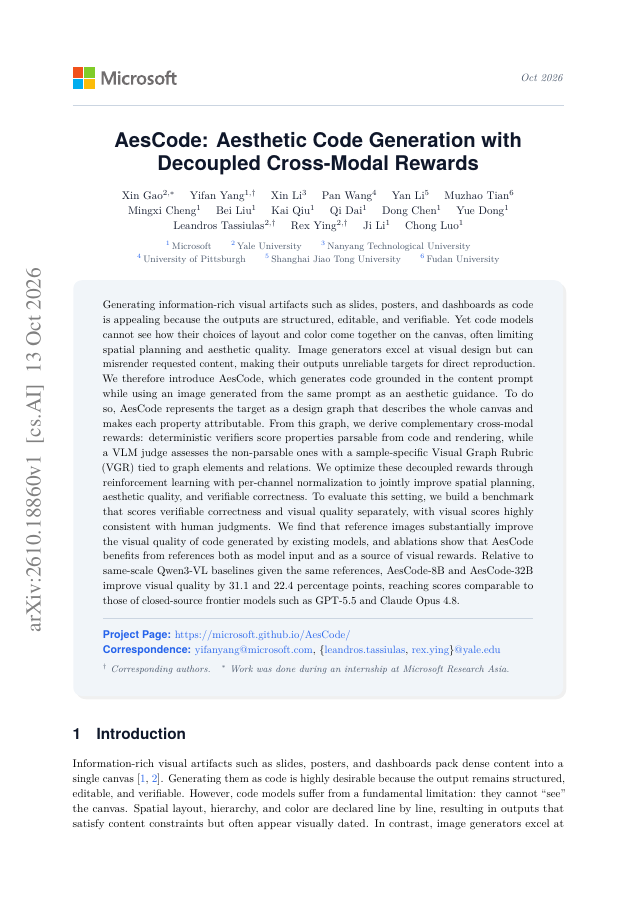
Generating information-rich visual artifacts such as slides, posters, and dashboards as code is appealing because the outputs are structured, editable, and verifiable. Yet code models cannot see how their choices of layout and color come together on the canvas, often limiting…
15 Oct 2026
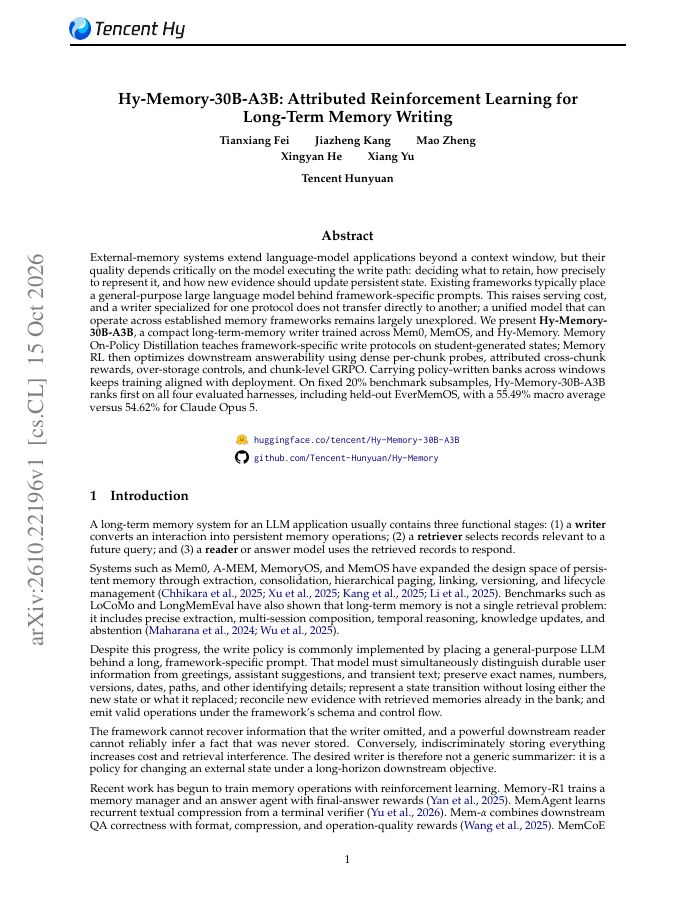
External-memory systems extend language-model applications beyond a context window, but their quality depends critically on the model executing the write path: deciding what to retain, how precisely to represent it, and how new evidence should update persistent state.
19 Oct 2026
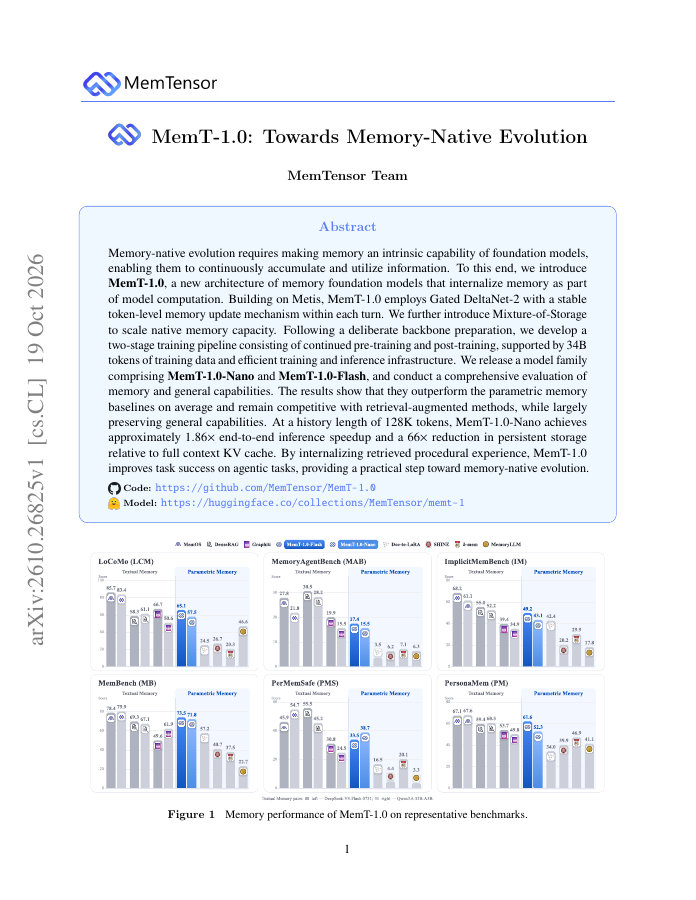
Memory-native evolution requires making memory an intrinsic capability of foundation models, enabling them to continuously accumulate and utilize information. To this end, we introduce MemT-1.0, a new architecture of memory foundation models that internalize memory as part of…
6 Oct 2026
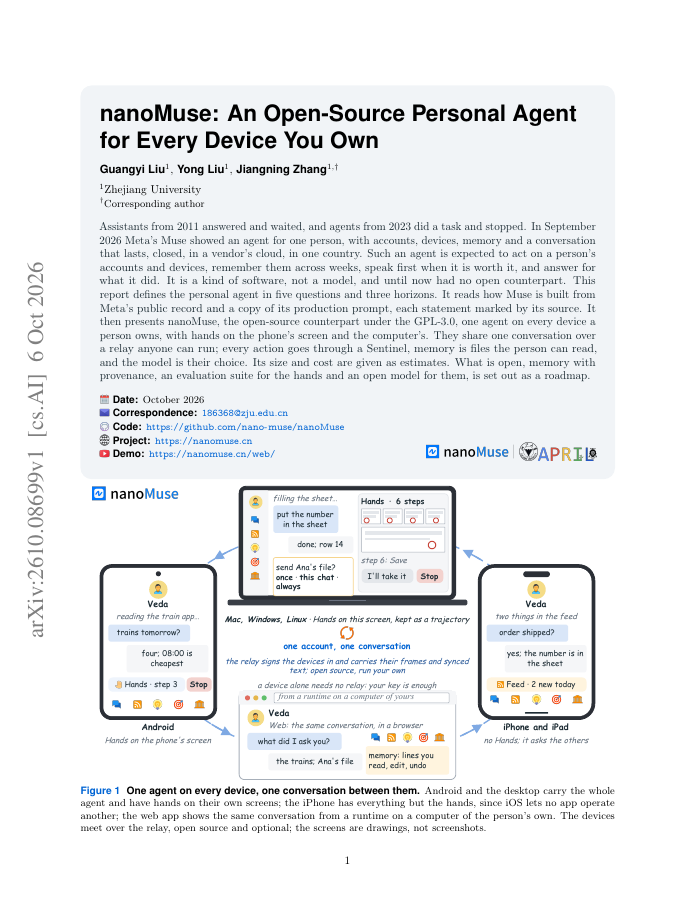
Assistants from 2011 answered and waited, and agents from 2023 did a task and stopped. In September 2026 Meta's Muse showed an agent for one person, with accounts, devices, memory and a conversation that lasts, closed, in a vendor's cloud, in one country.
12 Oct 2026
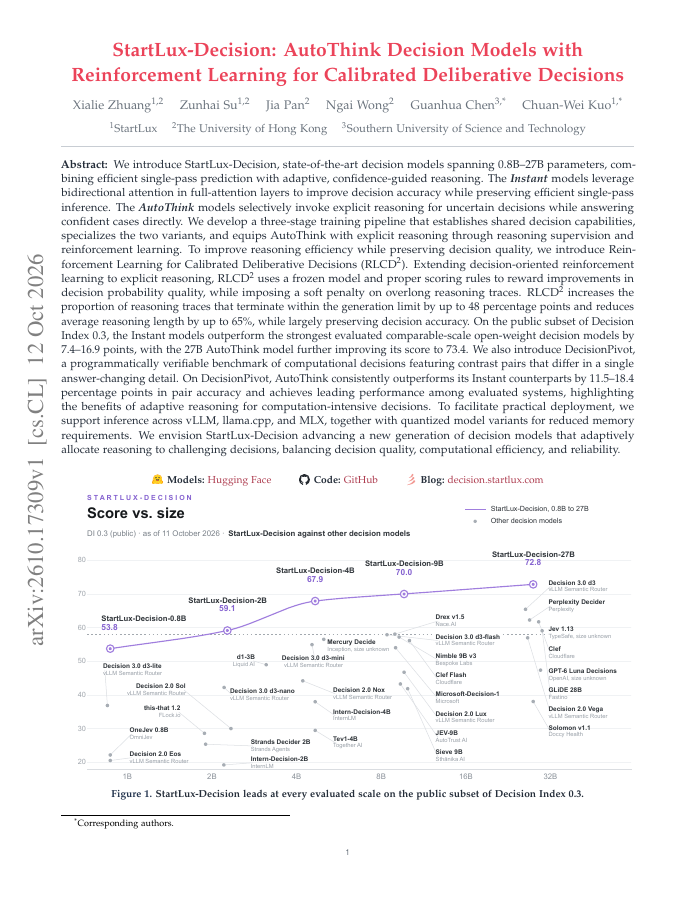
We introduce StartLux-Decision, decision models from 0.8B to 27B parameters that combine efficient single-pass prediction with adaptive, confidence-guided reasoning. The Instant models use bidirectional attention in full-attention layers to improve decision accuracy while…
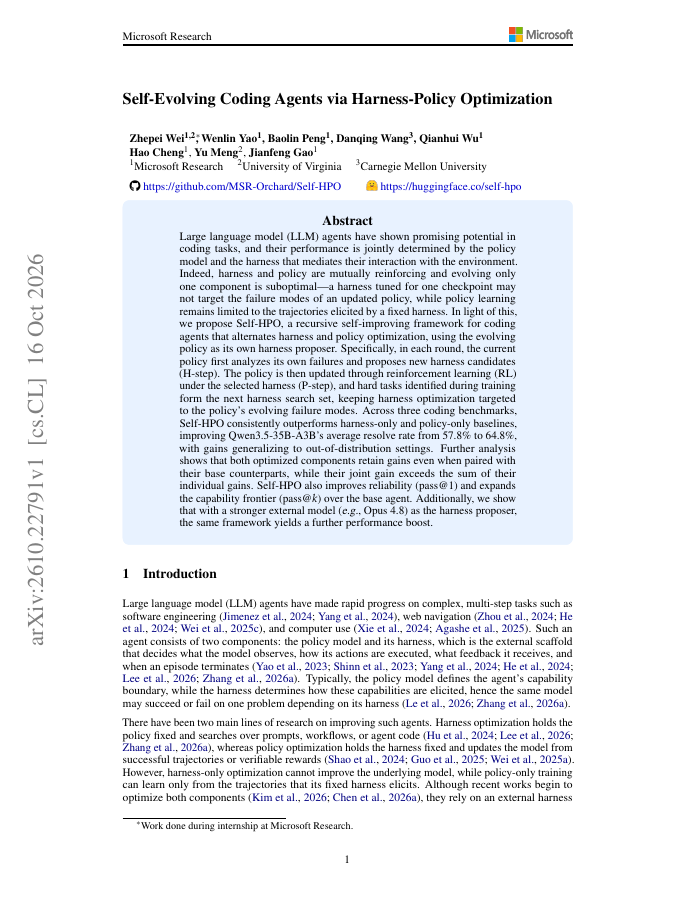
16 Oct 2026
Large language model (LLM) agents have shown promising potential in coding tasks, and their performance is jointly determined by the policy model and the harness that mediates their interaction with the environment.
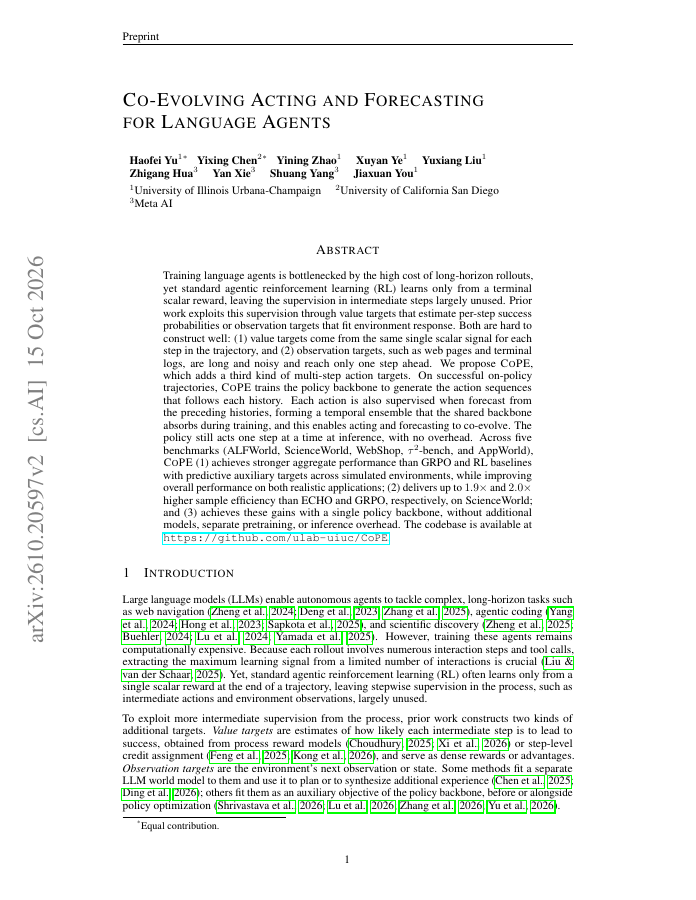
15 Oct 2026
Training language agents is bottlenecked by the high cost of long-horizon rollouts, yet standard agentic reinforcement learning (RL) learns only from a terminal scalar reward, leaving the supervision in intermediate steps largely unused.
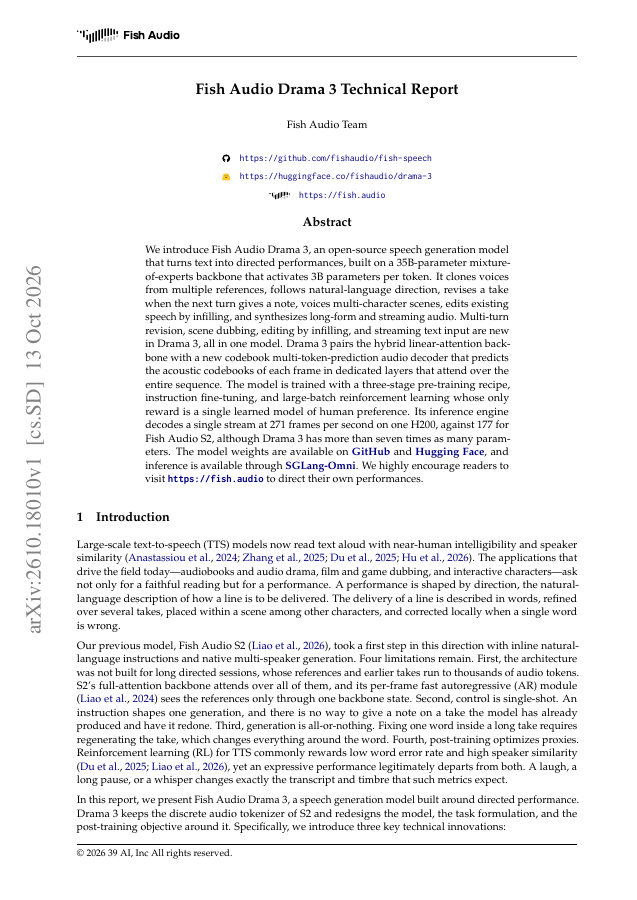
13 Oct 2026
We introduce Fish Audio Drama 3, an open-source speech generation model that turns text into directed performances, built on a 35B-parameter mixture-of-experts backbone that activates 3B parameters per token.
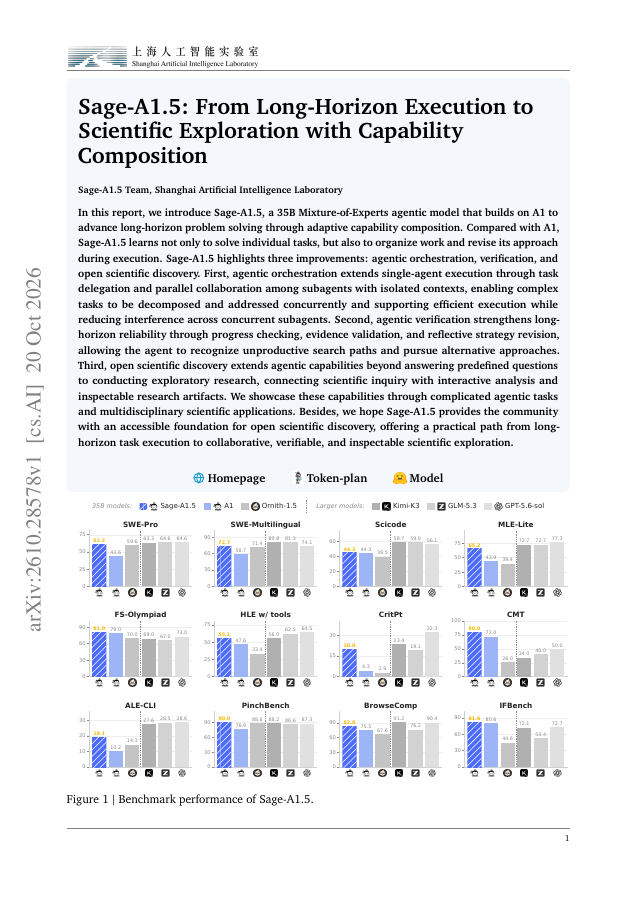
20 Oct 2026
In this report, we introduce Sage-A1.5, a 35B Mixture-of-Experts agentic model that builds on A1 to advance long-horizon problem solving through adaptive capability composition.
13 Oct 2026
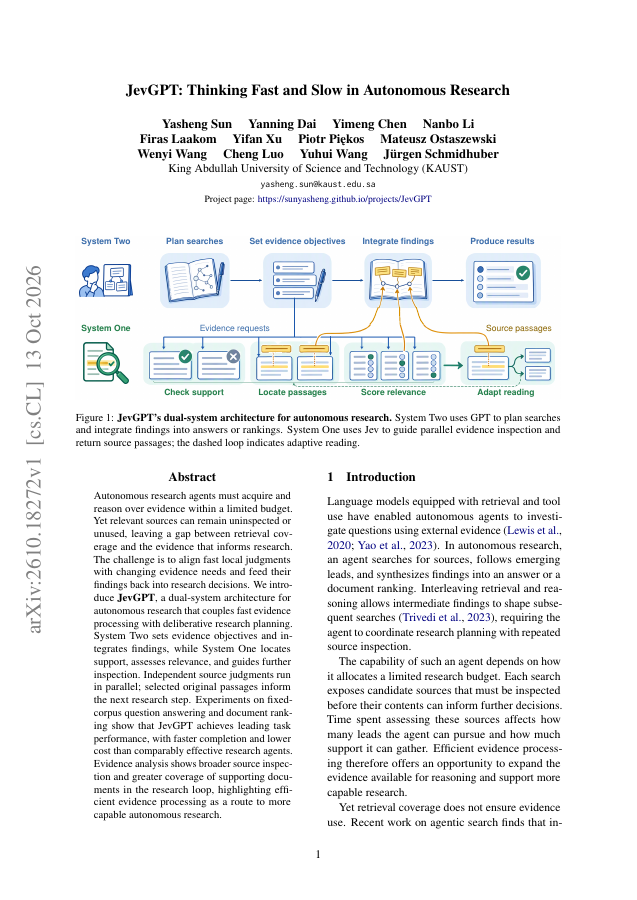
Autonomous research agents must acquire and reason over evidence within a limited budget. Yet relevant sources can remain uninspected or unused, leaving a gap between retrieval coverage and the evidence that informs research.
2 Oct 2026
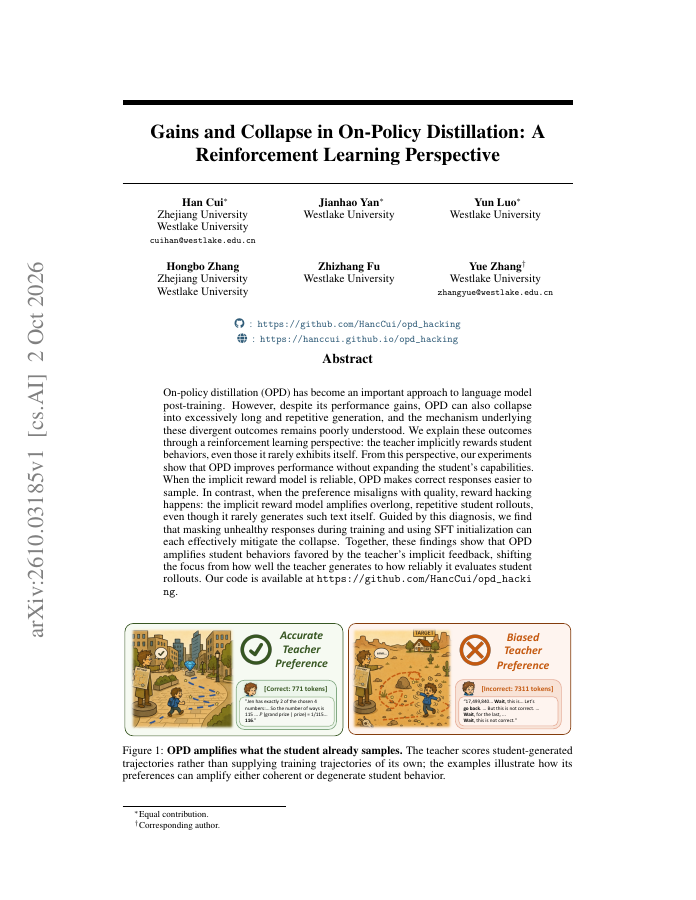
On-policy distillation (OPD) has become an important approach to language model post-training. However, despite its performance gains, OPD can also collapse into excessively long and repetitive generation, and the mechanism underlying these divergent outcomes remains poorly…
15 Oct 2026
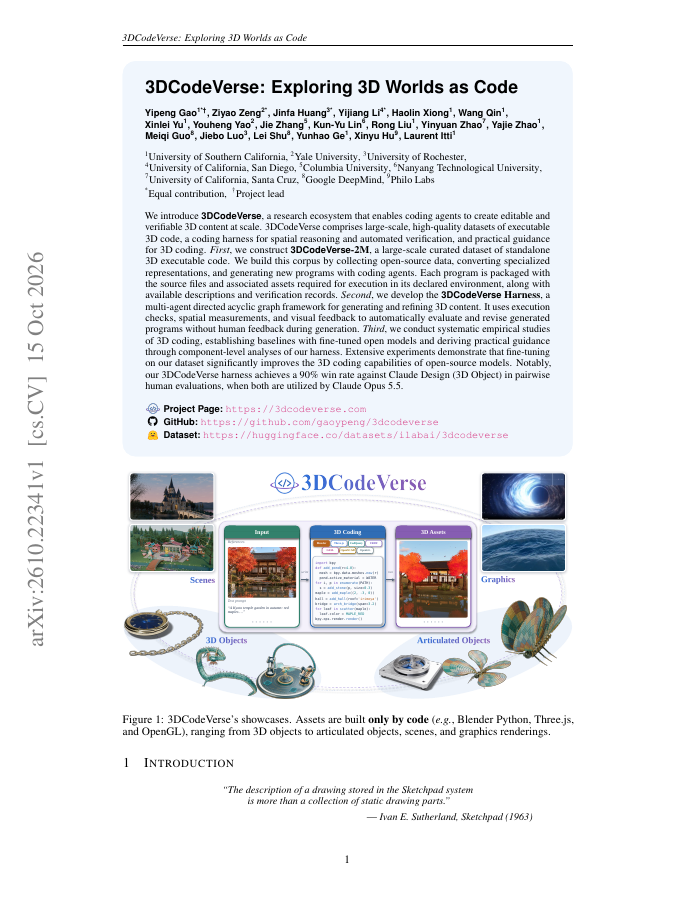
We introduce 3DCodeVerse, a research ecosystem that enables coding agents to create editable and verifiable 3D content at scale. 3DCodeVerse comprises large-scale, high-quality datasets of executable 3D code, a coding harness for spatial reasoning and automated verification, and…
13 Oct 2026
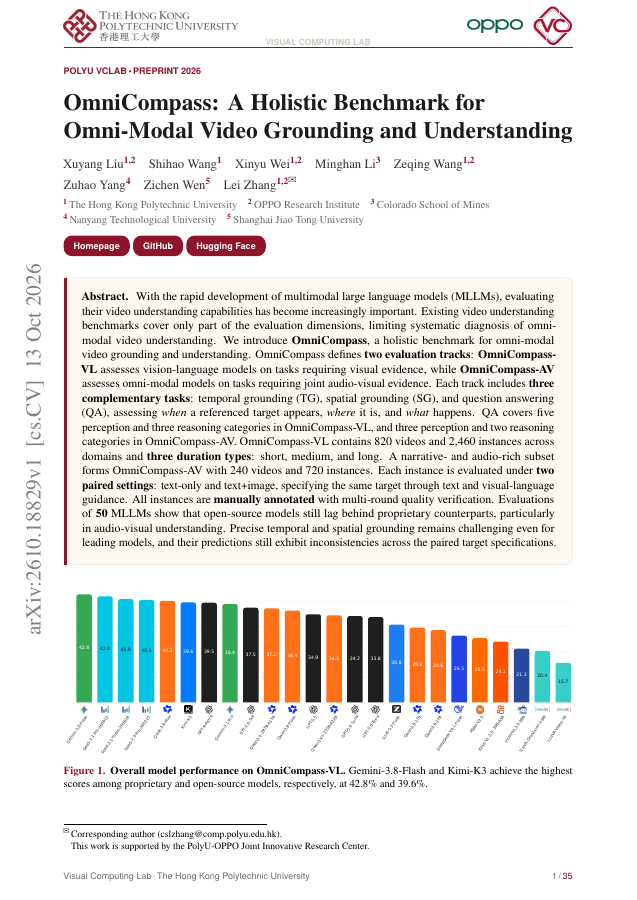
With the rapid development of multimodal large language models (MLLMs), evaluating their video understanding capabilities has become increasingly important. Existing video understanding benchmarks cover only part of the evaluation dimensions, limiting systematic diagnosis of…
2 Oct 2026
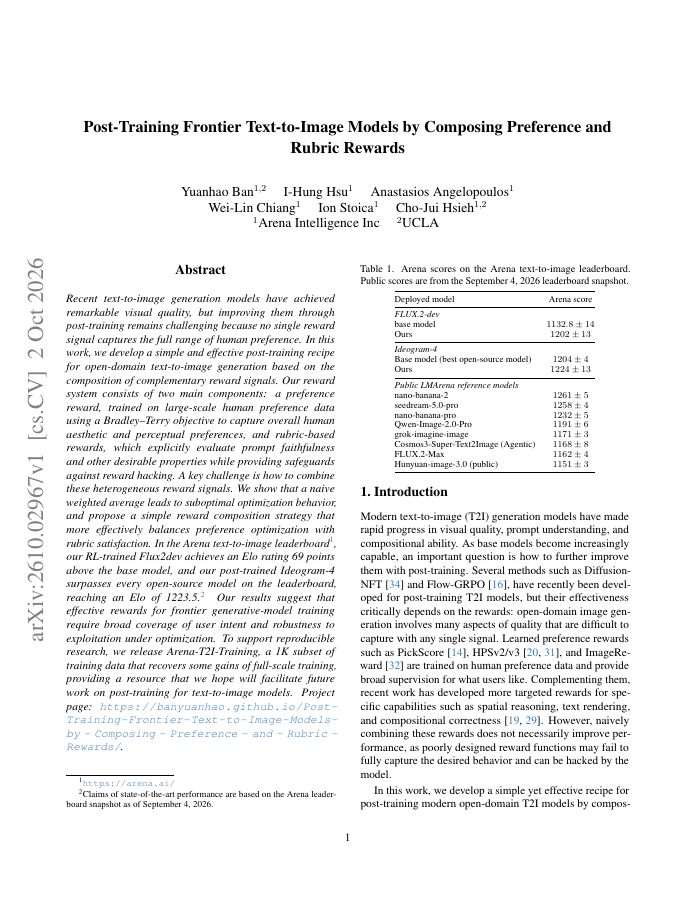
Recent text-to-image generation models have achieved remarkable visual quality, but improving them through post-training remains challenging because no single reward signal captures the full range of human preference.
15 Oct 2026
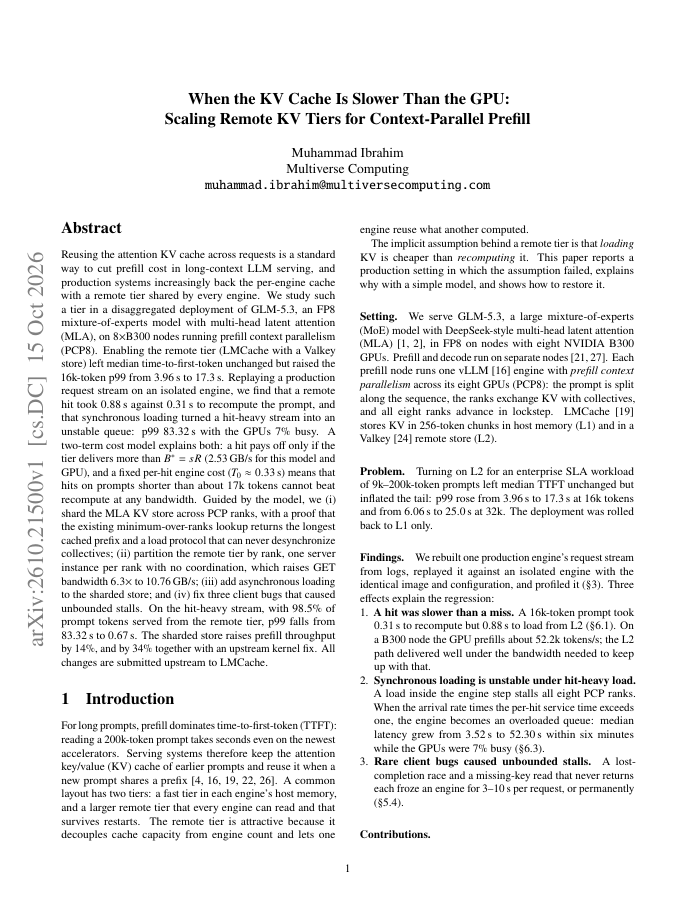
Reusing the attention KV cache across requests is a standard way to cut prefill cost in long-context LLM serving, and production systems increasingly back the per-engine cache with a remote tier shared by every engine.
19 Oct 2026
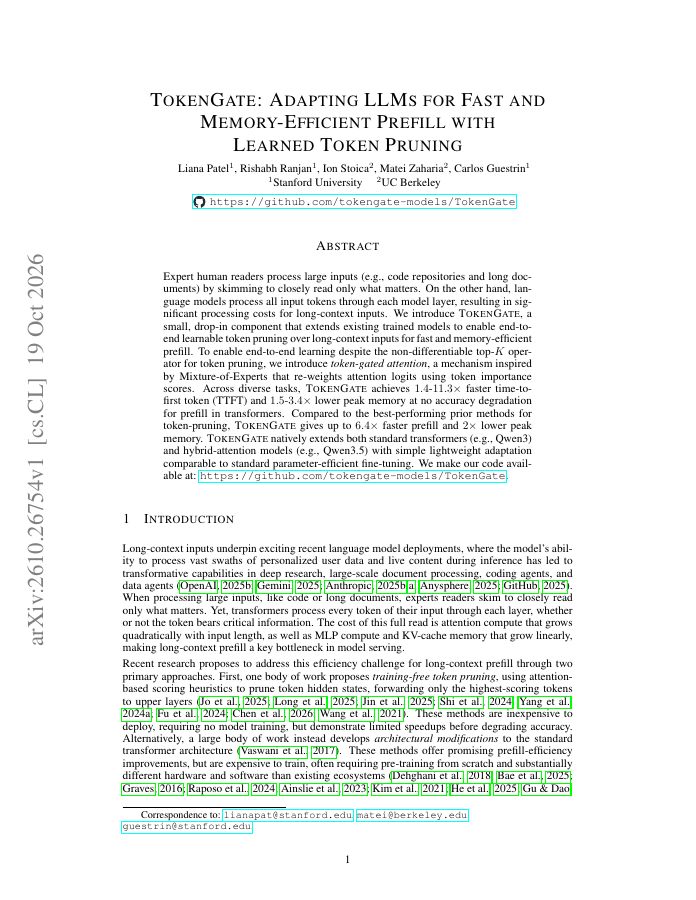
Expert human readers process large inputs (e.g., code repositories and long documents) by skimming to closely read only what matters. On the other hand, language models process all input tokens through each model layer, resulting in significant processing costs for long-context…