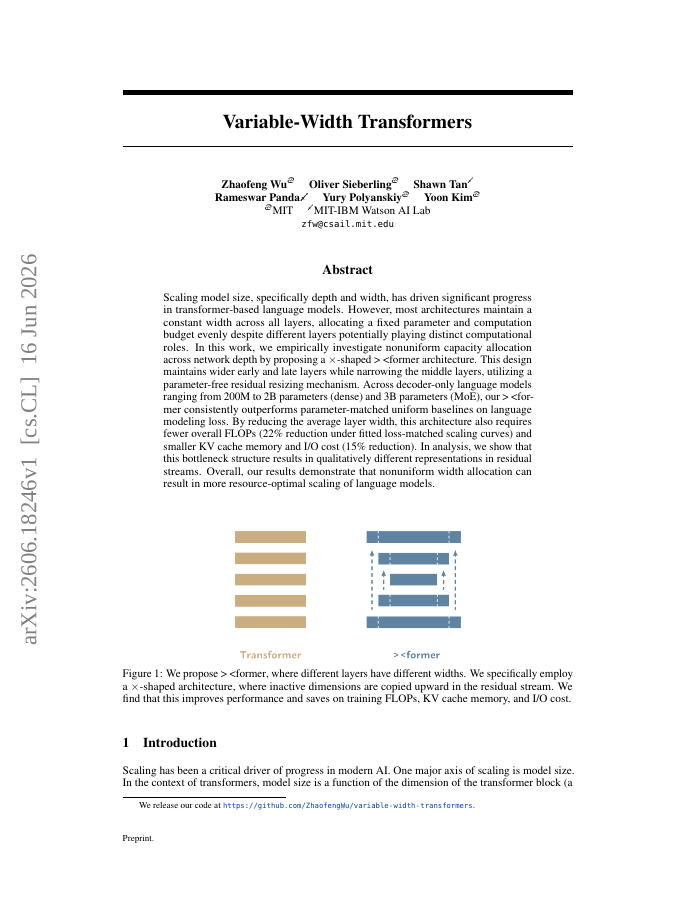
Scaling model size, specifically depth and width, has driven significant progress in transformer-based language models. However, most architectures maintain a constant width across all layers, allocating a fixed parameter and computation budget evenly despite different layers potentially playing distinct computational roles. In this work, we empirically investigate nonuniform capacity allocation across network depth by proposing a \times-shaped > <former architecture. This design maintains wider early and late layers while narrowing the middle layers, utilizing a parameter-free residual resizing mechanism. Across decoder-only language models ranging from 200M to 2B parameters (dense) and 3B parameters (MoE), our > <former consistently outperforms parameter-matched uniform baselines on language modeling loss. By reducing the average layer width, this architecture also requires fewer overall FLOPs (22% reduction under fitted loss-matched scaling curves) and smaller KV cache memory and I/O cost (15% reduction). In analysis, we show that this bottleneck structure results in qualitatively different representations in residual streams. Overall, our results demonstrate that nonuniform width allocation can result in more resource-optimal scaling of language models.
Variable-Width Transformers
Scaling model size, specifically depth and width, has driven significant progress in transformer-based language models. However, most architectures maintain a constant width across all layers, allocating a fixed parameter and computation budget evenly despite different layers…
- Preview
- Year
- 2026
- Stars
- 11
- Hosting
- Abstract onlyARXIV-DEFAULT
Cite
Notes
Only stored in your browser.
Attribution
- Abstract & full text
- arxiv.org/abs/2606.18246ARXIV-DEFAULT
- TL;DR
- Semantic Scholar