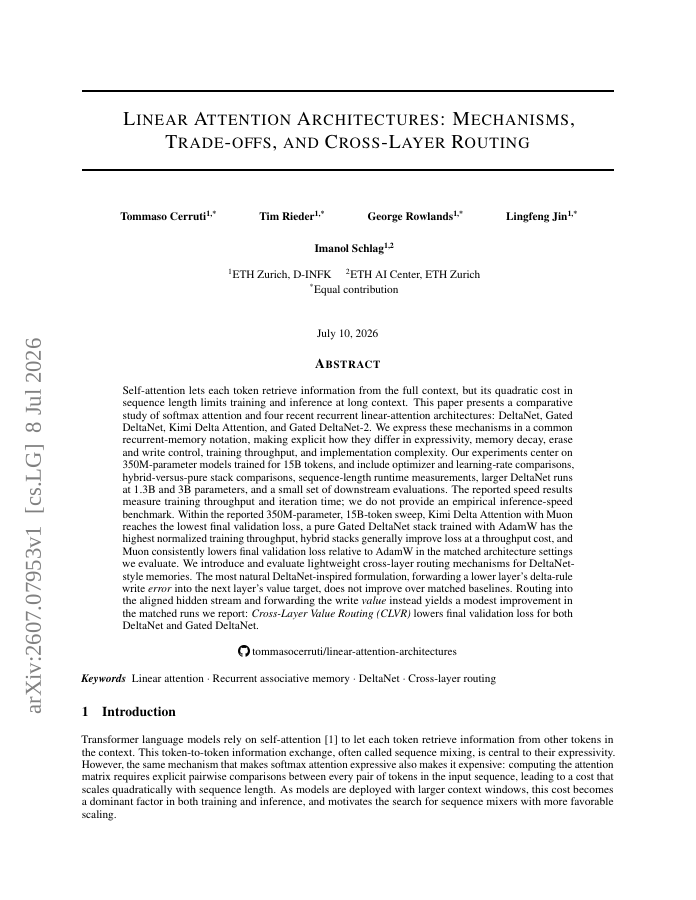
Self-attention lets each token retrieve information from the full context, but its quadratic cost in sequence length limits training and inference at long context. This paper presents a comparative study of softmax attention and four recent recurrent linear-attention architectures: DeltaNet, Gated DeltaNet, Kimi Delta Attention, and Gated DeltaNet-2. We express these mechanisms in a common recurrent-memory notation, making explicit how they differ in expressivity, memory decay, erase and write control, training throughput, and implementation complexity. Our experiments center on 350M-parameter models trained for 15B tokens, and include optimizer and learning-rate comparisons, hybrid-versus-pure stack comparisons, sequence-length runtime measurements, larger DeltaNet runs at 1.3B and 3B parameters, and a small set of downstream evaluations. The reported speed results measure training throughput and iteration time; we do not provide an empirical inference-speed benchmark. Within the reported 350M-parameter, 15B-token sweep, Kimi Delta Attention with Muon reaches the lowest final validation loss, a pure Gated DeltaNet stack trained with AdamW has the highest normalized training throughput, hybrid stacks generally improve loss at a throughput cost, and Muon consistently lowers final validation loss relative to AdamW in the matched architecture settings we evaluate. We introduce and evaluate lightweight cross-layer routing mechanisms for DeltaNet-style memories. The most natural DeltaNet-inspired formulation, forwarding a lower layer's delta-rule write error into the next layer's value target, does not improve over matched baselines. Routing into the aligned hidden stream and forwarding the write value instead yields a modest improvement in the matched runs we report: Cross-Layer Value Routing (CLVR) lowers final validation loss for both DeltaNet and Gated DeltaNet.
Linear Attention Architectures: Mechanisms, Trade-offs, and Cross-Layer Routing
Self-attention lets each token retrieve information from the full context, but its quadratic cost in sequence length limits training and inference at long context. This paper presents a comparative study of softmax attention and four recent recurrent linear-attention…
- Preview
- Year
- 2026
- Stars
- 15
- Hosting
- Full text hostedCC-BY-4.0
Cite
Notes
Only stored in your browser.
Attribution
- Abstract & full text
- arxiv.org/abs/2607.07953CC-BY-4.0
- TL;DR
- Semantic Scholar