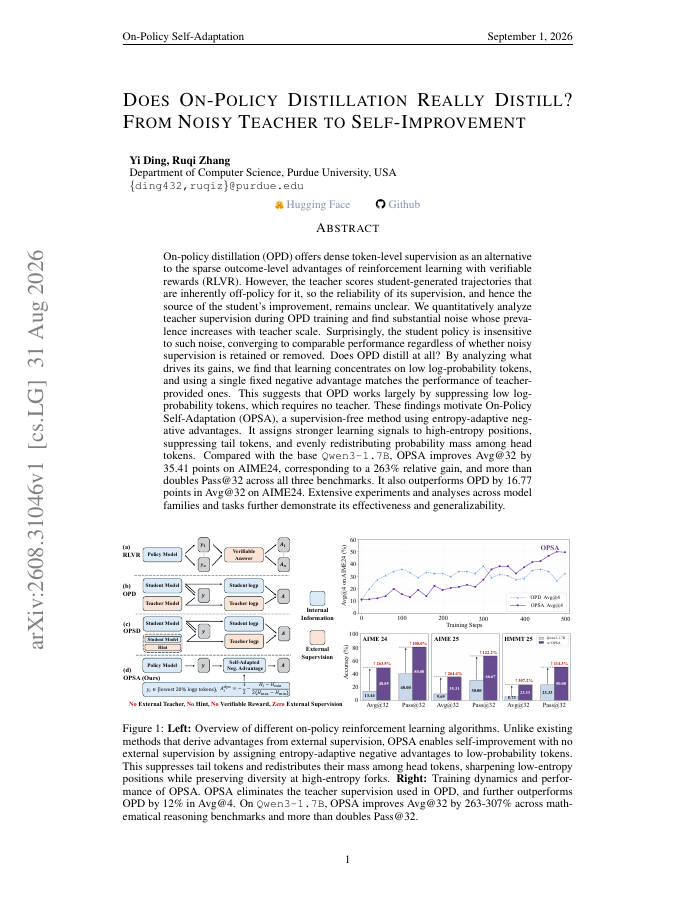
On-policy distillation (OPD) offers dense token-level supervision as an alternative to the sparse outcome-level advantages of reinforcement learning with verifiable rewards (RLVR). However, the teacher scores student-generated trajectories that are inherently off-policy for it, so the reliability of its supervision, and hence the source of the student's improvement, remains unclear. We quantitatively analyze teacher supervision during OPD training and find substantial noise whose prevalence increases with teacher scale. Surprisingly, the student policy is insensitive to such noise, converging to comparable performance regardless of whether noisy supervision is retained or removed. Does OPD distill at all? By analyzing what drives its gains, we find that learning concentrates on low log-probability tokens, and using a single fixed negative advantage matches the performance of teacher-provided ones. This suggests that OPD works largely by suppressing low log-probability tokens, which requires no teacher. These findings motivate On-Policy Self-Adaptation (OPSA), a supervision-free method using entropy-adaptive negative advantages. It assigns stronger learning signals to high-entropy positions, suppressing tail tokens, and evenly redistributing probability mass among head tokens. Compared with the base Qwen3-1.7B, OPSA improves Avg@32 by 35.41 points on AIME24, corresponding to a 263% relative gain, and more than doubles Pass@32 across all three benchmarks. It also outperforms OPD by 16.77 points in Avg@32 on AIME24. Extensive experiments and analyses across model families and tasks further demonstrate its effectiveness and generalizability.
Does On-Policy Distillation Really Distill? From Noisy Teacher to Self-Improvement
On-policy distillation (OPD) offers dense token-level supervision as an alternative to the sparse outcome-level advantages of reinforcement learning with verifiable rewards (RLVR).
- Preview
- Year
- 2026
- Stars
- 51
- Hosting
- Full text hostedCC-BY-4.0
Cite
Notes
Only stored in your browser.
Attribution
- Abstract & full text
- arxiv.org/abs/2608.31046CC-BY-4.0
- TL;DR
- Semantic Scholar