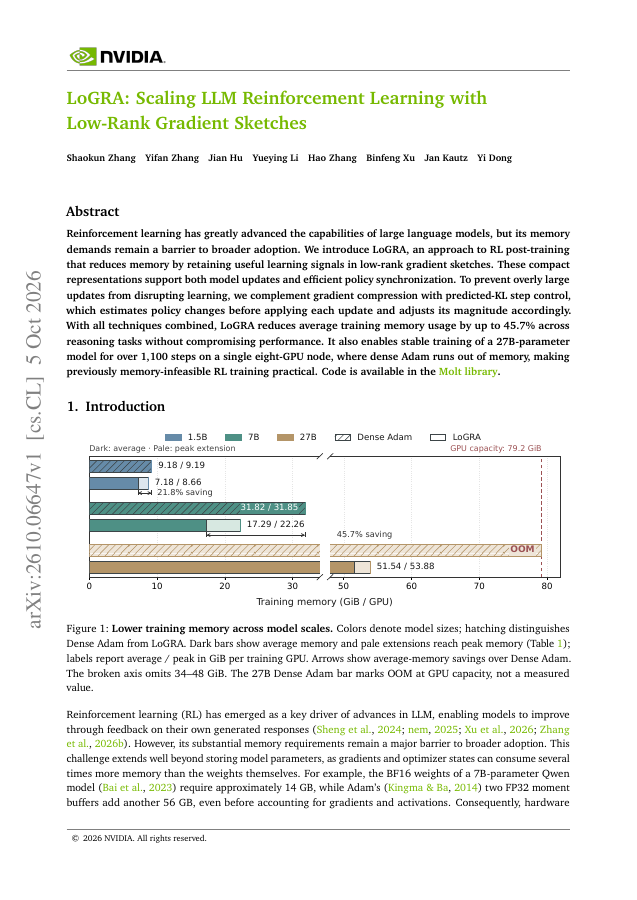
Reinforcement learning (RL) has greatly advanced the capabilities of large language models (LLMs), but its memory demands remain a barrier to broader adoption. We introduce LoGRA, an approach to RL post-training that reduces memory by retaining useful learning signals in low-rank gradient sketches. These compact representations support both model updates and efficient policy synchronization. To prevent overly large updates from disrupting learning, we complement gradient compression with predicted-KL step control, which estimates policy changes before applying each update and adjusts its magnitude accordingly. Across reasoning tasks, LoGRA reduces average training memory by up to 45.7% without sacrificing performance. It also enables stable training of a 27B-parameter model for over 1,100 steps on a single eight-GPU node, where dense Adam runs out of memory, making previously memory-infeasible RL training practical. Code is available in the Molt library.
LoGRA: Scaling LLM Reinforcement Learning with Low-Rank Gradient Sketches
Reinforcement learning (RL) has greatly advanced the capabilities of large language models (LLMs), but its memory demands remain a barrier to broader adoption. We introduce LoGRA, an approach to RL post-training that reduces memory by retaining useful learning signals in…
- Preview
- Year
- 2026
- Stars
- 2
- Hosting
- Abstract onlyARXIV-DEFAULT
Cite
Notes
Only stored in your browser.
Attribution
- Abstract & full text
- arxiv.org/abs/2610.06647ARXIV-DEFAULT
- TL;DR
- Semantic Scholar