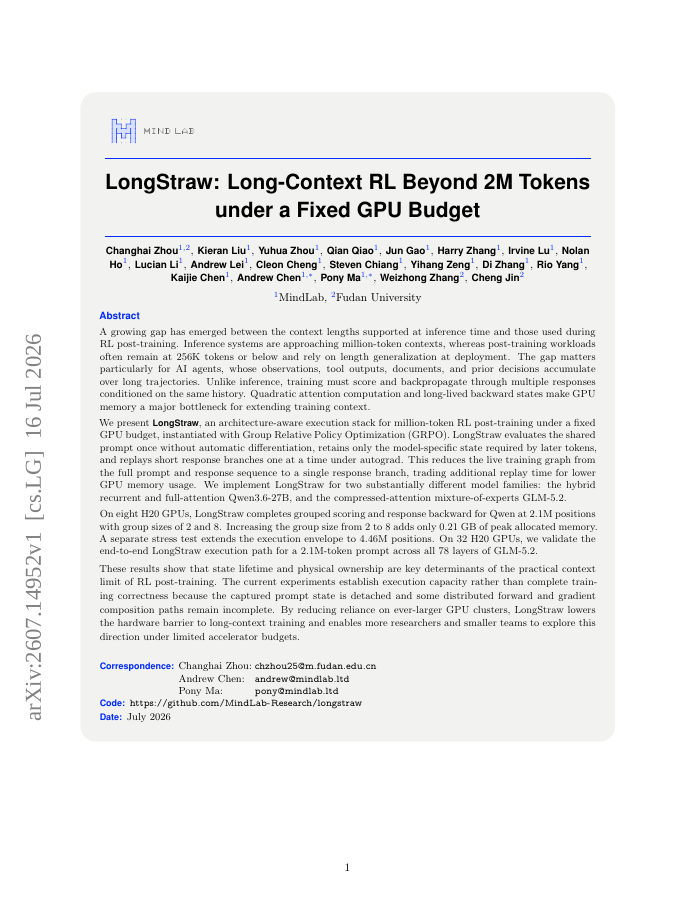
Long-context RL post-training is constrained by the lifetime of state and gradients, not attention cost alone. In GRPO, one multi-million-token prompt must serve old-policy and reference scoring plus multiple policy responses, while conventional autograd keeps the prompt graph and all response graphs live alongside model weights, caches, and distributed communication buffers. We present LongStraw, an objective-aware, architecture-aware system for resident-state virtualization, response replay, and distributed-gradient execution. Its transaction captures the shared prompt without autograd, retains only the architecture-required state on explicitly owned pages, restores that state for each group member, scores old/reference branches without a graph, replays one policy response at a time with autograd, and accumulates the resulting gradients before one distributed finalization and optimizer step. This schedule bounds the live training graph by the response suffix while reusing the expensive prompt computation across the complete GRPO group. We instantiate this design for two incompatible model structures. Qwen3.6-27B combines 48 recurrent GDN layers with 16 full-attention layers; LongStraw keeps the compact recurrent state and physically CP8-sharded KV pages, composes global attention through cross-rank LSE/output merging, and performs blockwise response replay. GLM-5.2 combines a 78-layer MLA/DSA attention stack with a 256-expert, top-8 MoE tail. Its implementation keeps CP-sharded MLA latent pages and DSA indexer-key pages in CPU memory, stages one layer at a time, reconstructs IndexShare-aware global sparse selection over CP32, and dispatches routed response tokens over EP32. The two paths share one transaction contract while specializing the retained state, replay operator, and collective communication to the architecture...
LongStraw: Long-Context RL Beyond 2M Tokens under a Fixed GPU Budget
Long-context RL post-training is constrained by the lifetime of state and gradients, not attention cost alone. In GRPO, one multi-million-token prompt must serve old-policy and reference scoring plus multiple policy responses, while conventional autograd keeps the prompt graph…
- Preview
- Year
- 2026
- Stars
- 43
- Hosting
- Full text hostedCC-BY-4.0
Cite
Notes
Only stored in your browser.
Attribution
- Abstract & full text
- arxiv.org/abs/2607.14952CC-BY-4.0
- TL;DR
- Semantic Scholar