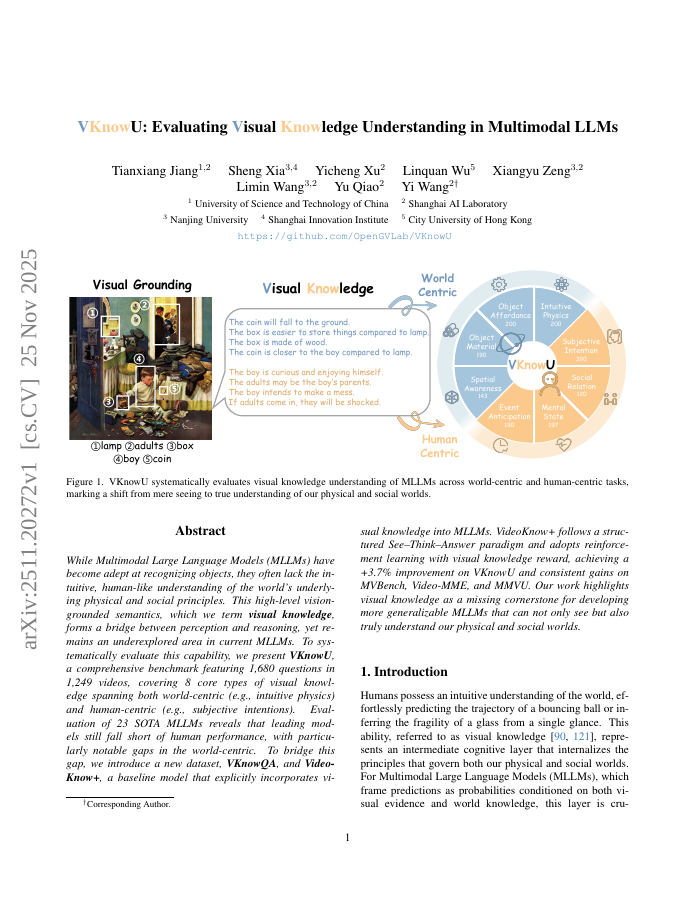
While Multimodal Large Language Models (MLLMs) have become adept at recognizing objects, they often lack the intuitive, human-like understanding of the world's underlying physical and social principles. This high-level vision-grounded semantics, which we term visual knowledge, forms a bridge between perception and reasoning, yet remains an underexplored area in current MLLMs. To systematically evaluate this capability, we present VKnowU, a comprehensive benchmark featuring 1,680 questions in 1,249 videos, covering 8 core types of visual knowledge spanning both world-centric (e.g., intuitive physics) and human-centric (e.g., subjective intentions). Evaluation of 23 SOTA MLLMs reveals that leading models still fall short of human performance, with particularly notable gaps in the world-centric. To bridge this gap, we introduce a new dataset, VKnowQA, and VideoKnow+, a baseline model that explicitly incorporates visual knowledge into MLLMs. VideoKnow+ follows a structured See-Think-Answer paradigm and adopts reinforcement learning with visual knowledge reward, achieving a +3.7% improvement on VKnowU and consistent gains on MVBench, Video-MME, and MMVU. Our work highlights visual knowledge as a missing cornerstone for developing more generalizable MLLMs that can not only see but also truly understand our physical and social worlds.
VKnowU: Evaluating Visual Knowledge Understanding in Multimodal LLMs
Visual knowledge, integrated into multimodal large language models through a new dataset and baseline model, improves understanding of physical and social principles beyond current capabilities.
- Preview
- Year
- 2025
- Venue
- arXiv 2025
- Authors
- 8
- Hosting
- Abstract onlyARXIV-DEFAULT
Cite
Notes
Only stored in your browser.
Attribution
- Abstract & full text
- arxiv.org/abs/2511.20272ARXIV-DEFAULT
- TL;DR
- Semantic Scholar